The tradition & historical record
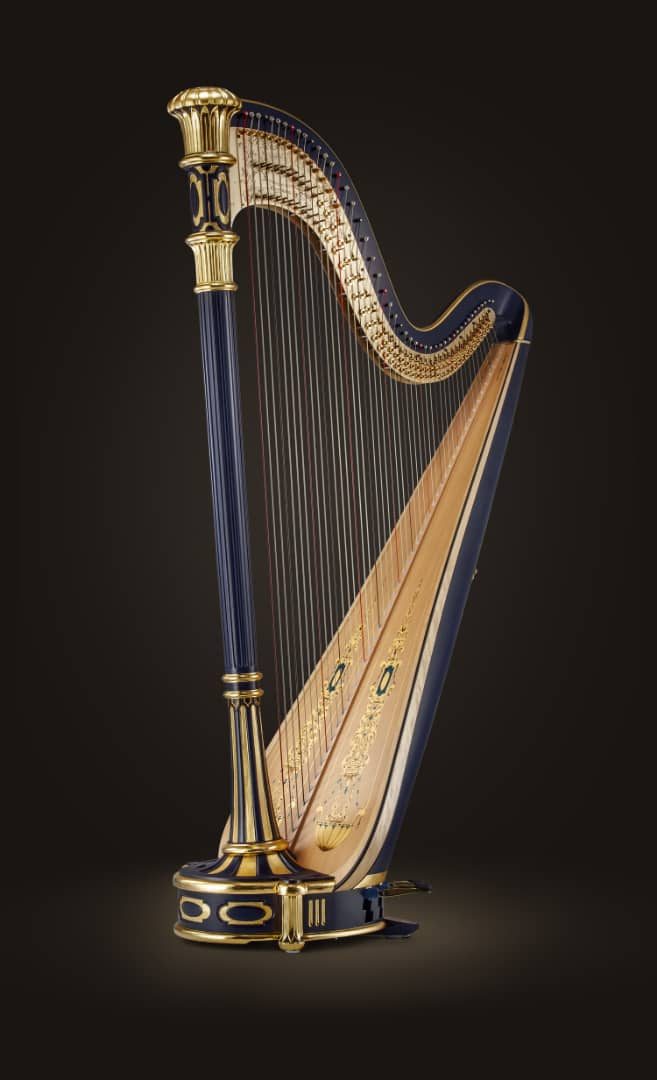
5 min read · 2 sourcesThe harp is a stringed musical instrument that has individual strings running at an angle to its soundboard; the strings are plucked with the fingers. Harps can be played in either a seated or standing position. Most commonly, harps are made of wood and are triangular in shape. Some have multiple rows of strings and pedal attachments. Ancient depictions of harps were recorded in Mesopotamia (Iraq), Persia (Iran) and Egypt, and later in India and China. By medieval times, harps had spread across Europe. Harps are found across the Americas; in some regions, they are used in traditional folk music. Distinct designs also emerged from the African continent. Harps have symbolic political traditions and are often used in logos, including in Ireland. Historically, strings were made of sinew (animal tendons). Other materials have included gut (animal intestines), plant fibre, braided hemp, cotton cord, silk, nylon, and wire. 1
History
Harps have been known since antiquity in Asia, Africa, and Europe, dating back at least as early as 3000 BCE. The instrument had great popularity in Europe during the Middle Ages and the Renaissance, where it evolved into a wide range of variants with new technologies, and was disseminated to Europe's colonies, finding particular popularity in Latin America. Although some ancient members of the harp family died out in the Near East and South Asia, descendants of early harps are still played in Myanmar and parts of Africa; other variants defunct in Europe and Asia have been used by folk musicians in the modern era. 1
West Asia and Egypt
The earliest harps and lyres were found in Sumer, c. 2500 BCE, with several harps excavated from burial pits and royal tombs in Ur. The oldest depictions of harps without a forepillar can be seen in the wall paintings of ancient Egyptian tombs in the Nile Valley, which date from the mid 3rd millennium BCE. These murals show an arched harp, an instrument that closely resembles the hunter's bow, without the pillar that we find in modern harps. The Chang flourished in Persia in many forms from its introduction, about 4000 BCE, until the 17th century CE. 1
Around 1900 BCE, arched harps in the Iraq-Iran region were replaced by angular harps with vertical or horizontal sound boxes. The Kinnor (Hebrew: כִּנּוֹר kīnnōr) was an ancient Israelite musical instrument in the yoke lutes family, the first one to be mentioned in the Hebrew Bible. Its exact identification is unclear, but in the modern day it is generally translated as "harp" or "lyre", and associated with a type of lyre depicted in Israelite imagery, particularly the Bar Kokhba coins. It has been referred to as the "national instrument" of the Jewish people, and modern luthiers have created reproduction lyres of the kinnor based on this imagery. By the start of the Common Era, "robust, vertical, angular harps", which had become predominant in the Hellenistic world, were cherished in the Sasanian court. In the last century of the Sasanian period, angular harps were redesigned to make them as light as possible ("light, vertical, angular harps"); while they became more elegant, they lost their structural rigidity. At the height of the Persian tradition of illustrated book production (1300–1600 CE), such light harps were still frequently depicted, although their use as musical instruments was reaching its end. 1
Greece
Marble sculptures of seated figures playing harps are known from the Cycladic civilisation dating from 2800–2700 BCE. 1
South Asia
Mesolithic era paintings from Bhimbetka show harp playing. An arched harp made of wooden brackets and metal strings is depicted on an Indus seal. The works of the Tamil Sangam literature describe the harp and its variants, as early as 200 BCE. Variants were described, ranging from 14 to 17 strings, and the instrument was used by wandering minstrels for accompaniment. Iconographic evidence of the yaal appears in temple statues dated as early as 600 BCE. One of the Sangam works, the Kallaadam recounts how the first yaaḻ harp was inspired by an archer's bow, when he heard the musical sound of its twang. Another early South Asian harp was the ancient veena, not to be confused with the modern Indian veena which is a type of lute. Some Samudragupta gold coins show of the mid-4th century CE show (presumably) the king Samudragupta himself playing the instrument. The ancient veena survives today in Burma, in the form of the saung harp still played there. 1
East Asia
The harp was popular in ancient China and neighbouring regions. The Chinese konghou harp is documented as early as the Spring and Autumn period (770–476 BCE) A similar harp, the Gonghu was played in ancient Korea, documented as early as the Goguryeo period (37 BCE–686 CE). 1
The text above is adapted from the Wikipedia article “Harp”, available under the Creative Commons Attribution-ShareAlike 4.0 licence. 1
harp is class of musical instruments, according to the structured record cited below. This entry was generated automatically from that record and has not yet been reviewed by a person familiar with the tradition. 2
The source record links this tradition to 65 external registers, which can be verified through the citation. 2