The tradition & historical record
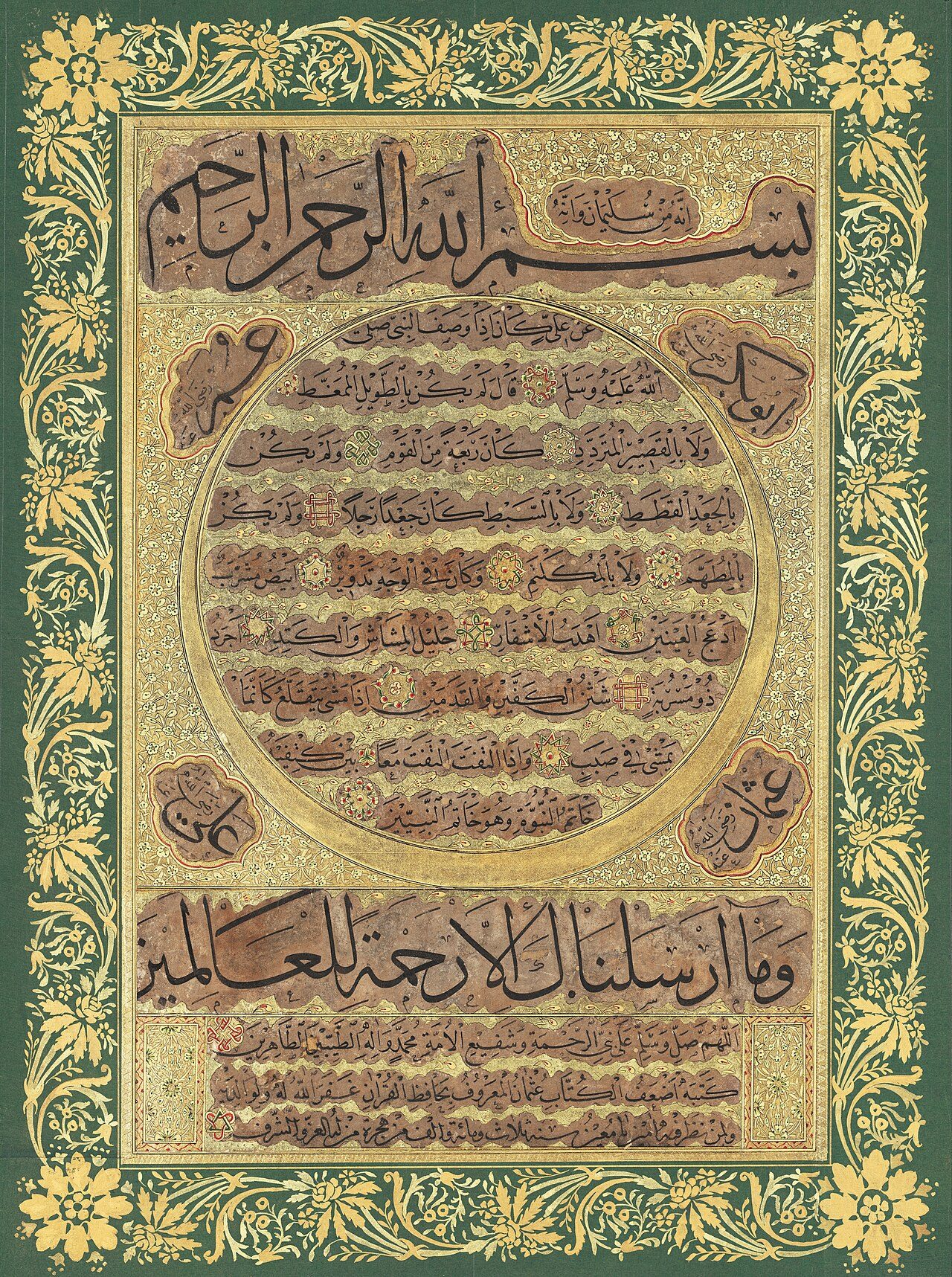
6 min read · 2 sourcesThe term ḥilya (Arabic: حلية, plural: ḥilān, or ḥulān; Turkish: hilye, plural: hilyeler) denotes both a visual form in Ottoman art and a religious genre of Ottoman-Arabic literature each dealing with the physical description of Muhammad. Hilya means "ornament". They originate with the discipline of shama'il, the study of Muhammad's appearance and character, based on hadith accounts, most notably al-Tirmidhi's Shama'il al-Muhammadiyya "The Sublime Characteristics of Muhammad". In Ottoman-era folk Islam, there was a belief that reading and possessing Muhammad's description protects the person from trouble in this world and the next, it became customary to carry such descriptions, rendered in fine calligraphy and illuminated, as amulets. In 17th-century Ottoman Turkey, ḥilān developed into an art form with a standard layout, often framed and used as a wall decoration. Later ḥilān were written for the four Rashid caliphs, the Companions of the Prophet, Muhammad's grandchildren Hasan and Husayn, and walis or saints. 1
Origins in hadith
Hilye, both as the literary genre and as the graphic art form, originates from shama'il, the study of Muhammad's appearance and character. The best source on this subject is considered to be al-Tirmidhi's Shama'il al-Muhammadiyya. The acceptance and influence of this work have led to the use of the term shama'il "appearance" to mean Muhammad's fine morals and unique physical beauty. As they contained hadiths describing Muhammad's spirit and physique, shama-il have been the source of ḥilān. The best-known and accepted of these hadith are attributed to his son-in-law and cousin Ali. The sources of ḥilān have been the six main hadith books along with other hadith sources, attributed to people such as Aisha, ibn Abbas, Abu Hurayra, and Hasan ibn Ali. While shama'il lists the physical and spiritual characteristics of Muhammad in detail, in ḥilān these are written about in a literary style. Among other descriptive shama'il texts are the Dalāʾil al-Nubuwwah of al-Bayhaqi, Tariḥ-i Isfahān of Abu Nu'aym al-Isfahani, Al-Wafāʾ biFaḍāʾil al-Muṣṭafā of ibn al-Jawzi and Al-Shifa of Qadi Iyad. 1
Literary genre
Although many ḥilān exist in Turkish literature, Persian literature does not have many examples of the shama'il and hilye genre. Abu Naeem Isfahani wrote a work titled Hilyetü'l-Evliya, but it is not about Muhammad. For this reason, the ḥilya is considered one of Turkey's national literary genres. Turkish literature has also some early works that may have inspired the appearance of the ḥilya as a literary genre. The Vesiletü'n-necat of Süleyman Çelebi (1351–1422), and the Kitab-i Muhammediye of Yazıcıoğlu Mehmed, referred to Muhammad's characteristics. A 255-verse long Risale-i Resul about the attributes of Muhammad, written by a writer with the penname of Şerifi, was presented to Şehzade Bayezid, one of the sons of Suleiman the Magnificent, at an unknown date that was presumably before the Şehzade died in 1562. This is believed to be the earliest ḥilya in verse form in Turkish literature. However, the Hilye-i Şerif by Mehmet Hakani (d. 1606–07) is considered the finest example of the genre (see section below). The first ḥilya written in prose form was the Hilye-i Celile ve Şemail-i 'Aliye by Hoca Sadeddin Efendi. Although the ḥilya tradition started with descriptions of Muhammad, later ḥilān were written about the first four Caliphs, the companions of the Prophet, Muhammad's grandchildren Hasan and Husayn, and walis "saints" such as Rumi. The second most important ḥilya, after Hakani's, is considered to be Cevri İbrahim Çelebi's ḥilya, Hilye-i Çihar-Yar-ı Güzin (1630), about the physical appearance of the first four caliphs. Another important ḥilya writer is Neşâtî (d. 1674), whose 184-verse long poem is about the physical characteristics of 14 prophets and Adam. 1
Art form
While writers developed hilye as a literary genre, calligraphers and illuminators developed it into a decorative art form. Because of their supposed protective effect, people in 17th century Ottoman Turkey started carrying around Muhammad's description. Similarly, because of the belief that a house with a ḥilya will not see poverty, trouble, fear or the devil, these texts came to be displayed prominently in a house. The term 'ḥilya' was used for the art form that presented these texts. Thus, the ḥilya, as a vehicle for Muhammad's presence after his death, was believed to have a talismanic effect, capable of protecting a house, a child, a traveller, or a person in difficulty. In addition, the purpose of the ḥilya is to help visualize Muhammad as a mediator between the sacred and human worlds, to connect with him by using the viewing of the ḥilya as an opportunity to send a traditional blessing upon him, and to establish an intimacy with him. The pocket ḥilān were written on a piece of paper, small enough to fit in a breast pocket after being folded in three. The folding lines were reinforced with cloth or leather. Other pocket ḥilān were made of wood. Hilyes to be displayed on a wall were prepared on paper mounted on wooden panels, although in the 19th century, thick paper sheets became another medium. The top part of ḥilān that were laid on wooded panels were carved and cut out in the form of a crown. The crown part would be richly illuminated and miniatures of Medina, the tomb of Muhammad or the Kaaba would be placed there, together or separately. Ottomans commissioned scribes to write ḥilān in fine calligraphy and artists to illuminate them. Serving as textual portraits of prophets, ḥilya panels have decorated homes for centuries. 1
Standard layout
The standard layout for the Ottoman ḥilya panel is generally attributed to Hâfiz Osman. This layout is generally considered to be the best and has come to be the classical form. It contains the following elements: 1
The baş makam ("head station"), a top panel containing the basmala or a blessing The göbek ("belly"), a round shape containing the first part of the main text in naskh. It often contains the description of Muhammad by Ali (according to Tirmidhi), with minor variations(see quote in the Origins section above). The hilâl ("crescent"), an optional section with no text, which is often gilded. A crescent encircling the göbek, with its thick middle part at the bottom. 1
Popularity of the graphic form
There are several reasons given for the popularity of graphic ḥilān. Islam prohibits the depiction of graphic representations of people that may lead to idols. For this reason, Islamic art developed in the forms of calligraphy, miniatures and other non-figurative arts. In miniatures, Muhammad's face was either veiled or blanked. Because of the prohibition on drawing the face of Muhammad, the need to represent Muhammad was satisfied by writing his name and characteristics. Many authors have commented that another reason is the affection that Muslims feel for Muhammad, which leads them to read about his physical and moral beauty. 1
The text above is adapted from the Wikipedia article “Hilya”, available under the Creative Commons Attribution-ShareAlike 4.0 licence. 1
Hilya is artwork depicting the appearance and character of Muhammad, according to the structured record cited below. This entry was generated automatically from that record and has not yet been reviewed by a person familiar with the tradition. 2
The source record links this tradition to 2 external registers, which can be verified through the citation. 2