The tradition & historical record
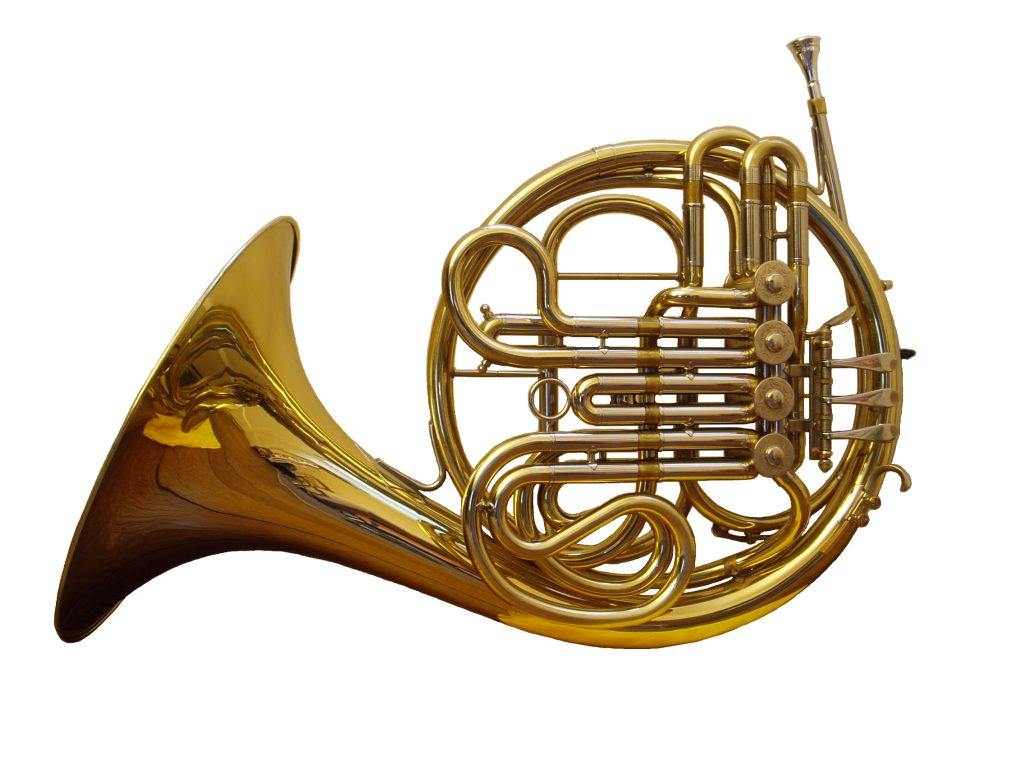
6 min read · 2 sourcesThe horn is a brass instrument in the horn family, made of tubing wrapped into a coil with a large flared bell and rotary valves. The term French horn refers to horns with piston valves, seldom used today; the double horn in F/B♭, a variety of German horn, is the horn most often used by players in professional orchestras and bands, although the descant and triple horn have become increasingly popular. A musician who plays a horn is known as a horn player or hornist. Pitch is controlled through the combination of the following factors: speed of air through the instrument (controlled by the player's lungs and thoracic diaphragm); diameter and tension of lip aperture (by the player's lip muscles—the embouchure) in the mouthpiece; plus, in a modern horn, the operation of valves by the left hand, which route the air into extra sections of tubing. Most horns have lever-operated rotary valves, but some, especially older horns, use piston valves (similar to a trumpet's) and the Vienna horn uses double-piston valves, or pumpenventil. The backward-facing orientation of the bell relates to the perceived desirability to create a subdued sound in concert situations, in contrast to the more piercing quality of the trumpet. A horn without valves is known as a natural horn, changing pitch along the natural harmonics of the instrument, similar to a bugle. Pitch may also be controlled by the position of the hand in the bell, in effect reducing the bell's diameter. 1
Name
The name "French horn" first came into use in the late 17th century. At that time, French makers were preeminent in the manufacture of hunting horns and were credited with creating the now-familiar, circular "hoop" shape of the instrument. As a result, these instruments were often called, even in English, by their French names: trompe de chasse or cor de chasse (lit. 'trumpet of hunt' or 'horn of hunt'—the clear modern distinction between trompes [trumpets] and cors [horns] did not exist at that time). German makers first devised crooks to make such horns playable in different keys—so musicians came to use "French" and "German" to distinguish the simple hunting horn from the newer horn with crooks, which in England was also called the Italian name corno cromatico (chromatic horn). More recently, "French horn" is often used colloquially, though the adjective has normally been avoided when referring to the European orchestral horn, ever since the German horn began replacing the French-style instrument in British orchestras around 1930. The International Horn Society has recommended since 1971 that the instrument be simply called the horn. There is also a more specific use of "French horn" to describe a particular horn type, differentiated from the German horn and Vienna horn. In this sense, "French horn" refers to a narrow-bore instrument (10.8–11.0 mm [0.43–0.43 in]) with three Périnet (piston) valves. It retains the narrow bell-throat and mouthpipe crooks of the orchestral hand horn of the late 18th century, and most often has an "ascending" third valve. This is a whole-tone valve arranged so that with the valve in the "up" position the valve loop is engaged, but when the valve is pressed the loop is cut out, raising the pitch by a whole tone. 1
History
As the name indicates, humans originally used to blow on the actual horns of animals before starting to emulate naturally occurring horns with metal ones. The use of animal horns survives with the shofar, a ram's horn, which plays an important role in Jewish religious rituals. Early metal horns were less complex than modern horns, consisting of valveless brass tubes, wound around a few times, with a slightly flared opening (the bell). These early "hunting" horns (French: cors de chasse) were originally played on a hunt, often while mounted, and the sound they produced was called a recheat. Change of pitch on these hunting horns was controlled entirely by the lips, as the use of valves and insertion of a hand in the bell to change pitch were later innovations. Without valves, only the notes within the harmonic series are available. By combining a long length with a narrow bore, the French horn's design allows the player to easily reach the higher overtones which differ by whole tones or less, thus making it capable of playing melodies before valves were invented. Early horns were commonly pitched in B♭ alto, A, A♭, G, F, E, E♭, D, C, and B♭ basso. Since the only notes available were those on the harmonic series of one of those pitches, horn-players had no ability to play in different keys. 1
Character
The sound and playing character of the German horn is distinctly different from those of the French model (the instrument of Franck, Debussy and Ravel), which is smaller in volume and regarded as more refined. The tone of the German horn is warm, rich, and dark in contrast to the French horn, which is light, brilliant, and open. 1
Types
Horns may be classified into single horn, double horn, compensating double horn, and triple horn as well as having the option of detachable bells. 1
Single horn
Single horns use a single set of tubes connected to the valves. This allows for simplicity of use and a much lighter weight. They are usually in the keys of F or B♭, although many F horns have longer slides to tune them to E♭, and almost all B♭ horns have a valve to put them in the key of A. The problem with single horns is the inevitable choice between accuracy or tone – while the F horn has the "typical" horn sound, above third-space C accuracy is a concern for the majority of players because, by its nature, one plays high in the horn's harmonic series where the overtones are closer together. This led to the development of the B♭ horn, which, although easier to play accurately, has a less desirable sound in the mid and especially the low register where it is not able to play all of the notes. The solution has been the development of the double horn, which combines the two into one horn with a single lead pipe and bell. Both main types of single horns are still used today as student models because they are cheaper and lighter than double horns. In addition, the single B♭ horns are sometimes used in solo and chamber performances and the single F survives orchestrally as the Vienna horn. Additionally, single F alto and B♭ alto descants are used in the performance of some baroque horn concertos and F, B♭ and F alto singles are occasionally used by jazz performers. Dennis Brain's benchmark recordings of the Mozart Horn Concerti were made on a single B♭ instrument by Gebr. Alexander, now on display at the Royal Academy of Music in London. 1
The text above is adapted from the Wikipedia article “French horn”, available under the Creative Commons Attribution-ShareAlike 4.0 licence. 1
horn is valved brass instrument with coiled tubing and flared bell, according to the structured record cited below. This entry was generated automatically from that record and has not yet been reviewed by a person familiar with the tradition. 2
The source record links this tradition to 50 external registers, which can be verified through the citation. 2