The tradition & historical record
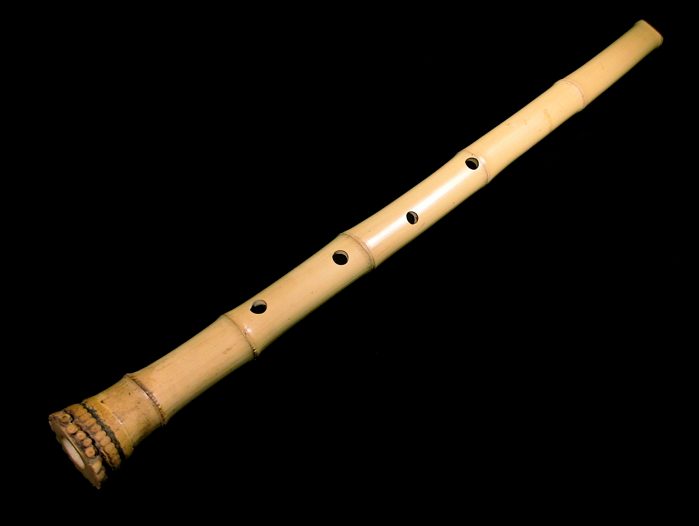
3 min read · 2 sourcesThe hotchiku (法竹(ほっちく), "bamboo of [the] dharma"; lit. 'dharma bamboo'), sometimes romanized as hocchiku or hochiku, is a Japanese aerophone, an end-blown bamboo flute, crafted from root sections of bamboo. The bamboo root is cleaned and sanded, resulting in a surface patterned with many small, circular knots where the roots formerly joined the stalk. The same part of the bamboo plant is also used to produce the shakuhachi but, unlike the shakuhachi, the hotchiku's inside (bore) and outside surfaces are left unlacquered, and an inlay is not used in the mouthpiece. The membranes at the nodes inside a hotchiku bore are generally left more intact than those of a shakuhachi, though older komuso shakuhachi also share this trait. Together, these characteristics make for a visibly and audibly raw and organic instrument. Hotchiku are sometimes referred to as jinashi nobekan, meaning "without ji [a paste made of clay and lacquer, used to smooth the bore on modern shakuhachi], one-piece"; hotchiku are not cut in two pieces for crafting or storage, unlike modern shakuhachi that are used as musical instruments. Hotchiku have four holes down the front for fingers and one hole on the back for the thumb of the upper hand. 1
Distinctions between hotchiku and traditional komuso shakuhachi
The term hotchiku was popularized by Watzumi Doso. Traditional komuso shakuhachi were quite similar, with three primary differences. First, modern hotchiku performers such as Doso and Okuda often prefer exceptionally long shakuhachi, while komuso shakuhachi rarely exceeded 2.1 shaku. Second, komuso shakuhachi had an inlaid mouthpiece, which protects the blowing edge from taking on excess moisture and rotting out. Thirdly, though ji is not used, the inside is painted with urushi, a natural lacquer made from the sap of the urushi tree, used in Japan from antiquity. Like the mouthpiece inlay, this protects the bore from taking on excess moisture and contributes to the flute's longevity. Lacking urushi and a mouthpiece inlay, hotchiku gradually take on moisture as they are played, making the tone less stable. Though komuso shakuhachi were not tuned to a precise scale either, they could generally be played together. As their hole positions were either calculated or copied from another shakuhachi, a particular honkyoku piece could be played roughly the same way on any shakuhachi. Hotchiku take even more freedom; some of Watazumi Doso's instruments were literally a piece of bamboo cut down with some holes seemingly randomly bored into it. Distinguishing hotchiku from shakuhachi in general can be difficult, as there are many types of shakuhachi. In addition to komuso shakuhachi, there are also modern ji-nashi nobekan shakuhachi, such as those made by John Kaizan Neptune, which are tuned to be played with modern (Western) musical instruments. Again, since the abolition of the Fuke sect in 1871, modern shakuhachi have been made in two halves in order to tune them more precisely, but shakuhachi used for Zen practice have been primarily "nobekan" shakuhachi since the beginning. 1
Famous hotchiku players
Watazumi Doso Roshi Nishimura Koku Atsuya Okuda 1
The text above is adapted from the Wikipedia article “Hotchiku”, available under the Creative Commons Attribution-ShareAlike 4.0 licence. 1
hotchiku is Japanese end-blown aerophone, according to the structured record cited below. This entry was generated automatically from that record and has not yet been reviewed by a person familiar with the tradition. 2
The source record links this tradition to 2 external registers, which can be verified through the citation. 2