The tradition & historical record
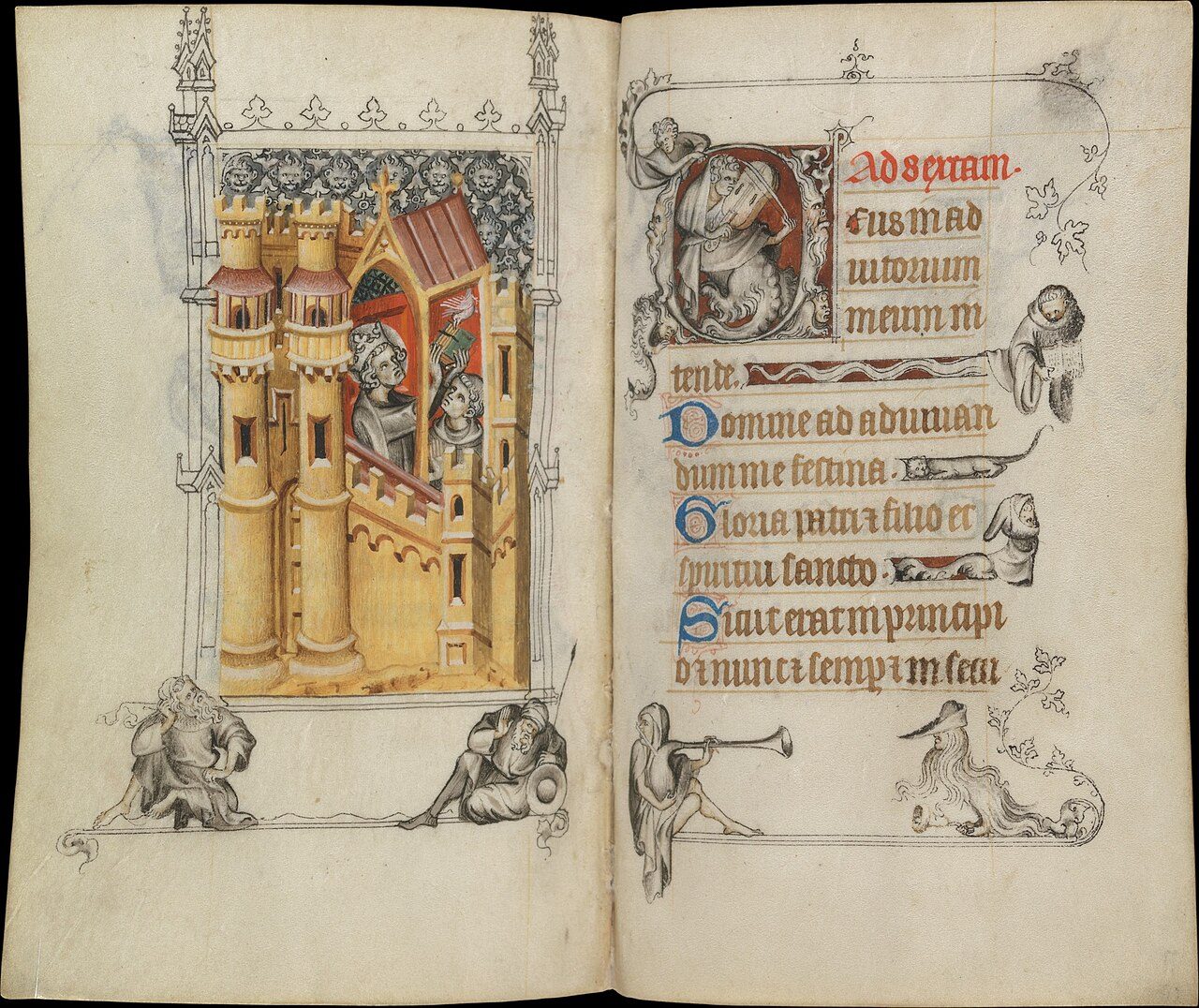
7 min read · 2 sourcesThe Hours of Jeanne d'Evreux is an illuminated book of hours in the Gothic style. According to the usual account, it was created between 1324 and 1328 by Jean Pucelle for Jeanne d'Evreux, the third wife of Charles IV of France. It was sold in 1954 to the Metropolitan Museum of Art in New York where it is now part of the collection held at The Cloisters (accession number 54.1.2), and usually on display. The book is very lavishly decorated, mostly in grisaille drawings, and is a highly important example of an early royal book of hours, a type of book designed for the personal devotions of a wealthy lay-person, which was then less than a century old. It has been described as "the high point of Parisian court painting", showing "the unprecedentedly refined artistic tastes of the time". 1
Description
The book is very small: the size of each vellum folio or page is 3 5/8 x 2 7/16 in. (9.2 x 6.2 cm), and the overall size including the current replacement binding is 3 7/8 x 2 13/16 x 1 1/2 in. (9.9 x 7.2 x 3.8 cm). There are 209 folios, with 25 full page miniatures, but many other historiated initials and images in the borders of most pages, so that over 700 illustrations have been counted. Only ten folios have no decoration, just plain text, suggesting that the book was never entirely finished. The vellum is extremely thin, almost transparent, and the text by an unknown scribe is very finely written. The miniatures use a variety of grisaille drawing in pen known (or at least so called in an inventory that included this work) as "de blanc et noir" and tempera for the other colours. Using both grisaille and colour together is a technique known as “camaïeu gris”. The full-page paintings include cycles of what are always the most commonly found phases of the Life of Christ, the Passion and Infancy. These illustrate the Hours of the Virgin, which is found in some other books of hours, but most unusually they are arranged on facing pages showing a scene from the Passion on the left and from the Infancy on the right, with eight pairs of scenes. However such an arrangement is often found in the ivory diptychs that were being produced in great numbers in Paris at this period. Another cycle shows nine scenes from the life of the Saint-King Louis IX of France decorating the office dedicated to him. 1
History and authorship
Although there are dissenting opinions, the book is generally believed to be the work of the leading Parisian illuminator, Jean Pucelle (or Jehan Pucele). It is usually identified with the book mentioned by Queen Jeanne in her will, in which she leaves to Charles V "un bien petit livret d'oroisons que le roy Charles, dont Dieu l'ame, avoit faict faire pour Madame, que pucelle enlumina" ("a very small prayer book which King Charles, may God protect him, had made for Madame, which Pucelle illuminated"). The identification of the patrons, illuminator and the date assigned to the work all largely depend on identifying this book with the manuscript in New York, as does any clear conception of what Pucelle's personal style was. However this refers to a prayer book not a book of hours, and it has been doubted that this imprecision would have been likely in such a context. In addition none of Jeanne's heraldry appears in the book, unlike two other royal manuscripts made when she was queen, her Coronation Book and a breviary. On the conventional assumptions, the book was first owned by Queen Jeanne until her death in 1371, when it was left to the then king Charles V. In 1380, an inventory of Charles V's possessions mentions a Dominican Book of Hours that had belonged to Jeanne d’Evreux. This book is assumed to be one mentioned in an inventory from 1401-2 of the books of John, Duke of Berry, who inherited many manuscripts from his brother's collection. 1
Pucelle
There are several different manuscripts thought to be illuminated by Pucelle and his workshop, but they show some discrepancies with regards to his style. Florens Deuchler, who was the chairman of Medieval Art and The Cloisters of the Metropolitan Museum of Art from 1968 to 1972, was very sceptical about attributing The Hours of Jeanne d’Evreux to Jean Pucelle, as was Elizabeth Flinn of the MMA. In an article called Jean Pucelle- Facts and Fictions he says: "we call him Jean Pucelle, although we do not know who he was, whether he worked as a chef d’atelier – the master of a workshop- or whether he was just an enlumineur we hear of by chance more often than we hear of his many colleagues working in Paris." There are a few other works that are claimed to be produced by the hand of Jean Pucelle, such as the Prayer Book of Bonne of Luxembourg, also located in the Metropolitan Museum of Art at The Cloisters, and the Belleville Breviary, that vary in style and quality. Karen Gould states: “Pucelle is believed to have painted the entire manuscript [the Hours of Jeanne d’Evreux].” Kathleen Morand is quite certain that “it [Hours of Jeanne d’Evreux] is also the only manuscript which we are certain was entirely executed by the hand of Pucelle.” Manuscripts such as the Prayer Book of Bonne of Luxembourg, are considered to be in the Pucelle style rather than by the master himself, while the Hours of Jeanne d’Evreux is thought to be by the master himself. The Metropolitan website currently uses the conventional attribution without any question marks indicating uncertainty. 1
Commission
Charles IV married Jeanne in 1325 and died in 1328, giving the dating for the book (Jeanne lived on for over 40 years, until 1371); it may have been a gift for the wedding or her coronation. The Hours were made for her private use, to provide a text for the daily prayers she would read or recite at intervals throughout the day. It is thought that Jean Pucelle was a member of the royal court workshop, working for Charles IV, and he was perhaps an Italian or at least had travelled to Italy, to judge by some elements of his work, including the Hours of Jeanne d’Evreux. Deuchler states: "with the appearance of Pucelle’s name, there was an exciting new departure in Parisian courtly book illumination, which, as a matter of fact, would not have been possible without the contribution of Italy- to be more specific, without the aid of Duccio. The “Pucelle Style” shows solid trecento connections in its painterly skill and its familiarity with southern perspective as it existed in Sienese models." Pucelle seems to have been the originator of the Italian influence in French manuscript illumination, and after his death, the Italian influence in Parisian art disappeared. Paintings by Duccio, especially the Maestà in Siena Cathedral and the Pulpit by Giovanni Pisano in Sant'Andrea, Pistoia can be directly related to elements of The Hours of Jeanne d’Evreux. Strasbourg Cathedral and its sculpture was also an influence on the book, as in the Passion Cycle, where specific details from the sculpture of the cathedral are borrowed by the manuscript. 1
Style
The hours are a classic masterpiece of Gothic illumination, and the arch… 1
The text above is adapted from the Wikipedia article “Hours of Jeanne d'Evreux”, available under the Creative Commons Attribution-ShareAlike 4.0 licence. 1
Hours of Jeanne d'Evreux is illuminated manuscript by Jean Pucelle, according to the structured record cited below. This entry was generated automatically from that record and has not yet been reviewed by a person familiar with the tradition. 2
The source record links this tradition to 5 external registers, which can be verified through the citation. 2