The tradition & historical record
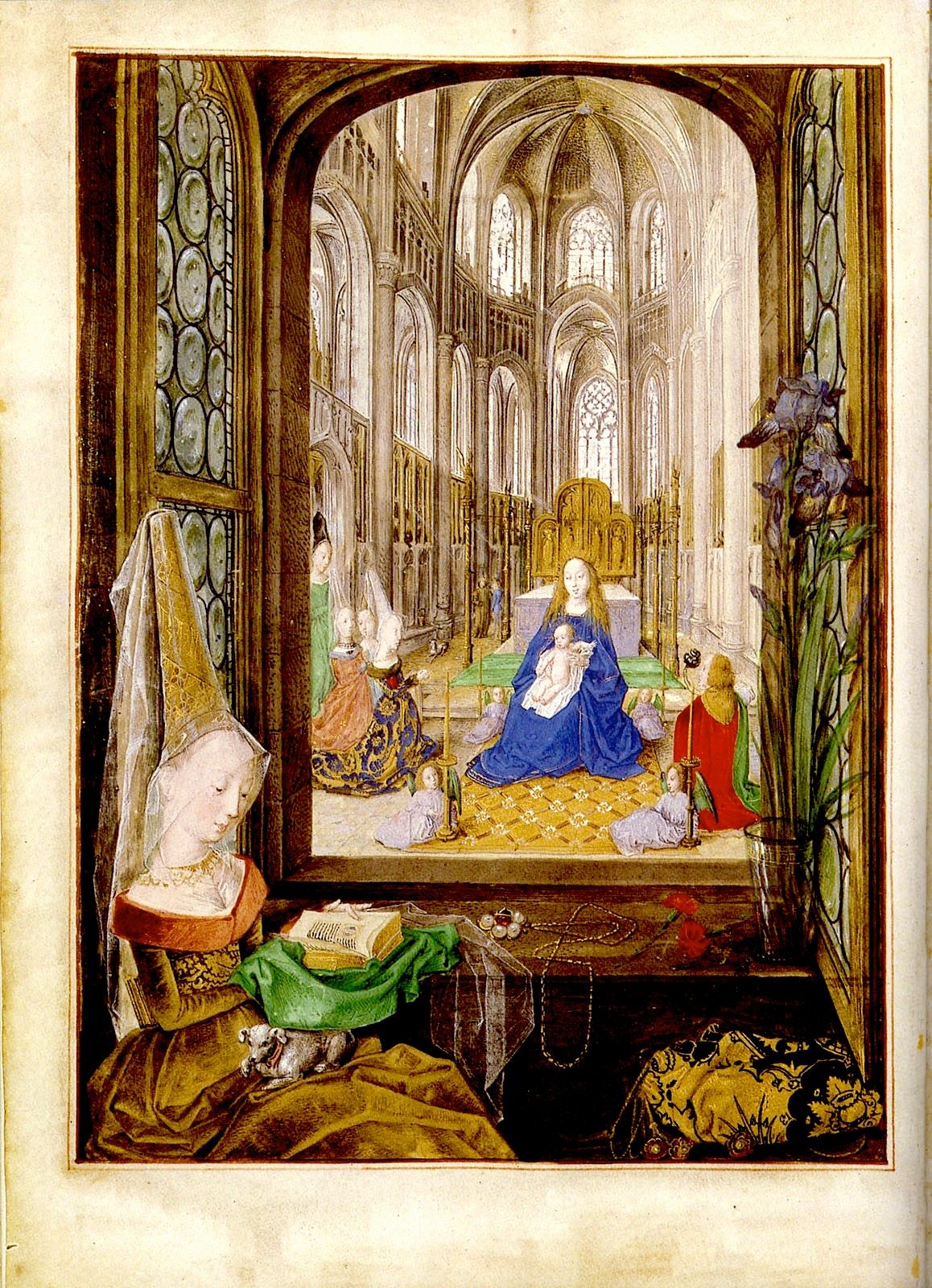
7 min read · 2 sourcesThe Hours of Mary of Burgundy (German: Stundenbuch der Maria von Burgund) is a book of hours, a form of devotional book for lay-people, completed in Flanders around 1477, and now in the National Library of Austria. It was probably commissioned for Mary, the ruler of the Burgundian Netherlands and then the wealthiest woman in Europe. No records survive as to its commission. The book contains 187 folios, each measuring 225 by 150 millimetres (8.9 in × 5.9 in). It consists of the Roman Liturgy of the Hours, 24 calendar roundels, 20 full-page miniatures and 16 quarter-page format illustrations. Its production began c. 1470, and includes miniatures by several artists, of which the foremost was the unidentified but influential illuminator known as the Master of Mary of Burgundy, who provides the book with its most meticulously detailed illustrations and borders. Other miniatures, considered of an older tradition, were contributed by Simon Marmion, Willem Vrelant and Lieven van Lathem. The majority of the calligraphy is attributed to Nicolas Spierinc, with whom the Master collaborated on other works and who may also have provided a number of illustrations. The two best known illustrations contain a revolutionary trompe-l'œil technique of showing a second perspective through an open window from the main pictorial setting. 1
Commission
The book was for centuries known as the "Vienna Hours of Charles the Bold", and thought to have been intended to mark the death of Charles the Bold, ruler of the Burgundian Netherlands, at the Battle of Nancy on 5 January 1477, and thus as a book of mourning, intended for either his widow, Margaret of York, or his daughter, Mary. As Charles's sole heir, Mary became both the wealthiest woman in Europe and the last of her dynasty. The idea that it was originally a book of mourning is reinforced by the mournful appearance of the opening 34 pages, where the gold and silver lettering is placed on parchment that has been stained black, in a technique associated with the so-called black books of hours. Only seven of these Illuminated manuscripts survive today, all produced in the mid to late 15th century. Given their novel visual appeal, and the use of gold and silver leaf, they were more expensive and highly prized than more conventional books of hours, and produced for high-ranking members of the court of Philip the Good and Charles the Bold. The Burgundian court had a preference for dark, sombre colourisation and the extant works in this style were mostly commissioned for them. Only the wealthy nobility could have afforded such books, and the taste for mournful colours – often reflected in their dress style – was reflected in the black, gold and silver of these manuscripts. After page 35, the parchment is predominantly left white and the images are lighter in tone. Given this change, the intention for the book may have changed from mourning to celebration: that is, its purpose changed from being a commemoration of Charles's death to a token of honour for Mary's marriage to Maximilian of Austria. 1
Attribution
Work on the book is thought to have begun c. 1470. The Flemish artist Nicolas Spierinc, a favourite of the Burgundian court and Charles in particular, has been identified as the chief scribe of the elegant and complex calligraphy. There is speculation that the artist was active in Bruges at the end of the 15th century. He may have directed assistants to carry out some of the lettering, excepting key passages. An anagram of his name appears on the borders of the miniature on folio 94v, The Way to Calvary. The miniatures were completed by a team of at least nine artists and illustrators, including Simon Marmion, attributed a single illustration, Willem Vrelant and Lieven van Lathem. Van Lathem is attributed with the "Christ before Pilate" miniature, which seems influenced by Hand K of the Turin-Milan Hours (c. 1420). Most attention is given to the innovative images attributed to the Master of Mary of Burgundy, known to have been active in Flanders between 1469 and 1483, and who was greatly influenced by the innovations of contemporary northern European panel painting, particularly the melancholy of Hugo van der Goes and the illusionism of Jan van Eyck. The Master is thought to have been the primary illuminator responsible for a second book commissioned by the family, the Prayer Book of Charles the Bold, now in Berlin. 1
A majority have been specifically attributed to one of these artists, though there is some debate over a number. The illustrations can be characterised by the use of everyday devotional objects, including books, rosary beads and contemporary everyday settings, to frame images of divine saints and thereby bringing the sacred into domestic, earthly spaces. 1
Design
The book consists of 186 original folios of 22.5 × 16.3 cm and three folios that were later additions, which measure 21.2 × 15.2 cm. In total there are 20 full-page miniatures, 14 smaller miniatures, 24 calendar sheets, 14 historiated initials and 78 ornamental borders. The text is preoccupied with the litany, and intercessory prayers. The margins on almost every page are decorated with drollerie consisting of flowers, insects, jewels and sibyls, some of which were designed by Lieven van Lathem. Those most praised by art historians were created by the Master of Mary of Burgundy. The marginalia and drolleries are painted in such a way as to suggest that objects are sprinkled over the foil in a three-dimensional manner that suggest, according to art historian Otto Pächt, that they seem not so much "in the imaginary space of the picture, but in that of the real world". 1
Miniatures
The book contains 20 full-page miniatures and 16 small format illustrations. They are all of the highest quality and can be mostly attributed to individual artists or hands. There are noticeable changes in standards and style between the miniatures attributed to the Master of Mary of Burgundy and those attributed to other hands. There is some commonality between the images; the idealised facial types are similar, and thin cumulus clouds appear throughout. 1
The Master's work is characterised by mixed colours that whiten toward the horizon, while in others they are saturated. He achieved the modelling of figures and objects by building layers of paint in thin but visible brush strokes, rather than hatching. His palette is noticeably darker than that of the other hands, mostly consisting of purples, browns and greys, with the areas around the figure's faces and hands coloured with black pigment. The art historian Thomas Kren says his miniatures in this book "constitute an art of profound emotion; subtle atmospheric effects; abundant, richly textured detail; and the most delicate draftsmanship. His miniatures convey a powerful sense of the moment". The book's best-known miniatures, the Virgin and Child, Christ nailed to the Cross, and the Crucifixion, are attributed to the Master. 1
Virgin and Child
Mary of Burgundy can be identified as the woman in the foreground of folio 14v … 1
The text above is adapted from the Wikipedia article “Hours of Mary of Burgundy”, available under the Creative Commons Attribution-ShareAlike 4.0 licence. 1
Hours of Mary of Burgundy is book of hours with several miniature paintings, according to the structured record cited below. This entry was generated automatically from that record and has not yet been reviewed by a person familiar with the tradition. 2
The source record links this tradition to 5 external registers, which can be verified through the citation. 2