The tradition & historical record
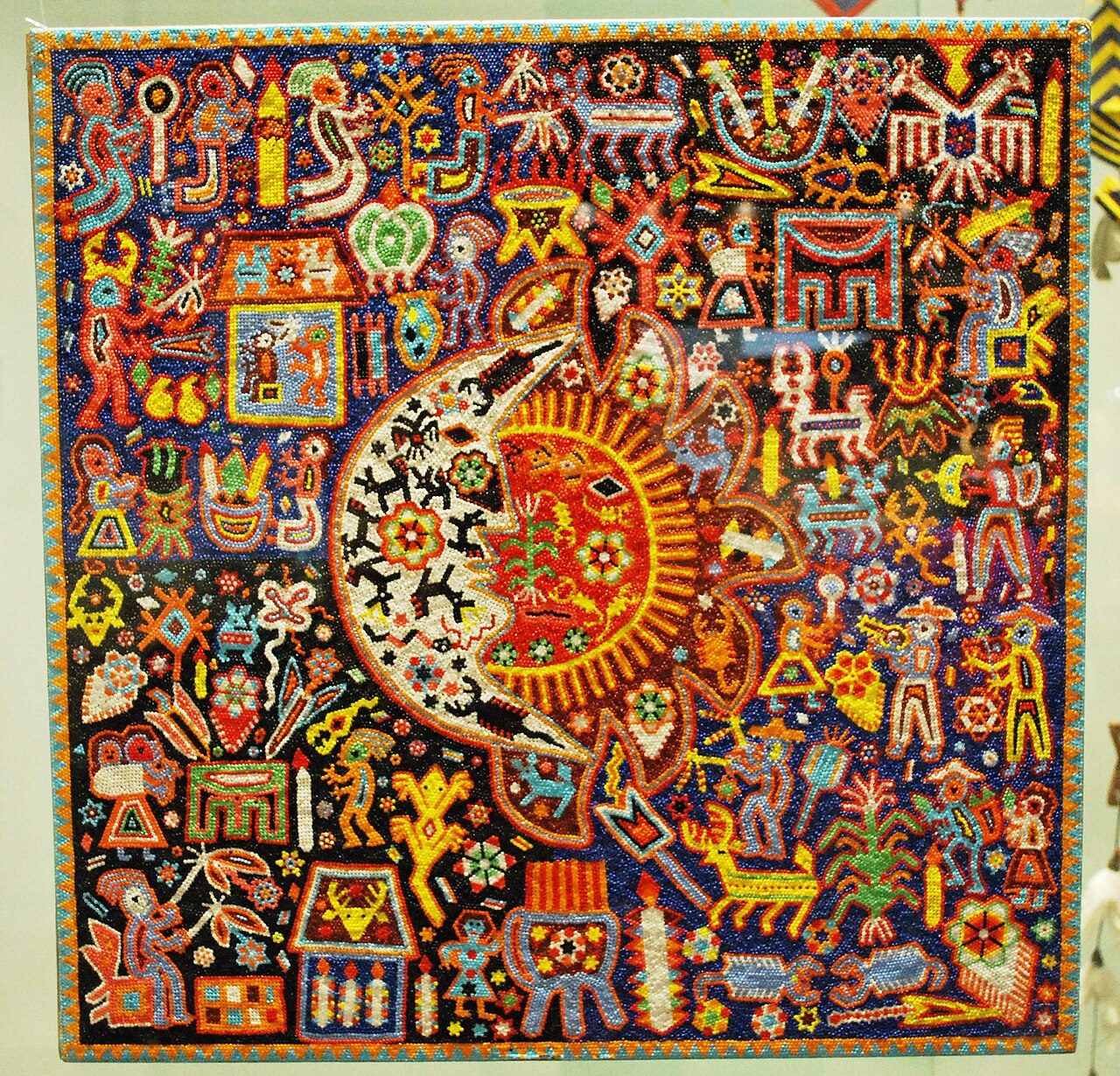
6 min read · 2 sourcesHuichol art broadly groups the most traditional and most recent innovations in the folk art and handcrafts produced by the Huichol people, who live in the states of Jalisco, Durango, Zacatecas and Nayarit in Mexico. The unifying factor of the work is the colorful decoration using symbols and designs which date back centuries. The most common and commercially successful products are "yarn paintings" and objects decorated with small commercially produced beads. Yarn paintings consist of commercial yarn pressed into boards coated with wax and resin and are derived from a ceremonial tablet called a nierika. The Huichol have a long history of beading, making the beads from clay, shells, corals, seeds and more and using them to make jewelry and to decorate bowls and other items. The "modern" beadwork usually consists of masks and wood sculptures covered in small, brightly colored commercial beads fastened with wax and resin. While the materials have changed and the purpose of many of the items have changed from religious to commercial purposes, the designs have changed little, and many retain their religious, symbolic and cultural significance. Many outsiders experience Huichol art as tourists in areas such as Guadalajara and Puerto Vallarta, without knowing about the people who make the items, and the meanings of the designs. 1
The Huichol People
The Huichols are an indigenous people who mostly live in the mountainous areas of northern Jalisco and parts of Nayarit in north central Mexico, with the towns of San Andrés, Santa Catarina and San Sebastián as major cultural centers. Their numbers are estimated at 50,000 and the name Huichol is derived from the word Wirriarika, which means soothsayer or medicine man in the Huichol language. After the Spanish arrived in the 16th century, the Huichols retreated into the rugged mountains of northern Jalisco and Nayarit. They converted to Christianity in the colonial period by Franciscan missionaries, most of the native Huichol culture managed to survive intact due to the isolation, and because the area lacked mineral or other resources of interest to the Spanish. Mexican historian and anthropologist Fernando Benítez states that the Huichols have probably maintained their ancient belief systems better than any other indigenous group in Mexico. Much of this isolationist tendency remains intact although economic circumstances have forced a number of good Huichols to migrate to areas such as Guadalajara, and coastal areas to work or sell their wares. The religious faith of the Huichols is still based on a "trinity" of veneration of the deer, corn and peyote. The last is ritually gathered each year on a long pilgrimage to the desert area of San Luis Potosí, where the people are said to have originated and used by shamans. The importance of this and the pantheon of gods is seen in their stylistic representations on just about everything that the Huichol decorate. They did not have a written language until recently, so these symbols were and are the primary form of preserving the ceremonies, myths and beliefs of ancient Huichol religion. 1
Yarn painting and beadwork
The best known Huichol art is made with modern, commercially produced items such as yarn and small beads. The Tepehuánes of Durango adapted the yarn paintings. These have replaced many of the traditional materials such as clay, stone and vegetable dyes. Making and decorating items with beads did not begin with importation of European glass beads, as it did with a number of indigenous cultures to the far north. Techniques for making and using beads have been in place long before that with beads made from bone, clay, stone, coral, turquoise, pyrite, jade and seeds. Huichol art was first documented in the very late 19th century by Carl Lumholtz. This includes the making of beaded earrings, necklaces, anklets and even more. What mostly links the yarn paintings and beaded objects made today is the continuance of the traditional patterns used for centuries to represent and communicate with the gods. The use of commercial materials has allowed for the production of more elaborate designs and brighter colors, as well as more flexibility in how traditional concepts are rendered. It has also allowed that the production of commercialized folk art along with the production of strictly religious items. The commercialization of Huichol art began when a Franciscan priest by the name of Ernesto Loera Ochoa began a Huichol museum at the Basilica of Our Lady of Zapopan just north of Guadalajara. One of the artists exhibited here was Ramón Medina Silva, whose work was exhibited and sold at the museum. Medina's work came to the attention of American Peter Furst, who suggested that Ramón represent the traditions and beliefs of his people by pressing colored yarn into a wax and resin-covered baseboard. 1
Noted Huichol artists
Notable Huichol artists include Emeteria Ríos Martínez, who has done a number of yarn painting murals. José Benítez Sánchez is a shaman-artist, who helped to expand yarn painting from its early decorative function to larger more vision like pieces. Pablo Taizan is also a shaman in the village of Mesa de Tirador. He principally does beadwork featuring animal figures used in healing. Santos de la Torre made a great mural for the metro station Palais Royal at the Louvre, Paris. In 2013 Mexican portrait documentary 'Echo of the Mountain', originally known in Spanish as Eco de la montaña directed by Nicolás Echevarría released based on his experiences during the mural creation. 1
More traditional items
Although the yarn paintings and items decorated with beads are the best known and most widely sold pieces, the Huichols continue to make a number of other types of folk art and handcrafts. Urus, or prayer arrows, are ceremonial arrows created to be shot into the air and petition the gods for special blessings. They are also sometimes left at certain places or sent down rivers. These arrows are decorated with symbols and designs related to the petition. From the far past to the present, men, women and children all wear woven bags around their waist to carry personal objects. These bags are colored and otherwise decorated for aesthetic and to magically protect the wearer. A "kuka" is a three dimensional ceremonial mask which is decorated by beading. These masks evolved from small gourd bowls originally covered in seeds, bone, clay, coral and shell, but these have been replaced by commercially produced beads. It is from these masks that the modern practice of covering wooden sculptures of snakes, dolls, small animals, jaguar heads and other forms is derived. Nearika are highly decorated ceremonial objects that can be circular or diamond-shaped. When Carl Lumholtz did his writing on the Huichol, he named the circular ones "frontal shields" and the diamond-shaped ones as "eyes" and giving rise to the concept of the "God's eyes," applied to a Huichol cross. Nearika are tablets of wood or bamboo which are heavily decorated placed into certain sacred areas. 1
Huichol decorative designs
Most Huichol patterns and des… 1
The text above is adapted from the Wikipedia article “Huichol art”, available under the Creative Commons Attribution-ShareAlike 4.0 licence. 1
Huichol art is folk art and handcrafts produced by the Wixarika or Huichol people, according to the structured record cited below. This entry was generated automatically from that record and has not yet been reviewed by a person familiar with the tradition. 2
The source record links this tradition to 1 external register, which can be verified through the citation. 2