The tradition & historical record
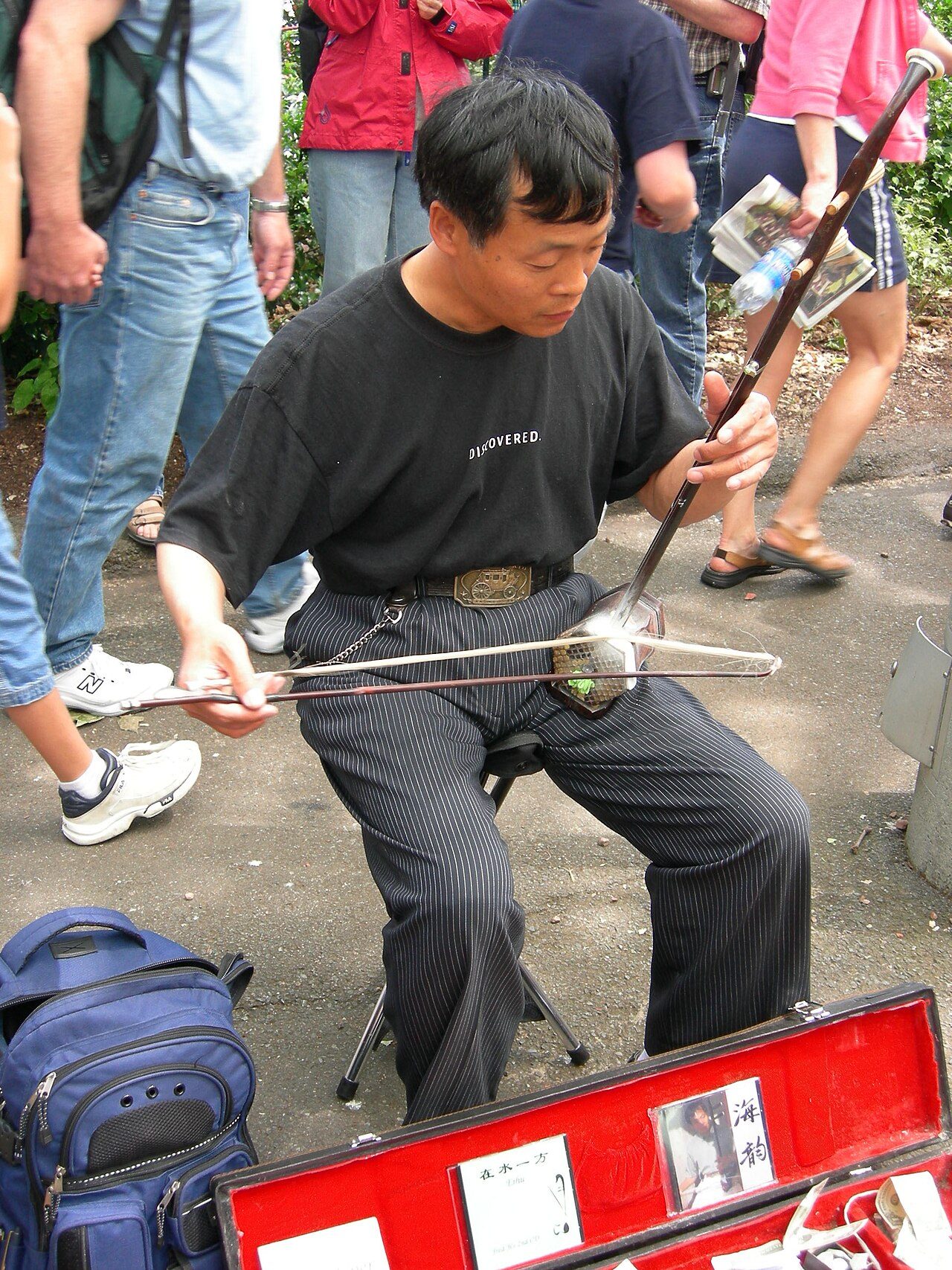
3 min read · 2 sourcesHuqin (Chinese: 胡琴; pinyin: húqin) is a family of bowed string instruments, more specifically, a spike fiddle popularly used in Chinese music. The instruments consist of a round, hexagonal, or octagonal sound box at the bottom with a neck attached that protrudes upwards. They also usually have two strings, and their soundboxes are typically covered with either snakeskin (most often python) or thin wood. Huqin instruments usually have two tuning pegs, one peg for each string. The pegs are attached horizontally through holes drilled in the instrument's neck. Most huqin have the bow hair pass in between the strings. Exceptions to having two strings and pegs include variations of huqin with three, four, and sometimes even more than five. These include the zhuihu, a three stringed huqin, the sihu, a huqin of Mongolian origin, and the sanhu, a lesser-known three-stringed variation. The most common huqin are the erhu, which is tuned to a middle range; zhonghu, which is tuned to a lower register, and gaohu, which is tuned to a higher pitch. The lowest pitched huqins include the dahu and gehu. The highest pitched huqin is the jinghu, used in the Beijing opera. 1
List of Chinese huqin instruments
Erhu (二胡); also called nanhu (南胡) Erquanqin (二泉琴); slightly larger erhu used specifically to play the melody Erquan Yingyue (二泉映月) Gaohu (高胡); also called yuehu (粤胡) Banhu (板胡) Jinghu (京胡) Jing erhu (京二胡) Zhonghu (中胡) Yehu (椰胡) Erxian (二弦) Tiqin (提琴) Tihu (提胡) Daguangxian (大广弦) Datong (大筒)photo Datongxian (大筒弦)photo Kezaixian (壳仔弦) - two-stringed fiddle with coconut body, used in Taiwan opera Hexian (和弦) Huluhu (traditional: 葫蘆胡; simplified: 葫芦胡) Maguhu (traditional: 馬骨胡; simplified: 马骨胡) Tuhu (土胡) Jiaohu (角胡) Zhuihu (traditional: 墜胡; simplified: 坠胡) Zhuiqin (traditional: 墜琴; simplified: 坠琴) Leiqin (雷琴) Sihu (四胡) Sanhu (三胡) Liuhu (六胡) Dahu (大胡) Dihu (低胡) Xiaodihu (小低胡) Zhongdihu (中低胡) Dadihu (大低胡) Cizhonghu Gehu (革胡) Diyingehu (低音革胡) Laruan (拉阮) Dalaruan (大拉阮) Paqin (琶琴) Dapaqin (大琶琴) Xiqin (奚琴) Niutuiqin or niubatui (牛腿琴 or 牛巴腿) (Guizhou) Matouqin (馬頭琴) (Inner Mongolia) Aijieke (艾捷克) (Xinjiang)[1] Sataer (萨它尔) (Xinjiang) Shaoqin (韶琴) an electric erhu 1
Cambodia
Tro (Cambodia) Tro che (Cambodia) Tro Khmer (Cambodia) Tro sau thom (Cambodia) Tro sau toch (Cambodia) Tro u (Cambodia) Tro Ou Chamhieng (Cham people, Cambodia) 1
Indonesia
Kongahyan (Indonesia) Tehyan (Indonesia) Sukong (Indonesia) Sukong, Tehyan and Kongahyan are 3 similar instrument. The only difference being the size and tuning. The Sukong has a lower tuning (A and E), the Tehyan has the tuning of D and A and the Kongahyan, the smallest of the 3, has the highest tuning (G and D). These three are used throughout the island of Java and Bali for things like "Gambang Keromong", "Lenong", "Ondel-ondel", and "Topeng Betawi". 1
Japan
Kokyū (Japan) (though this is actually descended from the rebab and related instruments, through South East Asia and the Ryukyu islands) 1
Korea
Haegeum (Korea; derived from the Xiqin) Sohaegeum (North Korea) Junghaegeum (North Korea) Daehaegeum (North Korea) Jeohaegeum (North Korea) 1
The text above is adapted from the Wikipedia article “Huqin”, available under the Creative Commons Attribution-ShareAlike 4.0 licence. 1
huqin is family of bowed string instruments, more specifically, a spike fiddle popularly used in Chinese music, according to the structured record cited below. This entry was generated automatically from that record and has not yet been reviewed by a person familiar with the tradition. 2
The source record links this tradition to 5 external registers, which can be verified through the citation. 2