The tradition & historical record
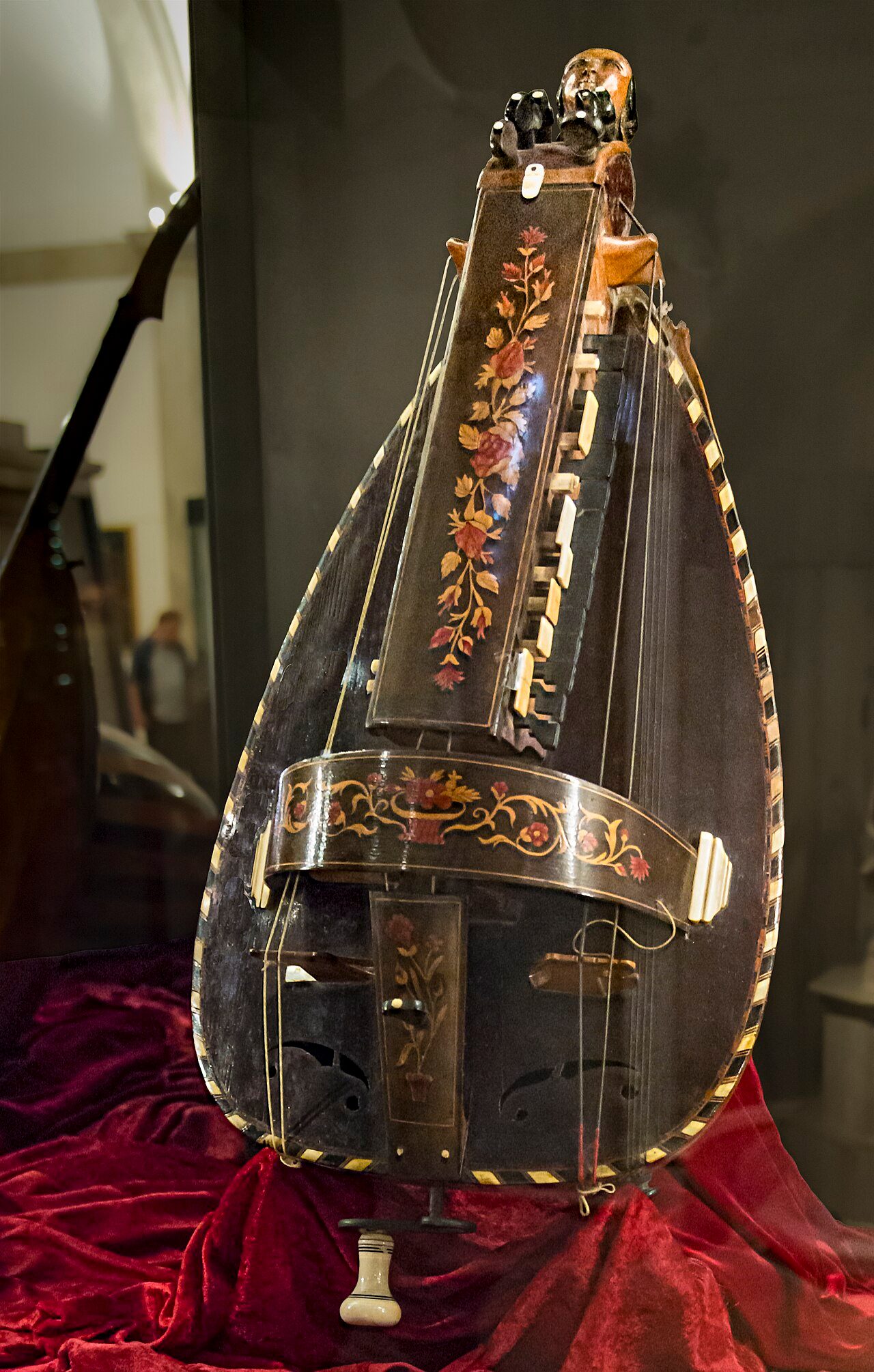
6 min read · 2 sourcesThe hurdy-gurdy is a string instrument that produces sound by means of a hand-cranked rosined wheel that rubs against the strings. The wheel functions much like a violin (or nyckelharpa) bow, and single notes played on the instrument sound similar to those of a violin. Melodies are played on a keyboard that presses tangents—small wedges, typically made of wood or metal—against one or more of the strings to change their pitch. Like most other acoustic stringed instruments, it has a sound board and hollow cavity to make the vibration of the strings audible. Most hurdy-gurdies have multiple drone strings, which give a constant pitch accompaniment to the melody, resulting in a sound similar to that of bagpipes. For this reason, the hurdy-gurdy is often used interchangeably or along with bagpipes. It is mostly used in French, Occitan, Aragonese, Cajun French, Asturian, Cantabrian, Galician, Hungarian, and Slavic folk music. It can also be seen in early music settings such as medieval, renaissance or baroque music. One or more of the gut strings called 'trompette' usually passes over a buzzing bridge called the 'chien' that can be made to produce a distinctive percussive buzzing sound as the player turns the wheel. The chien was originally designed with a hollow interior to provide a small storage space for spare strings. The players found that this hollow construction also enhanced the desired buzzing timbre. 1
History
The hurdy-gurdy is generally thought to have originated from fiddles in either Europe or the Middle East (e.g., the rebab instrument) before the eleventh century A.D. The first recorded reference to fiddles in Europe was in the 9th century by the Persian geographer Ibn Khurradadhbih (died 911) describing the lira (lūrā) as a typical instrument within the Byzantine Empire. One of the earliest forms of the hurdy-gurdy was the organistrum, a large instrument with a guitar-shaped body and a long neck in which the keys were set (covering one diatonic octave). The organistrum had a single melody string and two drone strings, which ran over a common bridge, and a relatively small wheel. Due to its size, the organistrum was played by two people, one of whom turned the crank while the other pulled the keys upward. Pulling keys upward is cumbersome, so only slow tunes could be played on the organistrum. The pitches on the organistrum were set according to Pythagorean temperament and the instrument was primarily used in monastic and church settings to accompany choral music. Abbot Odo of Cluny (died 942) is supposed to have written a short description of the construction of the organistrum entitled Quomodo organistrum construatur (How the Organistrum Is Made), known through a much later copy, but its authenticity is very doubtful. Another 10th-century treatise thought to have mentioned an instrument like a hurdy-gurdy is an Arabic musical compendium written by Al Zirikli. 1
Terminology
A person who plays the hurdy-gurdy is called a hurdy-gurdist, or (particularly for players of French instruments) viellist. In France, a player is called un sonneur de vielle (literally "a sounder of vielle"), un vielleux or un vielleur. Because of the prominence of the French tradition, many instrument and performance terms used in English are commonly taken from the French, and players generally need to know these terms to read relevant literature. Such common terms include: 1
Trompette: the highest-pitched drone string that features the buzzing bridge Mouche: the drone string pitched a fourth or fifth below the trompette Petit bourdon: the drone string pitched an octave below the trompette Gros bourdon: the drone string pitched an octave below the mouche Chanterelle(s): melody string(s), also called chanters or chanter strings in English Chien: (literally "dog"), the buzzing bridge Tirant: a small peg set in the instrument's tailpiece that is used to control the sensitivity of the buzzing bridge 1
Nomenclature
According to the Oxford English Dictionary, the mid-18th-century origin of the term hurdy-gurdy is onomatopoeic in origin, after the repetitive warble in pitch that characterizes instruments with solid wooden wheels that have warped due to changes in humidity or after the sound of the buzzing-bridge. Alternately, the term is thought to come from the Scottish and northern English term for uproar or disorder, hirdy-girdy or from hurly-burly, an old English term for noise or commotion. The instrument is sometimes more descriptively called a wheel fiddle in English, but this term is rarely used among players of the instrument. Another possible derivation is from the Hungarian hegedűs (Slovenian variant hrgadus) meaning a fiddle. In France, the instrument is known as vielle à roue (wheel fiddle) or simply vielle (even though there is another instrument with this name – vielle), while in the French-speaking regions of Belgium it is also known in local dialects as vièrlerète/vièrlète or tiesse di dj'va ('horse's head'). The Flemings and the Dutch call it a draailier, which is similar to its German name, Drehleier. An alternate German name, Bauernleier, means "peasant's lyre". In Italy, it is called the ghironda or lira tedesca while in Spain, it is a zanfona in Galicia, zanfoña in Zamora, rabil in Asturias and viola de roda in Catalonia. In the Basque language, it is known as a zarrabete. In Portugal, it is called sanfona. The Hungarian name tekerőlant and the alternative forgólant both mean "turning lute". Another Hungarian name for the instrument is nyenyere, which is thought to be an onomatopoeic reference to the repetitive warble produced by a wheel that is not even. 1
Shape
In her overview of the instrument's history, Palmer recorded twenty-three different forms, and there is still no standardized design today. The six-stringed French vielle à roue is the best-known and most common sort. A number of regional forms developed, but outside France the instrument was considered a folk instrument and there were no schools of construction that could have determined a standard form. There are two primary body styles for contemporary instruments: guitar-bodied and lute-backed. Both forms are found in French-speaking areas, while guitar-bodied instruments are the general form elsewhere. The box form symphonia is also commonly found among players of early music and historical re-enactors. 1
Strings
Historically, strings were made of gut, which is still a preferred material today and modern instruments are mounted with violin (D or A) and cello (A, G, C) strings. However, metal-wound strings have become common in the twentieth century, especially for the heavier drone strings or for lower melody strings if octave tuning is used. Nylon is also sometimes used, but is disliked by many players. Some instruments also have optional sympathetic strings, generally guitar or banjo B strings. The drone strings produce steady sounds at fixed pitches. 1
The text above is adapted from the Wikipedia article “Hurdy-gurdy”, available under the Creative Commons Attribution-ShareAlike 4.0 licence. 1
hurdy-gurdy is mechanical stringed musical instrument, according to the structured record cited below. This entry was generated automatically from that record and has not yet been reviewed by a person familiar with the tradition. 2
The source record links this tradition to 47 external registers, which can be verified through the citation. 2