The tradition & historical record
6 min read · 2 sourcesIndian art consists of a variety of art forms, including painting, sculpture, pottery, and textile arts such as woven silk. Geographically, it spans South Asia, including what is now India, Pakistan, Bangladesh, Sri Lanka, Nepal, Bhutan, and at times Afghanistan, the Maldives, and Tibet, amongst a few other places. A strong sense of design is characteristic of Indian art and can be observed in its modern and traditional forms. The earliest Indian art originated during the prehistoric settlements of the 3rd millennium BCE, such as the rock shelters of Bhimbetka, which contain some of the world's oldest known cave paintings. On its way to modern times, Indian art has had cultural influences, as well as religious influences such as Hinduism, Buddhism, Jainism, Sikhism and Islam. In spite of this complex mixture of religious traditions, generally, the prevailing artistic style at any time and place has been shared by the major religious groups. In historic art, sculpture in stone and metal, mainly religious, has survived the Indian climate better than other media and provides most of the best remains. Many of the most important ancient finds that are not in carved stone come from the surrounding, drier regions rather than India itself. 1
Rock Art
Rock art of India includes rock relief carvings, engravings and paintings, some (but by no means all) from the South Asian Stone Age. It is estimated there are about 1300 rock art sites with over a quarter of a million figures and figurines. The earliest rock carvings in India were discovered by Archibald Carlleyle, twelve years before the Cave of Altamira in Spain, although his work only came to light much later via J Cockburn (1899). Dr. V. S. Wakankar discovered several painted rock shelters in Central India, situated around the Vindhya Range. Of these, the c. 750 sites making up the Bhimbetka rock shelters have been enrolled as a UNESCO World Heritage Site; the earliest paintings are some 10,000 years old. The paintings in these sites commonly depicted scenes of human life alongside animals, and hunts with stone implements. Their style varied with region and age, but the most common characteristic was a red wash made using a powdered mineral called geru, which is a form of iron oxide (hematite). 1
Indus Valley Civilisation (c. 3300 BCE – c. 1750 BCE)
Despite its widespread sophistication, the Indus Valley Civilisation seems to have taken no interest in public large-scale art, unlike many other early civilisations. A number of gold, terracotta and stone figurines of girls in dancing poses reveal the presence of some forms of dance. Additionally, the terracotta figurines included cows, bears, monkeys, and dogs. By far the most common form of figurative art found is small carved seals. Thousands of steatite seals have been recovered, and their physical character is fairly consistent. In size they range from 3⁄4 inch to 11⁄2 inches square. In most cases they have a pierced boss at the back to accommodate a cord for handling or for use as personal adornment. Seals have been found at Mohenjo-Daro depicting a figure standing on its head, and another, on the Pashupati Seal, sitting cross-legged in a yoga-like pose. This figure has been variously identified. Sir John Marshall identified a resemblance to the Hindu god, Shiva. The animal depicted on a majority of seals at sites of the mature period has not been clearly identified. Part bull, part zebra, with a majestic horn, it has been a source of speculation. As yet, there is insufficient evidence to substantiate claims that the image had religious or cultist significance, but the prevalence of the image raises the question of whether or not the animals in images of the IVC are religious symbols. The most famous piece is the bronze Dancing Girl of Mohenjo-Daro, which shows remarkably advanced modelling of the human figure for this early date. After the end of the Indus Valley Civilisation, there is a surprising absence of art of any great degree of sophistication until the Buddhist era. 1
Vedic period
The millennium following the collapse of the Indus Valley Civilisation, coinciding with the Indo-Aryan migration during the Vedic period, is devoid of anthropomorphical depictions. It has been suggested that the early Vedic religion focused exclusively on the worship of purely "elementary forces of nature by means of elaborate sacrifices", which did not lend themselves easily to anthropomorphological representations. Various artefacts may belong to the Copper Hoard culture (2nd millennium BCE), some of them suggesting anthropomorphological characteristics. Interpretations vary as to the exact signification of these artifacts, or even the culture and the periodization to which they belonged. Some examples of artistic expression also appear in abstract pottery designs during the Black and Red ware culture (1450-1200 BCE) or the Painted Grey Ware culture (1200-600 BCE), with finds in a wide area, including the area of Mathura. After a gap of about a thousand years, most of the early finds correspond to what is called the "second period of urbanization" in the middle of the 1st millennium BCE. The anthropomorphic depiction of various deities apparently started in the middle of the 1st millennium BCE, possibly as a consequence of the influx of foreign stimuli initiated with the Achaemenid conquest of the Indus Valley, and the rise of alternative local faiths challenging Vedism, such as Buddhism, Jainism and local popular cults. 1
Mauryan art (c. 322 BCE – c. 185 BCE)
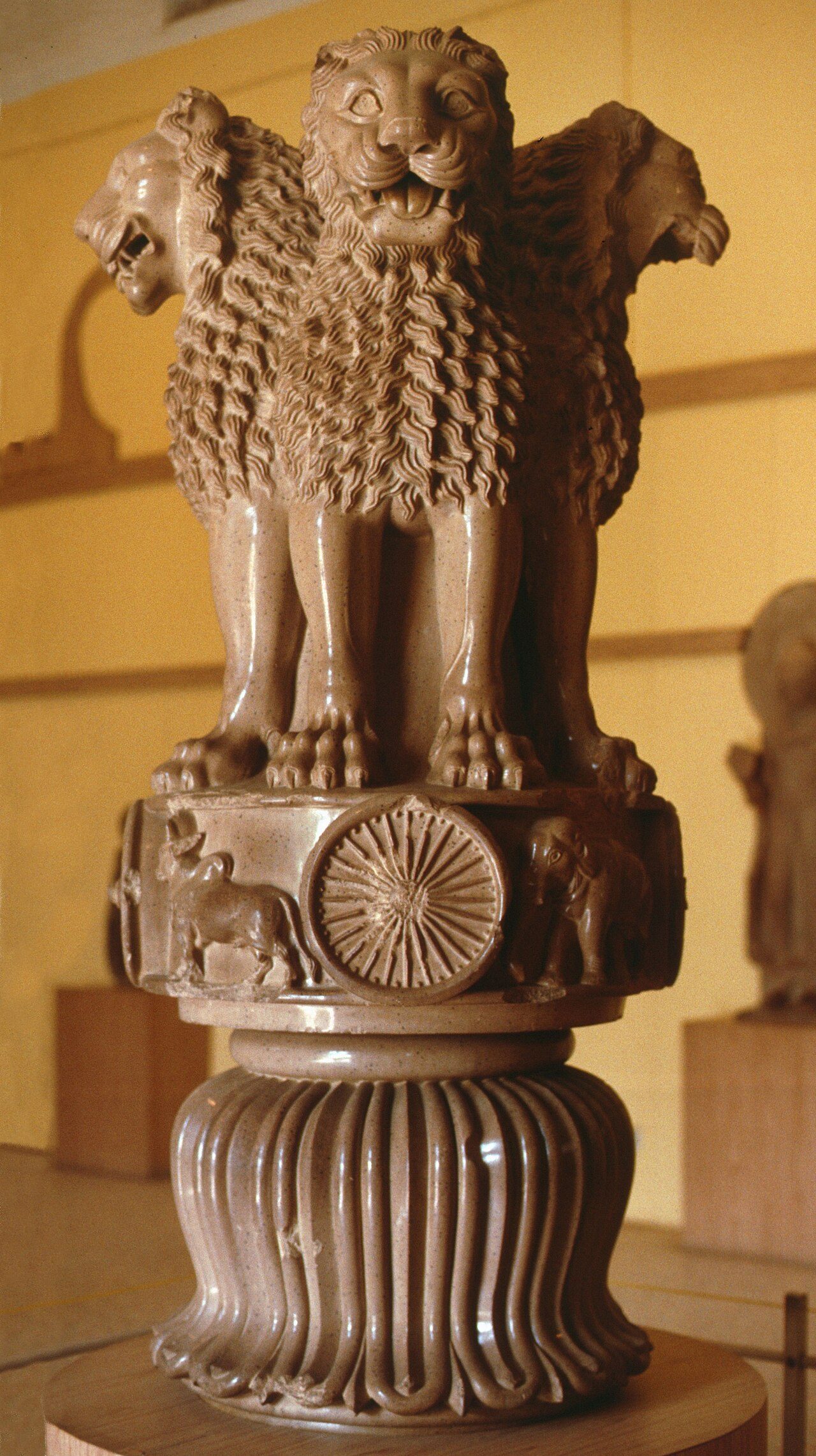
The Maurya Empire flourished from 322 BCE to 185 BCE. At its maximum extent, it controlled most of the subcontinent, an expansion that facilitated a profound artistic and cultural synthesis. Mauryan art incorporates both indigenous Indian ancient traditions, and distinct influences from ancient Persia and the Hellenistic world, as shown by the Pataliputra capital. Emperor Ashoka, who died in 232 BCE, adopted Buddhism about half-way through his 40-year reign, and patronized several large stupas at key sites from the life of the Buddha, although very little decoration from the Mauryan period survives, and there may not have been much in the first place. There is more from various early sites of Indian rock-cut architecture. The most famous survivals are the large animals surmounting several of the Pillars of Ashoka, which showed a confident and boldly mature style and craft and first of its kind iron casting without rust until date, which was in use by vedic people in rural areas of the country, though we have very few remains showing its development. The famous detached Lion Capital of Ashoka, with four animals, was adopted as the official Emblem of India after Indian independence. Mauryan sculpture and architecture is characterized by a very fine Mauryan polish given to the stone, which is rarely found in later periods. Many small popular terracotta figurines are recovered in archaeology, in a range of often vigorous if somewhat crude styles. Both animals and human figures, usually females presumed to be deities, are found. 1
Colossal Yaksha statuary (2nd century BCE)
Yakshas seem to have been the … 1
The text above is adapted from the Wikipedia article “Indian art”, available under the Creative Commons Attribution-ShareAlike 4.0 licence. 1
Indian art is art from Indian Subcontinent cultures, according to the structured record cited below. This entry was generated automatically from that record and has not yet been reviewed by a person familiar with the tradition. 2
The source record links this tradition to 22 external registers, which can be verified through the citation. 2