The tradition & historical record
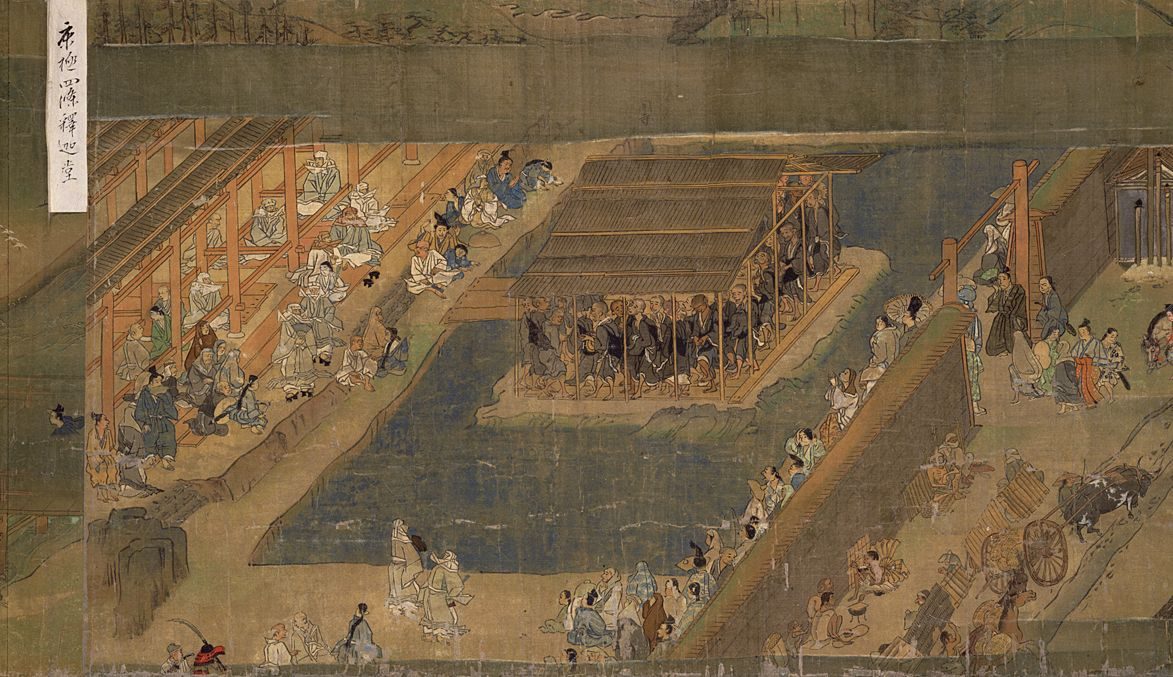
7 min read · 2 sourcesThe Ippen Shōnin Eden (一遍 上人 絵 伝; "Illustrated Biography of the itinerant monk Ippen") is a group of emakimono or emaki (painted narrative handscrolls) from the Kamakura period of Japanese history (1185–1333). A set of illuminated manuscripts, the group describes the life of Ippen (1234–1289), a Buddhist monk who founded the Ji-shū (時宗; "Time sect") branch of Pure Land Buddhism. Amongst the various emakimono bearing this title, the original version from 1299, named Ippen Hijiri-e (一遍 聖 絵; "Paintings from the life of the holy man Ippen"), is the best known and most famous. A second version, made in a more accessible style in the 14th century, and named Yugyō Shonin Engi-e (遊行上人縁起絵; "The Pictorial Origin Story of the Itinerant Saint"), also recounts the biography of the monk. As many copies of these two original emakimono were subsequently produced, the whole group is often referred to under the term Ippen Shōnin Eden. The Ippen Hijiri-e, the original version created by Shōkai (聖 戒) and painted by En'i, consists of twelve rolls of silk, a very expensive material, with alternating calligraphy texts and paintings. 1
Emakimono arts
Originating in Japan in the sixth or seventh century through trade with the Chinese Empire, emakimono art spread widely among the aristocracy in the Heian period. An emakimono consists of one or more long rolls of paper narrating a story through yamato-e texts and paintings. The reader discovers the story by progressively unrolling the scroll with one hand while rewinding it with the other hand, from right to left (according to the then horizontal writing direction of Japanese script), so that only a portion of text or image of about 60 cm (24 in) is visible. The narrative assumes a series of scenes, the rhythm, composition and transitions of which are entirely the artist's sensitivity and technique. The themes of the stories were very varied: illustrations of novels, historical chronicles, religious texts, biographies of famous people, humorous or fantastic anecdotes, etc. The Kamakura period (12th–14th century), which followed a period of unrest and civil war, was marked by the arrival in power of the warrior class (the samurai). This politically and socially unstable period provided fertile ground for Buddhism to proselytize, whether through the depiction of the sutras, or by illustrated accounts of the lives of illustrious monks. Under the impetus of the new warrior class in power and the new Buddhist sects, artistic production was very sustained and the themes and techniques were even more varied than before, signalling the "golden age" of emakimono (the 12th and 13th centuries). The Ippen Shōnin Eden fits into this context. Biographies of monks (kōsōden-e or eden) were very popular at the time of the Kamakura, that theme being favoured by the emergence of many Pure Land Buddhist schools. 1
Ippen and the Ji-shū school
The various versions and copies of the Ippen Shōnin Eden relate the life of Ippen (1234–1289), a Buddhist monk who, in 1274, founded the Ji-shū school, one of the branches of Pure Land Buddhism that supplanted the ancient esoteric and elitist Japanese schools of the Kamakura period. Following the Pure Land principles, Ippen taught that the Amida Buddha (Amitābha) welcomes into his paradise anyone who has faith in him; he initiates the faithful to the daily recitation of the name of the Amida Buddha (nenbutsu) and the rituals of ecstatic dances and songs (odori nenbutsu), a simple religious practice accessible to all, even the poor and the uneducated. According to the accounts of the time, this doctrine would have been revealed to Ippen by a manifestation of the Buddha; Ippen then devoted his life to travelling throughout Japan, especially rural areas, to carry the message. 1
Born in 1239, Ippen was the second son of a family of the Kōno samurai clan in Iyo Province. He entered religious orders at the age of fifteen and studied the teachings of Pure Land Buddhism (known in Japan as Jōdo) in Dazaifu with Shōtatsu (聖達), himself a disciple of Shōkū (証空), before devoting himself to hermit meditation in the mountains. In the summer of 1274, Ippen retired to the Kumano shrine, a sacred place of the Shinto religion. According to legend, he there received a revelation (gongen) that invited him to spread throughout the country the faith of Amida: ie any man can access the Pure Land (ōjō) of the Buddha Amida through the nenbutsu, that is to say the recitation invoking his name. From then onwards, Ippen travelled to temples and shrines in Japan to spread this doctrine. 1
The two versions of the emakimono
The emakimono narrating the life of Ippen and collectively known as Ippen Shōnin Eden are divided into two lineages: those from the version known as Shōkai (聖 戒) (disciple and younger brother or nephew of Ippen), made in 1299, and those from the version referred to as Sōshun (宗 俊) (pupil of Taa (他阿), himself a disciple of Ippen), completed between 1304 and 1307, and now lost. The oldest and most famous of the Shōkai versions is known as Ippen Hijiri-e (一遍 聖 絵) and of the Sōshun versions is called Yugyō Shōnin Engi-e (遊行上人縁起絵) or Ippen Shōnin Ekotoba den (一遍上人絵詞伝). Various direct or indirect copies of the Shōkai and Sōshun versions exist, such as the Shinkō-ji copy (1323), rather burlesque in the vein of the otogi-zōshi movement, the Miei-dō copy (second half of the 14th or early 15th century), close to the original of 1299, and the Kōmyō-ji copy (in Yamagata, made in 1594 by Kanō Eitoku), aiming at the extraordinary. The exhaustive list of temples or institutions with a copy today (excluding private collections and fragments) is: 1
in line with the Shōkai version at Kankikō-ji (Kyoto): the Shinzenkō-ji copy (Kyoto, the so-called Miei-dō-bon, now stored in the Sonkyōkaku bunko library and in the Kitamura family collection), the Daigan-ji copy (Niigata) and the Fujita Art Museum copy (Osaka); in line with the Sōshun version at Shōjōkō-ji (Fujisawa; the original version has been lost, but the temple itself has a copy): the Konren-ji copies (Kyoto, two copies), and the copies known as Shinkō-ji (Kobe), Kōmyō-ji (Yamagata), Senshō-ji (Niigata), Raigō-ji (Niigata), Konkō-ji (Kyoto), Jōshō-ji (Onomichi) and Kondai-ji (Nagano); according to H. 1
Description
The very first version, known as that of Shōkai (disciple and close to Ippen during his lifetime), was completed in 1299, ten years after the monk's death, and remains the best known and most studied by historians and specialists in art history: with it, the art of the emakimono reaches "one of its peaks". The work consists of twelve scrolls 0.38 m (1 ft 3 in) high and 9.22 m × 10.90 m (30.2 ft × 35.8 ft) long, which have the distinction of being in silk (probably to mark the importance of the monk) and not in paper as is most common. 1
Themes
The texts of the Shōkai version narrate the key episodes of Ippen's life in three broad periods: his initiation and his studies of Buddhism until the revelation of 1274 in Kumano, the creation of the congregation that would become the Ji-shū school, and the end of his… 1
The text above is adapted from the Wikipedia article “Ippen Shōnin Eden”, available under the Creative Commons Attribution-ShareAlike 4.0 licence. 1
Ippen Shōnin Eden is Japanese narrative pictures scrolls about the life of the priest Ippen, according to the structured record cited below. This entry was generated automatically from that record and has not yet been reviewed by a person familiar with the tradition. 2
The source record links this tradition to 2 external registers, which can be verified through the citation. 2