The tradition & historical record
5 min read · 2 sourcesThe Irish bouzouki (Irish: búsúcaí) is an adaptation of the Greek bouzouki (Greek: μπουζούκι). The newer Greek tetrachordo bouzouki (4 courses of strings) was introduced into Irish traditional music in the mid-1960s by Johnny Moynihan of the folk group Sweeney's Men, who retuned it from its traditional Greek tuning C3F3A3D4 to G2D3A3D4, a tuning he had pioneered previously on the mandolin. Alec Finn, first in the Cana Band and subsequently in De Dannan, introduced the first Greek trichordo (3 course) bouzouki into Irish music. In the early 1970s, Andy Irvine, who was a member of Sweeney's Men with Johnny Moynihan, gave a Greek tetrachordo bouzouki to Dónal Lunny, who replaced the octave strings on the two lower G and D courses with unison strings, thus reinforcing their lower frequencies. Soon after, on a visit with Irvine to the workshop of luthier Peter Abnett, Lunny commissioned a four-course bouzouki with a three-piece, partially staved back. This was the first bouzouki built specifically for Irish music. Since then, the instrument has been adapted by many instrument builders for Irish traditional and other styles of folk music. 1
Present role in Irish music
With a few exceptions, instrumentalists playing the bouzouki in Irish music tend to use it less for virtuoso melodic work, and more for the chordal or contrapuntal accompaniment, the melodies being played on other instruments, such as the flute or fiddle. A few individuals though, have pioneered the bouzouki's application for melodic work, including such players as Pat Kilbride, Brian McNeill, Jamie McMenemy, Gerald Trimble, Roger Landes, Ross McNerney and others. 1
Development
The original Greek bouzouki is a three course / six-string instrument (trichordo) tuned D3−A3−D4 (with an octave pair on the lower course). In the 1950s, a four course / eight-string (tetrachordo) version was developed in Greece, tuned C3−F3−A3−D4 (with octave pairs on the C and F courses) and popularized by Manolis Hiotis. The modern tetrachordo bouzouki was noticed by Irish musicians, who adopted and adapted it for accompaniment in Irish folk music, from whence it has diffused into other folk genres. 1
Transport from Greece to Ireland
Johnny Moynihan is credited with bringing the first tetrachordo Greek bouzouki to Ireland and retuning it to G2−D3−A3−D4 (intervals he had first used on the mandolin). However, according to Leagues O'Toole, Moynihan bought his first bouzouki from his friend Tony Ffrench, who had brought it back to Ireland from Greece, but decided he couldn't play it, or didn't want to. In the mid-1960s, Moynihan established a presence for the instrument in Irish music with the popular folk trio Sweeney's Men. During the recording of their 1968 eponymous album, Sweeney's Men, Andy Irvine also played Moynihan's bouzouki on the track "Johnston". 1
Shortly after he returned from Eastern Europe in late 1969, Irvine met Dónal Lunny – who had been playing guitar up to that point – and gave him a Greek bouzouki he had brought back from his travels. Being left-handed, Lunny reversed the strings and, crucially, replaced the octave strings on the two lowest courses with unison strings, thus fundamentally changing the character of the instrument. Approximately a year later, Lunny accompanied Irvine to Peter Abnett's workshop and commissioned a partially staved-back instrument with similar specifications, marking the first Irish bouzouki to be specially made. This modified bouzouki was first integrated into Irish folk music when Irvine and Lunny popularized it with the advent of Planxty in 1972. Irvine, however, credits Moynihan with having "brought the bouzouki to Ireland" in his lyric to "O'Donoghue's", his memoir of his experience of the early folk revival days in Dublin in the early '60s. 1
Irish-made bouzoukis
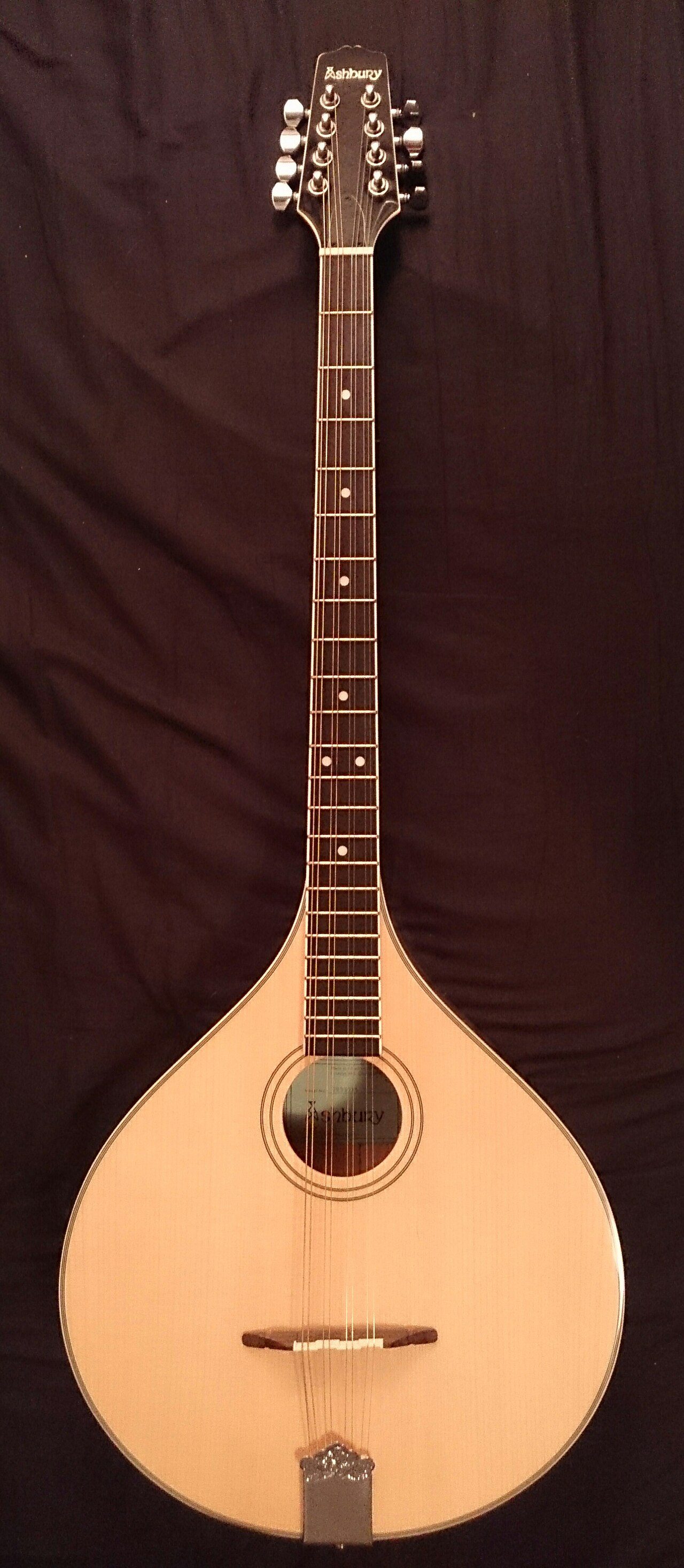
Almost immediately after the Greek bouzouki's initial introduction, new designs built specifically for Irish traditional music were developed. English builder Peter Abnett, – who was the first instrument-maker to build a uniquely "Irish" bouzouki, for Dónal Lunny in 1972 – developed a hybrid design with a 3-piece, partially staved back, and straight sides. Eventually other builders chose to use a flat back with straight sides which is the current prevailing design amongst most current builders. The scale length of the Irish bouzouki most often ranges from 24 to 25 inches (60 to 65 cm). Some instruments have scales as long as 26 or even 27 inches (66 to 68 cm). 1
Diffusion into other folk music
The Irish bouzouki has also become integrated into some other western European musical traditions over the past forty years. It is now popularly used in the music of England, Scotland, Canada, the United States, Asturias, Galicia, Brittany, and even the Scandinavian countries. Instrumental arrangements by musicians such as Ale Möller from Sweden, Jamie McMenemy of the Breton group Kornog, Elias Garcia of the Asturian groups Tuenda and Llan de Cubel, and Ruben Bada of the Asturian group DRD, typify the complex admixture of melody and chordal accompaniment to be found amongst skilled continental players. It has also become fashionable for some of these musicians to mix instrumental pieces from the Balkans into their material, creating the novelty of western European instruments playing music typically played by Bulgarian / Macedonian tamburas or Greek bouzoukis in their native setting. 1
The text above is adapted from the Wikipedia article “Irish bouzouki”, available under the Creative Commons Attribution-ShareAlike 4.0 licence. 1
Irish bouzouki is adaptation of the Greek bouzouki, according to the structured record cited below. This entry was generated automatically from that record and has not yet been reviewed by a person familiar with the tradition. 2
The source record links this tradition to 4 external registers, which can be verified through the citation. 2