The tradition & historical record
7 min read · 2 sourcesThe Isabella Breviary (Ms. 18851) is a late 15th-century illuminated manuscript now in the British Library, London. Queen Isabella I of Castile was given the manuscript shortly before 1497 by her ambassador Francisco de Rojas to commemorate the double marriage of her children and the children of Emperor Maximilian of Austria and Duchess Mary of Burgundy. 1
Origin
The work known as the breviary of Isabella I of Castile is a Breviarium Romanum made in Flanders for a Castilian nobleman Francisco de Rojas near the end of the 15th century. It was a present for Isabel at the occasion of the marriage of her children with the children of Maximilian. 1
Francisco de Rojas y Escobar was a Castilian diplomat who carried out several important diplomatic missions for Ferdinand. He negotiated the marriage between Infante Juan, the Crown Prince, and Margaret of Austria and Philip the Handsome and Infanta Joanna of Castile. The negotiations were finalized in 1495. The marriage of Joanna and Philip took place on 20 October 1496 in Lier and that of Juan and Margaret on 3 April 1497 in Burgos. On folio 436 verso of the manuscript, the arms of the Catholic Monarchs and of both the Wedding couples are painted. 1
Description
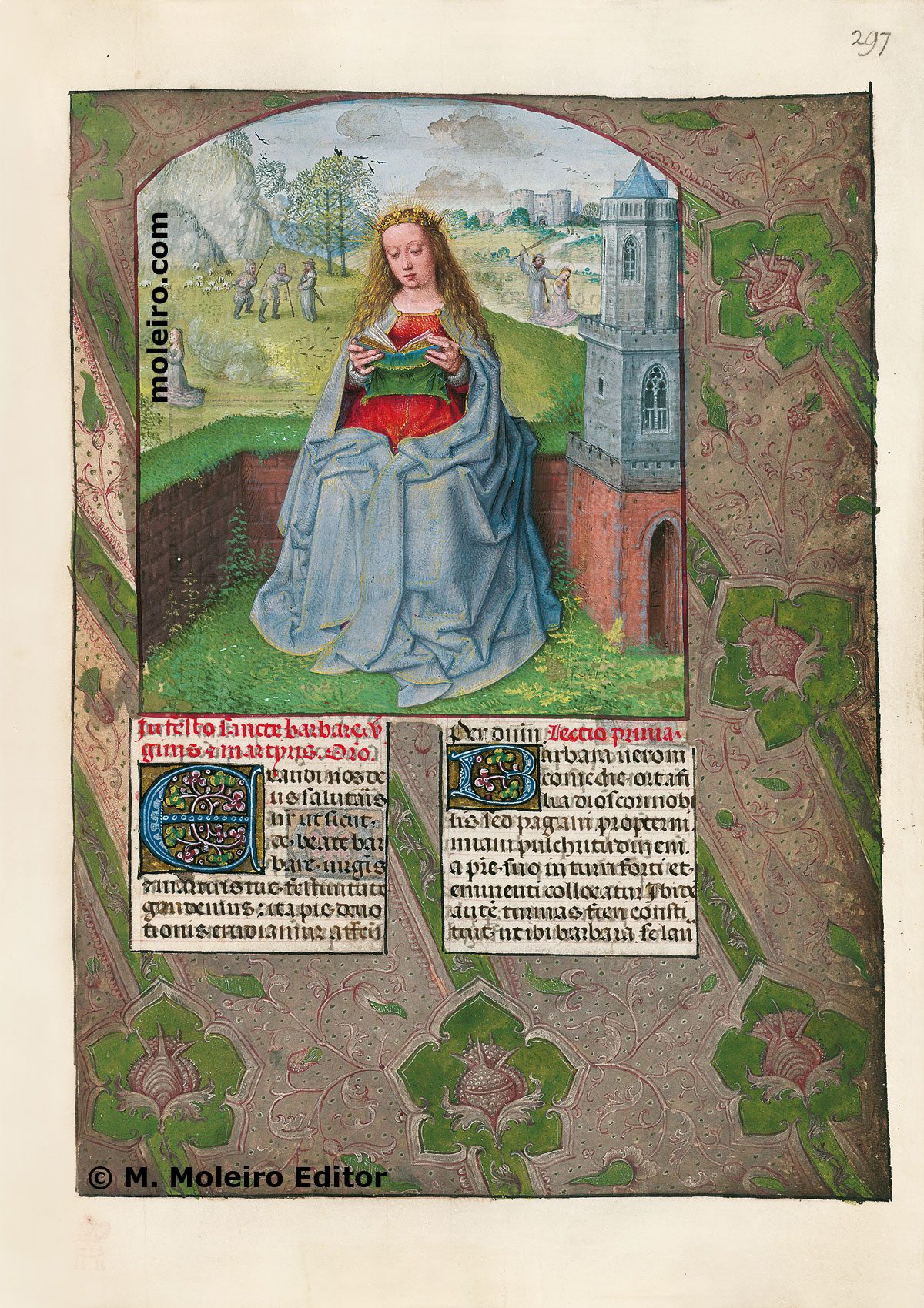
The manuscript is written in medieval Latin and was made according to the Dominican use. It contains 523 folios measuring 230 x 160 mm. and the ruled space is 135 x 95 mm. The text is written in a round gothic script (gotica rotunda) in two columns of 34 lines. Columns and lines are ruled with red ink, but the ruling is barely visible. The manuscript contains 170 miniatures and is one of the most lavishly decorated breviaries that were preserved. The miniatures are distributed as follows: 1
Calendar: 12 Proprium de tempore: 50 Psalter: 27 Proprium et commune Sanctorum: 81 One can find two types of miniatures in the codex, page wide and column wide ones. There are 44 page wide miniatures and most of them are 24 lines high. One has a height of 26 lines, two of them are 19 lines high and one is only 18 lines high. In addition there are 104 column wide paintings whose height varies between nine and nineteen lines. Furthermore, the manuscript has twelve calendar pages, one full-page miniature and a folio with coats of arms and mottos on banners. It also counts eight historiated initials one of which remained unfinished. The calendar is of the Flemish type; not all days are assigned to a saint or a typical office for a feast day, so many of the days of the month are left open. Starting from folio 402 the parchment is slightly different from that used before, but also the style of the handwriting, the initials and the illumination are different from the previous part of the book. And there are also differences in the lay-out, the responsories were smaller than the remainder of the text in the first part while this is no longer so from folio 402 on, with the exception of the quire that contains the folios 499-506. So scholars think that the manuscript was made in two campaigns. 1
Breviaries for lay use
This breviary was not the only one in Isabella's collection; the queen owned at least twenty breviaries, according to the inventory reconstituted by Elisa Ruiz García. We can only guess why Isabella collected so many breviaries. While it was usual in those days that the noble ladies had a book of hours for their personal devotion, a breviary was a book for the clergy. It is quite possible that, since books of hours were in the possession of the "general public", and since the upper middle class possessed luxurious versions, the highest class strove to distinguish themselves with a more "professional" prayer book, namely a breviary. Its larger format further distinguished the Isabella Breviary by accommodating a completely different illumination program. Many breviaries were highly decorated and were a symbol of status but often they serve very few practical purposes as they were expensive, heavy and difficult to transport without damaging them. Therefore other small versions of a breviaries were used and they were commonly called Book of hours. Upon Isabel's death they auctioned many of her breviaries and books of hours. One of this examples published in Spanish by Philippe Pigouchet in 1498 was sold for 51 Maravedí in the auction (pp 551) and can be download here. The first breviaries for lay use were made for the French royal house. Their example was soon followed by the Dukes of Burgundy of the house of Valois-Burgundy and later on by the Spanish and Portuguese royal families. Some of the famous medieval breviaries: 1
Breviary of Philippe le Bel, ca. 1290-1295, BnF Latin 1023. Belleville-breviarium Paris 1323-1326, BnF, Ms. Lat. 1
History
It is not known who had the breviary after the death of Isabella, or even during her lifetime. If it had passed by descent it would have remained part of the Spanish royal collection. In his work of 1883 Waagen reports that it was taken by the French from the Escorial during the War of the Pyrenees in 1794. In 1815, the work was in the possession of John Dent, a British collector. In 1817 it was described by Thomas Frognall Dibdin. After the death of Dent in 1826, his collection was sold in 1827 at an auction held by Robert Harding Evans and in the catalogue four pages were devoted to the Breviary. In this catalogue that a faulty interpretation of the text of Francisco Rojas was given; it led to the story that the book was in honour of Isabella's support for the expedition of Christopher Columbus. The Breviary was sold for £378 to Philip Hurd, member of the Inner Temple. Five years later, after Hurd died, the codex was once again sold on an auction at Evans and acquired by John Soane, the architect, for the sum of £520 Soane sold the breviary to Sir John Tobin for £645; Tobin had bought the noted Bedford Hours at the auction by Evans where Soane bought the Isabella Breviary, and in 1833 he bought a book of hours of Joanna of Castile (add. 18852). While the manuscript was in the possession of Tobin, Frederic Madden and the German art historian Gustav Friedrich Waagen were given the opportunity to study the manuscript. Waagen was very impressed by the miniature of St. John at Patmos (f309r), attributed today to Gerard David. Upon Sir John's death in 1851 the collection went to his son, the Rev. John Tobin of Liscard Hall. He was approached by the bookseller William Boone who offered him £1900 for the complete collection (eight manuscripts) from his father. 1
Content
A breviary contains the public or canonical prayers, hymns, the Psalms, readings, and notations for everyday use, especially by bishops, priests, monks, and deacons in the Divine Office (i.e., at the canonical hours or Liturgy of the Hours.) The core of the breviaries as they were in use in medieval times was the Psalter with the 150 psalms attributed to King David. 1
The text above is adapted from the Wikipedia article “Isabella Breviary”, available under the Creative Commons Attribution-ShareAlike 4.0 licence. 1
Isabella Breviary is 15th-century illuminated manuscript, according to the structured record cited below. This entry was generated automatically from that record and has not yet been reviewed by a person familiar with the tradition. 2
The source record links this tradition to 2 external registers, which can be verified through the citation. 2