The tradition & historical record
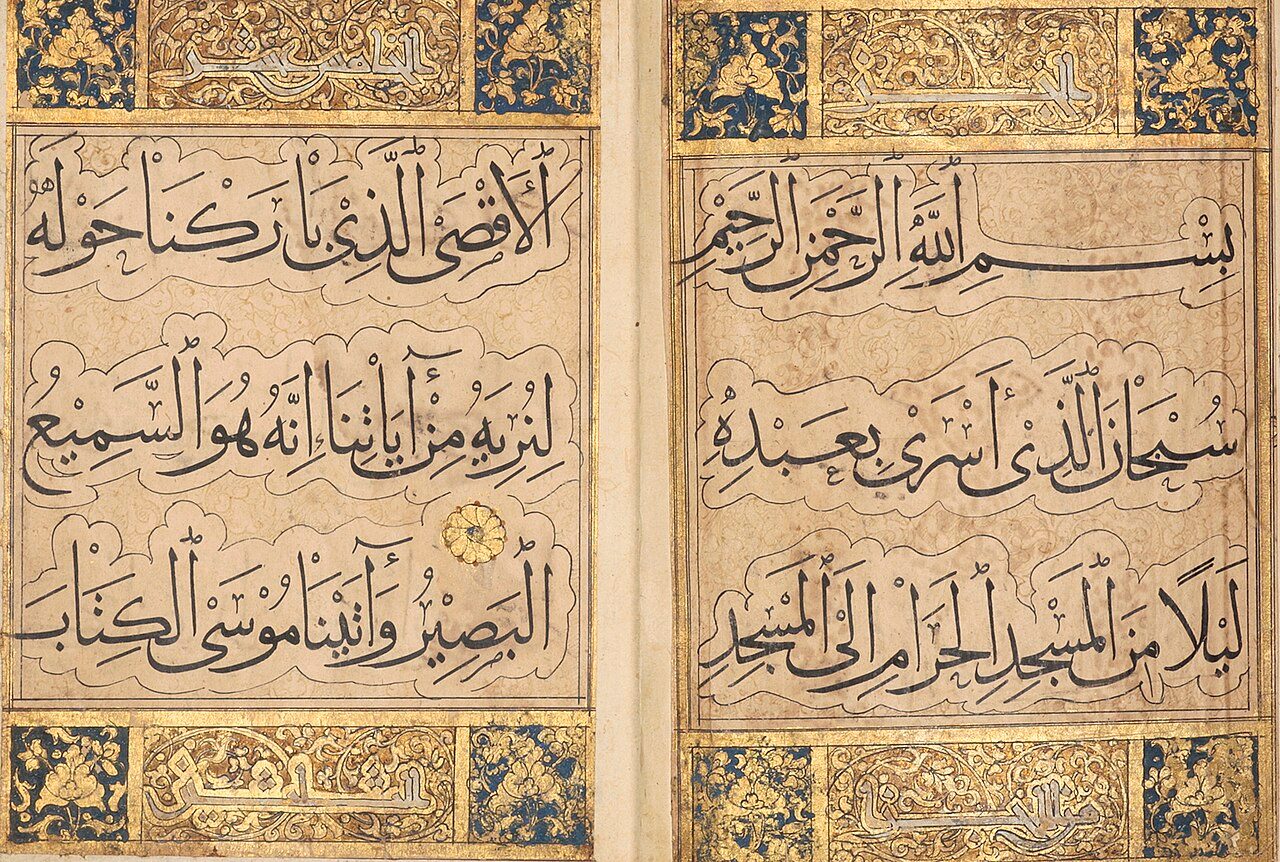
6 min read · 2 sourcesIslamic calligraphy is the artistic practice of penmanship and calligraphy, in the languages which use the Arabic alphabet or the alphabets derived from it. It is a highly stylized and structured form of handwriting that follows artistic conventions and is often used for Islamic religious texts, architecture, and decoration. It includes Arabic, Persian, Ottoman, and Urdu calligraphy. It is known in Arabic as khatt Arabi (خط عربي), literally meaning "line", "design", or "construction". The development of Islamic calligraphy is strongly tied to the Quran, as chapters and verses from the Quran are a common and almost universal text upon which Islamic calligraphy is based. Although artistic depictions of people and animals are not explicitly forbidden in the Quran, Islamic traditions have often limited figural representation in Islamic religious texts in order to avoid idolatry. Some scholars argue that Kufic script was developed by the late 7th century in Kufa, Iraq, from which it takes its name. This early style later evolved into several forms, including floral, foliated, plaited or interlaced, bordered, and square Kufic. In the ancient world, though, artists sometimes circumvented aniconic prohibitions by creating intricate calligraphic compositions that formed shapes and figures using tiny script. Calligraphy was a valued art form, and was regarded as both an aesthetic and moral pursuit. 1
Instruments and media
The traditional instrument of the Islamic calligrapher is the qalam, a pen normally made of dried reed or bamboo. The ink is often in colour and chosen so that its intensity can vary greatly, creating dynamism and movement in the letter forms. Some styles are often written using a metallic-tip pen. 1
Islamic calligraphy can be applied to a wide range of decorative mediums other than paper, such as tiles, vessels, carpets, and stone. Before the advent of paper, papyrus and parchment were used for writing. During the 9th century, an influx of paper from China revolutionized calligraphy. Libraries in the Muslim world regularly contained hundreds and even thousands of books. For centuries, the art of writing has fulfilled a central iconographic function in Islamic art. Although the academic tradition of Islamic calligraphy began in Baghdad, the centre of the Islamic empire during much of its early history, it eventually spread as far as India and Spain. Coins were another support for calligraphy. Beginning in 692, the Islamic caliphate reformed the coinage of the Near East by replacing Byzantine Christian imagery with Islamic phrases inscribed in Arabic. This was especially true for dinars, or gold coins of high value. Generally, the coins were inscribed with quotes from the Quran. By the tenth century, the Persians, who had converted to Islam, began weaving inscriptions onto elaborately patterned silks. So precious were textiles featuring Arabic text that Crusaders brought them to Europe as prized possessions. A notable example is the Suaire de Saint-Josse, used to wrap the bones of St. Josse in the Abbey of St. 1
Kufic
The Kufic style emphasizes rigid and angular strokes, it developed alongside the Naskh script in the 7th century. Although some scholars dispute this, Kufic script was supposedly developed around the end of the 7th century in Kufa, Iraq, from which it takes its name. The style later developed into several varieties, including floral, foliated, plaited or interlaced, bordered, and square kufic. Due to its straight and orderly style of lettering, Kufic was frequently used in ornamental stone carving as well as on coins. It was the main script used to copy the Quran from the 8th to 10th century and went out of general use in the 12th century when the flowing naskh style became more practical. However, it continued to be used as a decorative element to contrast superseding styles. There was no set rules of using the Kufic script; the only common feature is the angular, linear shapes of the characters. Due to the lack of standardization of early Kufic, the script differs widely between regions, ranging from very square and rigid forms to flowery and decorative ones. Common varieties include square Kufic, a technique known as banna'i. Contemporary calligraphy using this style is also popular in modern decorations. Decorative Kufic inscriptions are often imitated into pseudo-Kufics in medieval and Renaissance Europe. Pseudo-Kufics is especially common in Renaissance depictions of people from the Holy Land. The exact reason for the incorporation of pseudo-Kufic is unclear. It seems that Westerners mistakenly associated 13th–14th century Middle Eastern scripts with systems of writing used during the time of Jesus, and thus found it natural to represent early Christians in association with them. 1
Naskh
The use of cursive scripts coexisted with Kufic, and historically cursive was commonly used for informal purposes. Naskh first appeared within the first century of the Islamic calendar. Naskh translates to "copying", as it became the standard for transcribing books and manuscripts. The script is the most ubiquitous among other styles, used in the Quran, official decrees, and private correspondence. It became the basis of modern Arabic print. Kufic is commonly believed to predate naskh, but historians have traced the two scripts as coexisting long before their codification by ibn Muqla, as the two served different purposes. Kufi was used primarily in decoration, while Naskh served for everyday scribal use. 1
Thuluth
Thuluth was developed during the 15th century and slowly refined by Ottoman calligraphers including Mustafa Râkim, Shaykh Hamdallah, and others, till it became what it is today. Letters in this script have long vertical lines with broad spacing. The name, meaning "one third", may possibly be a reference to the x-height, which is one-third of the 'alif, or to the fact that the pen used to write the vowels and ornaments is one third the width of that used in writing the letters. 1
Reqāʿ
Reqāʿ is a handwriting style similar to thuluth. It first appeared in the 10th century. The shape is simple with short strokes and small flourishes. Yaqut al-Musta'simi was one of the calligraphers who employed this style. The Arab, Ibn al-Bawwab is actually believed to have created this script. 1
The text above is adapted from the Wikipedia article “Islamic calligraphy”, available under the Creative Commons Attribution-ShareAlike 4.0 licence. 1
Islamic calligraphy is artistic practice of calligraphy in the Islamic world, according to the structured record cited below. This entry was generated automatically from that record and has not yet been reviewed by a person familiar with the tradition. 2
The source record links this tradition to 7 external registers, which can be verified through the citation. 2