The tradition & historical record
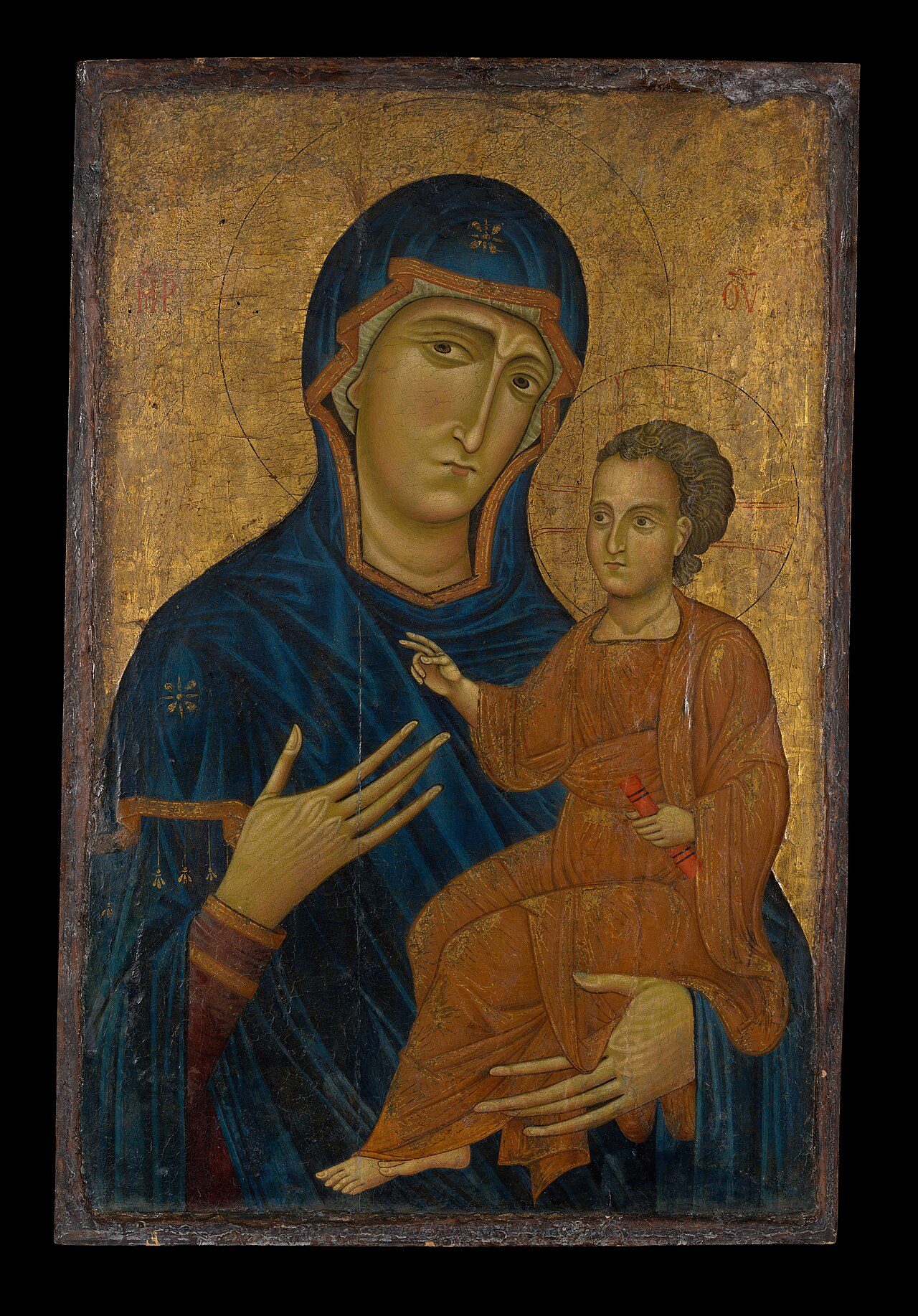
6 min read · 2 sourcesItalo-Byzantine is a style term in art history, mostly used for medieval paintings produced in Italy under heavy influence from Byzantine art. It initially covers religious paintings copying or imitating the standard Byzantine icon types, but painted by artists without a training in Byzantine techniques. These are versions of Byzantine icons, most of the Madonna and Child, but also of other subjects; essentially they introduced the relatively small portable painting with a frame to Western Europe. Very often they are on a gold ground. It was the dominant style in Italian painting until the end of the 13th century, when Cimabue and Giotto began to take Italian, or at least Florentine, painting into new territory. But the style continued until the 15th century and beyond in some areas and contexts. Maniera greca ("Greek style/manner") was the Italian term used at the time, and by Vasari and others; it is one of the first post-classical European terms for style in art. Vasari was no admirer, defining the Renaissance as a rejection of "that clumsy Greek style" ("quella greca goffa maniera"); other Renaissance writers were similarly critical. This also covered actual Byzantine icons in Italy; by the Renaissance these were imported on a large scale from Crete, then a Venetian possession. 1
Terms and scope
The term "Italo-Byzantine" is used for sculpture much less often, as the Byzantines did not provide large models to follow for that. It may be used of ivories, mosaics and the like. In architecture it is the almost inevitable term used for San Marco, Venice, and a few other very old buildings in Venice (the Fondaco dei Turchi for example) and on the small islands of Torcello (Torcello Cathedral) and Murano in the lagoon, but is not often used for other buildings (until 19th-century revivals such as Westminster Cathedral and Bristol Byzantine). Even the rest of Venetian Gothic architecture does not owe much to Byzantium. The people of the parts of southern Italy and Sicily ruled by the Byzantines during the High Middle Ages often continued to speak Greek until about the 16th century and had Greek Orthodox religious habits. They and things relating to them may be called Italo-Byzantine, or alternatively "Italo-Greek" or "Italo-Albanian". The Eastern Catholic Italo-Byzantine or Italo-Albanian Catholic Church was set up to enable them to keep Orthodox traditions within the Catholic Church; it now has some 70,000 members, not all in Italy. Variants of maniera greca in contemporary sources such as inventories included alla greca, more greco, grechescha and pittura greca, as well as ones using "Cretan" or "Candia", the Venetian name for Heraklion, then as now the main city on Crete. These included quadro a la candiota and quadro candiota piccolo ("a small Candia picture"); they are probably best regarded as a characterization by style rather than a record of the place of origin. 1
Baroque sculpture
Maniera greca had a different meaning from the 17th century, when it described a trend in Baroque sculpture especially associated with Francois Duquesnoy, a Flemish sculptor working in Rome and his pupils such as Rombaut Pauwels. Duquesnoy's Saint Susanna (1633) in Santa Maria di Loreto, Rome is an example. At the time even artists in Rome were able to see very little actual ancient Greek sculpture, and their idea of "Greekness" is rather subtle and hard to reconstruct today; to a large degree it relates to Hellenistic sculpture rather than that of earlier periods, and gives a more restrained and less dramatic style of Baroque than that of, say, Bernini. 1
History
The Italo-Byzantine icon style is usually said to have become common after the Sack of Constantinople in 1204 by the Fourth Crusade. The booty brought back to Europe included many icons, which probably stimulated demand for more, and provided models for local artists. The portable panel painting was not a usual form in the West before this, though a few Byzantine examples had arrived, and were often highly revered, and a few had been locally produced, like the possibly 7th-century Madonna della Clemenza. The 13th century also saw a great increase in devotions to the Virgin Mary, led by the Franciscan Order, founded five years after the sack. At this point most examples were probably made for churches, or for great households; these tended to be left to churches later. The reasons and forces that led to the development of altarpieces are not generally agreed upon. Placing decorated reliquaries of saints on or behind the altar, as well as the tradition of decorating the front of the altar with sculptures or textiles, preceded the first altarpieces. During the 13th century, liturgical changes (only reversed in the 20th century) placed the priest celebrating mass on the same side of the altar as the congregation, so with his back to them for much of the time. This encouraged the creation of altarpieces behind and above the altar were a visual devotional focus. Most larger Italo-Byzantine paintings were altarpieces, for which the elaborately framed polyptych or "composite altarpiece" form soon developed. These were especially common in Venice, where large mural schemes in fresco were rare; mosaic was greatly preferred, but too expensive for most churches. 1
Western panel-painting before about 1200
Italian painting up to about 1200 was used for illuminated manuscripts, frescos, and on wood, large painted crucifixes for rood crosses in churches, as well as assorted pieces of furniture and so on. The life-size crucifixes were not a Byzantine form, and were probably regarded in Italy as a cheaper version of the crosses with a sculpted corpus or body. Famous versions of the sculpted type include the Gero Cross (Cologne, 10th-century), the Holy Face of Lucca (originally 11th-century or earlier), and the 12th-century Catalan Batlló Majesty. The painted crucifixes typically included many smaller figures in sections at the four extremities of the cross, and built out to the sides below the horizontal arms, level with Christ's torso and legs, as in the cross in Sarzana Cathedral, dated 1138, the earliest dated Tuscan painting. Of the painted versions the San Damiano cross of about 1100 is one of few early survivals; perhaps it has only remained intact because Francis of Assisi had a revelation in front of it around 1206. There are more survivals from later in the century; some are not entirely flat, but have the face and halo protruding somewhat from the main plane, to help visibility from below. It was to make works such as these that Italian panel painters had presumably been trained, as well as combinations of frescos, the painting of sculpture in both wood and stone, and illuminating manuscripts. 1
Cretan paintings
Venetian Crete had a busy painting industry, with Cretan, Italian, and (especially after 1453) mainland Greek artists at work. 1
The text above is adapted from the Wikipedia article “Italo-Byzantine”, available under the Creative Commons Attribution-ShareAlike 4.0 licence. 1
Italo-Byzantine is style term in art history, according to the structured record cited below. This entry was generated automatically from that record and has not yet been reviewed by a person familiar with the tradition. 2
The source record links this tradition to 3 external registers, which can be verified through the citation. 2