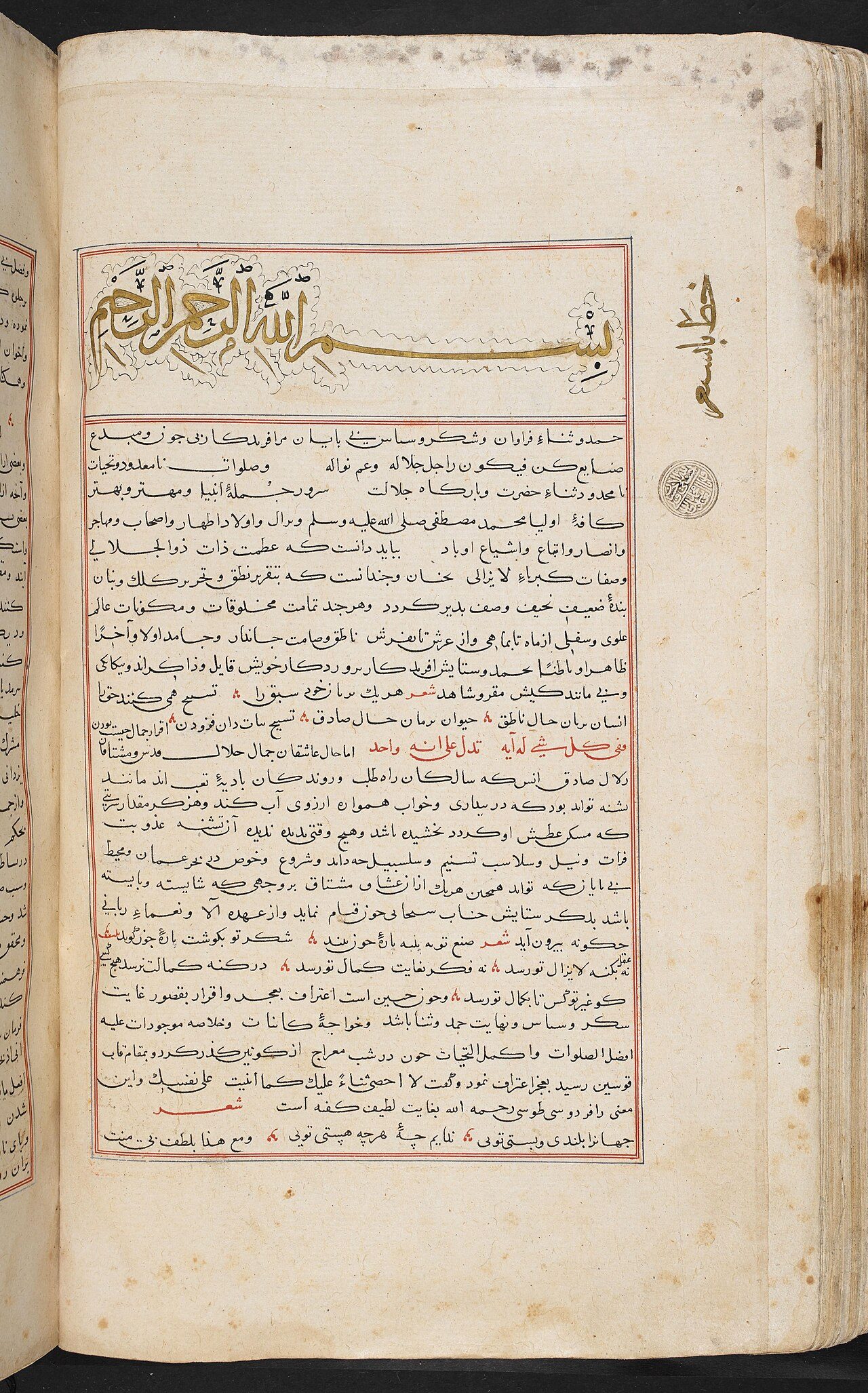
The tradition & historical record
6 min read · 2 sourcesJāmiʿ al-Tawārīkh (lit. 'The Compendium of Chronicles') is a work of literature and history, produced in the Mongol Ilkhanate. Written by Rashid al-Din Hamadani (1247–1318 AD) at the start of the 14th century, the breadth of coverage of the work has caused it to be called "the first world history". It was in three volumes and published in Arabic and Persian versions. The extant manuscripts represent "one of the most important surviving examples of Ilkhanid art in any medium", and are the largest surviving body of early examples of the Persian miniature. The work describes cultures and major events in world history from China to Europe, while spotlighting Mongol history with a view to securing the Mongol Empire's cultural legacy. The lavish illustrations and calligraphy required the efforts of hundreds of scribes and artists, with the intent that two new copies (one in Persian, and one in Arabic) would be created each year and distributed to schools and cities around the Ilkhanate, in the Middle East, Central Asia, Anatolia, and the Indian subcontinent. Approximately 20 illustrated copies were made of the work during Rashid al-Din's lifetime, but only parts have survived, covering roughly 400 pages of the original work. The oldest known copy is an Arabic version, of which half has been lost, but one set of pages is currently in the Khalili Collection of Islamic Art (London, England), comprising 59 folios from the second volume of the work. 1
Contents
The Jāmiʿ al-Tawārīkh consists of four main sections of different lengths: 1
The Taʾrīkh-ī Ghazānī, the most extensive part, which includes: The Mongol and Turkic tribes: their history, genealogies and legends The history of the Mongols from Genghis Khan up to the death of Mahmud Ghazan (d. 1304). The second part includes: The history of the reign of Öljaitü up to 1310 (no known copy) The history of the non-Mongol peoples of Eurasia (a universal history from the time of Creation, following the organization of work of the Abbasid historian al-Tabari in his History of the Prophets and Kings, often referred to as at-Tabari's History, and to the historic Muslim history of Qazi Beiza'i in the Neẓām al-Tawārīkh: Adam and the patriarchs the kings of pre-Islamic Iran Muhammad and the Caliphs (Rashidun, Umayyad, Abbasid and Fatimid Caliphates) the Islamic dynasties of Persia (Ghaznavids, the shahs of Khwarezm, the Isma'ili state of Alamut) the Turkic peoples the History of China Jewish history Frangistan (i.e., Europe, primarily the Papal States and Holy Roman Empire) the Indians The Shu'ab-i panjganah ("Five genealogies, of the Arabs, Jews, Mongols, Franks, and Chinese"). This text exists in two copies of the manuscript in the library of the Topkapı Palace in Istanbul (ms 2937), but has only been published on microfilm. The Suwar al-aqalim, a geographical compendium. Unfortunately, it has not survived in any known manuscript. 1
Author
Rashid-al-Din Hamadani was born in 1247 at Hamadan, Iran into a Jewish family. The son of an apothecary, he studied medicine and joined the court of the Ilkhan emperor, Abaqa Khan, in that capacity. He converted to Islam around the age of thirty. He rapidly gained political importance, and in 1304 became the vizier of emperor and Muslim convert Ghazan. He retained his position until 1316, experiencing three successive reigns, but, convicted of having poisoned the second of these three Khans, Öljaitü, he was executed on July 13, 1318. Hamdani was responsible for setting up a stable social and economic system in Iran after the destruction of the Mongol invasions, and was an important artistic and architectural patron. He expanded the university at Rab'-e Rashidi, which attracted scholars and students from Egypt and Syria to China, and which published his many works. He was also a prolific author, though few of his works have survived: only a few theological writings and a correspondence which is probably apocryphal are known today in addition to the Jāmiʿ al-tawārīkh. His immense wealth made it said of him that he was the best paid author in Iran. 1
Description
The Jāmiʿ al-tawārīkh was one of the grandest projects of the Ilkhanate period, "not just a lavishly illustrated book, but a vehicle to justify Mongol hegemony over Iran". The text was initially commissioned by Il-Khan Ghazan, who was anxious for the Mongols to retain a memory of their nomadic roots, now that they had become settled and adopted Persian customs. Initially, the work was intended only to set out the history of the Mongols and their predecessors on the steppes, and took the name Taʾrīkh-ī Ghazānī, which makes up one part of the Jāmiʿ al-tawārīkh. To compile the History, Rashid al-Din set up an entire precinct at the university of Rab'-e Rashidi in the capital of Tabriz. It contained multiple buildings, including a mosque, hospital, library, and classrooms, employing over 300 workers. After the death of Ghazan in 1304, his successor Öljaitü asked Rashid al-Din to extend the work, and write a history of the whole of the known world. This text was finally completed in sometime between 1306 and 1311. After Rashid al-Din's execution in 1318, the Rab-i-Rashidi precinct was plundered, but the in-process copy that was being created at the time survived, probably somewhere in the city of Tabriz, possibly in the library of Rashid's son, Ghiyath al-Din. Later, Rashid's son became Vizier, in his own right, and expanded the restored university precinct of his father. Several of the Jāmiʿ's compositions were used as models for the later seminal illustrated version of the Shahnameh known as the Demotte Shahnameh. 1
In the 15th century, the Arabic copy was in Herat, perhaps claimed after a victory by the Timurid dynasty. It then passed to the court of the Mughal Empire in India, where it was in the possession of the emperor Akbar (r. 1556–1605). 1
Illustrations
Much of the illustration for the various copies of the Jāmiʿ al-tawārīkh was done at the Rab-al Rashidi university complex, though they were also done elsewhere in the Mongol empire. The illustrations in this text are part of the artistic tradition of Persian miniatures and the medium of the numerous Jāmiʿ al-tawārīkh manuscripts vary slightly, with most of the miniatures being made using ink, watercolor, and occasionally silver. The images within, designed to correspond to its texts, depict historical and religious events, courtly scenes, and authority figures spanning nationalities and ethnicities. Because of Rashid al-Din's mandate for an Arabic and Persian version of the text to be produced every year there was an adopted standard style for the illustrations, giving characters Mongol countenance and dress, that made the differentiation between key figures difficult. Stylistic Influences Elements of the illustrations are influenced by Chinese painting techniques; most notably, the use of dark outlines and transparent washes, in contrast to the opaque watercolor style which would later become characteristic of Persian painting. 1
Questions about work
There is little reas… 1
The text above is adapted from the Wikipedia article “Jami' al-tawarikh”, available under the Creative Commons Attribution-ShareAlike 4.0 licence. 1
Jami' al-tawarikh is work of literature and history, produced in the Mongol Ilkhanate, according to the structured record cited below. This entry was generated automatically from that record and has not yet been reviewed by a person familiar with the tradition. 2
The source record links this tradition to 7 external registers, which can be verified through the citation. 2