The tradition & historical record
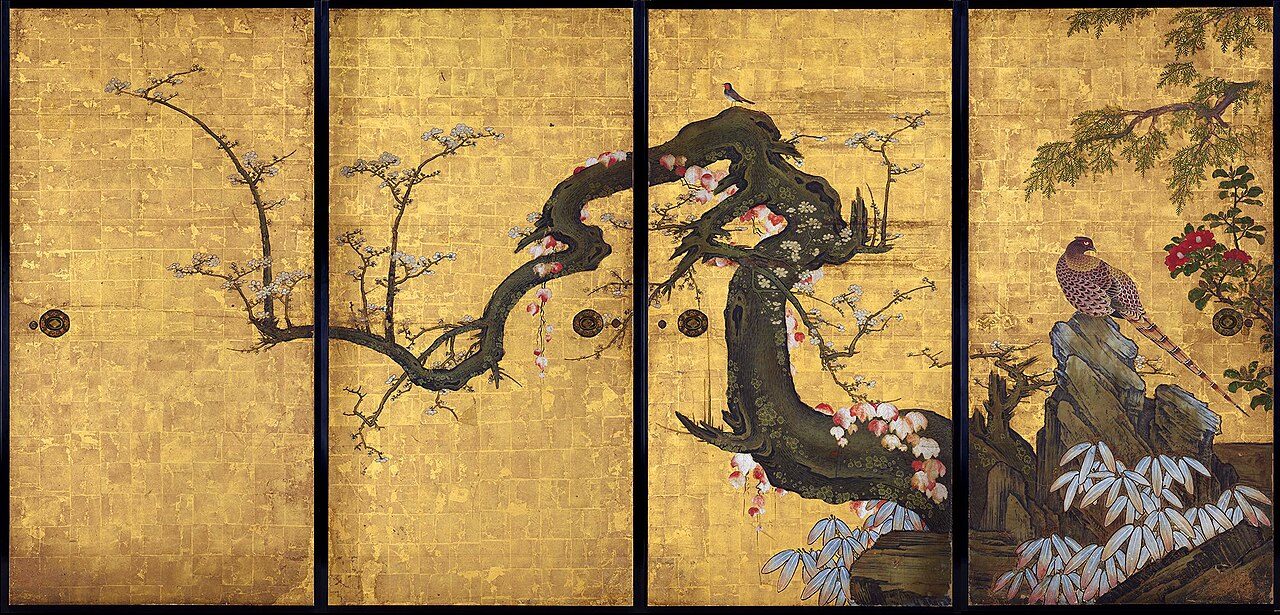
6 min read · 2 sourcesJapanese painting (絵画; kaiga; also gadō 画道) is one of the oldest and most highly refined of the Japanese visual arts, encompassing a wide variety of genres and styles. As with the history of Japanese arts in general, the long history of Japanese painting exhibits synthesis and competition between native Japanese aesthetics and the adaptation of imported ideas, mainly from Chinese painting, which was especially influential at a number of points; significant Western influence only comes from the 19th century onwards, beginning at the same time as Japanese art was influencing that of the West. Areas of subject matter where Chinese influence has been repeatedly significant include Buddhist religious painting, ink-wash painting of landscapes in the Chinese literati painting tradition, calligraphy of sinograms, and the painting of animals and plants, especially birds and flowers. However, distinctively Japanese traditions have developed in all these fields. The subject matter that is widely regarded as most characteristic of Japanese painting, and later printmaking, is the depiction of scenes from everyday life and narrative scenes that are often crowded with figures and detail. 1
Ancient Japan and Asuka period (until 710)
The origins of painting in Japan date well back into Japan's prehistoric period. Simple figural representations, as well as botanical, architectural, and geometric designs are found on Jōmon period pottery and Yayoi period (1000 BC – 300 AD) dōtaku bronze bells. Mural paintings with both geometric and figural designs have been found in numerous tumuli dating to the Kofun period and Asuka period (300–700 AD). Along with the introduction of the Chinese writing system (kanji), Chinese modes of governmental administration, and Buddhism in the Asuka period, many art works were imported into Japan from China and local copies in similar styles began to be produced. 1
Nara period (710–794)
With further establishment of Buddhism in 6th- and 7th-century Japan, religious painting flourished and was used to adorn numerous temples erected by the aristocracy. However, Nara-period Japan is recognized more for important contributions in the art of sculpture than painting. The earliest surviving paintings from this period include the murals on the interior walls of the Kondō (金堂) at the temple Hōryū-ji in Ikaruga, Nara Prefecture. These mural paintings, as well as painted images on the important Tamamushi Shrine include narratives such as jataka, episodes from the life of the historical Buddha, Shakyamuni, in addition to iconic images of buddhas, bodhisattvas, and various minor deities. The style is reminiscent of Chinese painting from the Sui dynasty or the late Sixteen Kingdoms period. However, by the mid-Nara period, paintings in the style of the Tang dynasty became very popular. These also include the wall murals in the Takamatsuzuka Tomb, dating from around 700 AD. This style evolved into the Kara-e genre, which remained popular through the early Heian period. As most of the paintings in the Nara period are religious in nature, the vast majority are by anonymous artists. A large collection of Nara period art, Japanese as well as from the Chinese Tang dynasty is preserved at the Shōsō-in, an 8th-century repository formerly owned by Tōdai-ji and currently administered by the Imperial Household Agency. 1
Heian period (794–1185)
With the development of the Esoteric Buddhist sects of Shingon and Tendai, painting of the 8th and 9th centuries is characterized by religious imagery, most notably painted mandala (曼荼羅, mandara). Numerous versions of mandala, most famously the Diamond Realm Mandala and Womb Realm Mandala at Tōji in Kyoto, were created as hanging scrolls, and also as murals on the walls of temples. A noted early example is at the five-story pagoda of Daigo-ji, a temple south of Kyoto. The Kose School was a family of court artists founded by Kanaoka Kose in the latter half of the 9th century, during the early Heian period. This school does not represent a single style of painting like other schools, but the various painting styles created by Kanaoka Kose and his descendants and pupils. This school changed Chinese style paintings with Chinese themes into Japanese style and played a major role in the formation of yamato-e painting style. With the rising importance of Pure Land sects of Japanese Buddhism in the 10th century, new image-types were developed to satisfy the devotional needs of these sects. These include raigōzu (来迎図), which depict Amida Buddha along with attendant bodhisattvas Kannon and Seishi arriving to welcome the souls of the faithful departed to Amida's Western Paradise. A noted early example dating from 1053 are painted on the interior of the Phoenix Hall of the Byōdō-in, a temple in Uji, Kyoto. 1
Kamakura period (1185–1333)
These genres continued on through Kamakura period Japan. This style of art was greatly exemplified in the painting titled Night Attack on the Sanjo Palace, a piece full of vibrant colors, details, and a great visualization from a novel titled the Heiji Monogatari. E-maki of various kinds continued to be produced; however, the Kamakura period was much more strongly characterized by the art of sculpture, rather than painting. "The Kamakura period extended from the end of the twelfth through the fourteenth century. It was a time of art works, such as paintings, but mainly sculptures that brought a more realistic visual of life and its aspects at the time. In each of these statues many life-like traits were incorporated into the production of making them. Many sculptures included noses, eyes, individual fingers, and other details that were new to the sculpture place in art." As most of the paintings in the Heian and Kamakura periods are religious in nature, the vast majority are by anonymous artists. One artist known for his perfection in this new Kamakura period art style was Unkei, and he eventually mastered this sculpturing art form and opened his own school called Kei School. As this era went on, "there were the revival of still earlier classical styles, the importation of new styles from the Continent and, in the second half of the period, the development of unique Eastern Japanese styles centering around the Kamakura era". 1
Muromachi period (1333–1573)
During the 14th century, the development of the great Zen monasteries in Kamakura and Kyoto had a major impact on the visual arts. Suibokuga, an austere monochrome style of ink painting introduced from the Ming dynasty China of the Song and Yuan ink wash styles, especially Muqi (牧谿), largely replaced the polychrome scroll paintings of the early zen art in Japan attached to Buddhist iconography norms from centuries earlier such as Takuma Eiga (宅磨栄賀). Despite the new Chinese cultural wave generated by the Higashiyama culture, some polychrome portraiture remained – primary in the form of chinso paintings of Zen monks. Catching a Catfish with a Gourd (located at Taizō-in, Myōshin-ji, Kyoto), by the priest-painter Josetsu, marks a turning point in Muromachi painting. 1
The text above is adapted from the Wikipedia article “Japanese painting”, available under the Creative Commons Attribution-ShareAlike 4.0 licence. 1
Japanese painting is art of painting in Japan, according to the structured record cited below. This entry was generated automatically from that record and has not yet been reviewed by a person familiar with the tradition. 2
The source record links this tradition to 16 external registers, which can be verified through the citation. 2