The tradition & historical record
3 min read · 2 sourcesJesus Hominum Salvator (Latin for Jesus, Savior of Humankind) is a tempera painting by Andreas Ritzos. Ritzos was one of the founders of the Cretan School of painting. His teacher was Angelos Akotantos. Andreas Ritzos was active from 1436 to 1492. He painted in the traditional Greek-Italian Byzantine style combined with Italian Renaissance Venetian painting. The technique later became known as the maniera greca. Sixty of his works survived. Symbols and abbreviations have been a fundamental part of the Christian religion. Both Greek and Italian artists developed a pictorial representation of theological subjects. The Christogram is one of the earliest symbols of the faith. Roman Emperor Constantine implemented the symbol Chi Rho as part of his military insignia. The Greek letters Chi Rho are the first two letters in the Greek spelling of Christ ΧΡΙΣΤΟΣ pronounced Christos. The vertical stroke of the rho intersects the center of the chi. Another important Christogram evolved during the Byzantine Empire. The name is derived from the first three letters of Jesus's name in Greek ΙΗΣΟΥΣ pronounced Iésous. The Latinized version of the letters IHS (Iesus Hominum Salvator) were extremely popular during Byzantine times. The Latin version means Jesus Savior of Humankind. Another version was In Hoc Signo (In this sign). 1
Description
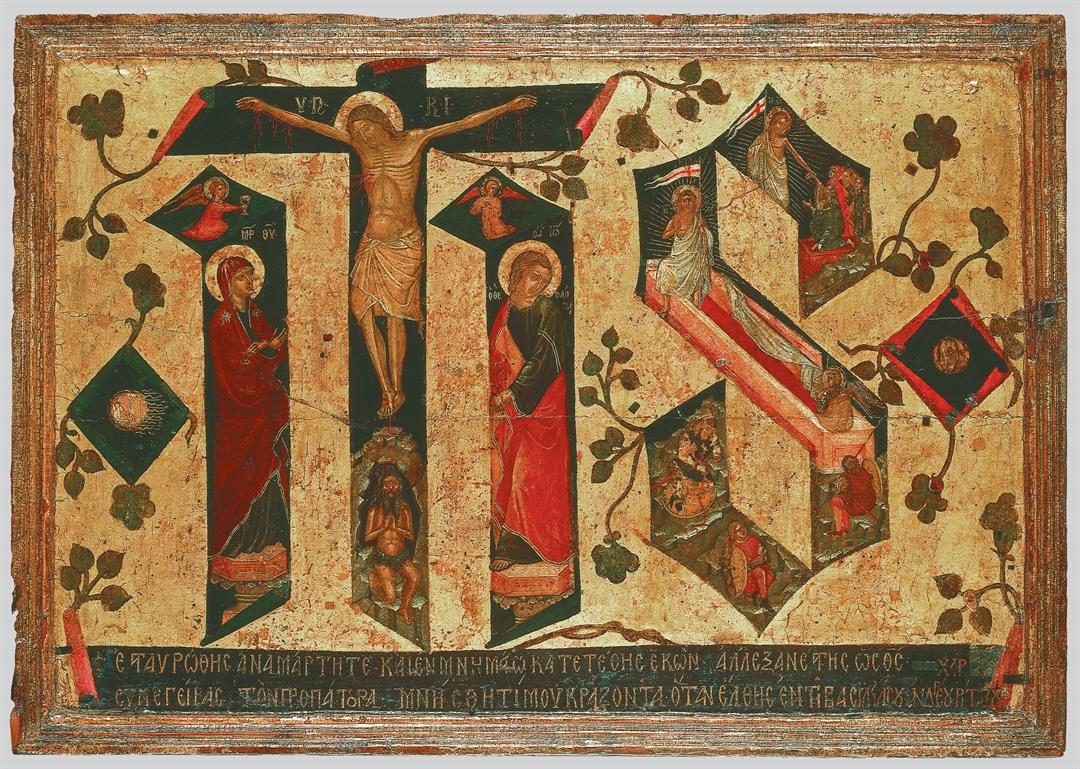
The materials used were egg tempera paint and gold leaf on a wood panel. The height of the painting is 44.5 cm (17.5 in) and the width is 63.5 cm (25 in). The work is dated between 1440 and 1492. The painting is unique because artists rarely used Christogram symbols in fine art paintings. To the left and right of the image two spheres appear within diamond-shaped symbols. The sphere to our left is the sun and on our right, the moon appears. Both planetary figures are painted in detail. The Christogram features the crucifixion in the letters I and H. The Virgin Mary appears within the letter I. She stands on a pedestal weeping the crucifixion. The garment of the celestial figure is painted in the traditional Byzantine style. Above the Virgin appears an angel with a cup. The angel is about to collect the blood seeping out of the wounded Christ figure. A similar angel appears in Pavias's Crucifixion collecting the blood of Christ. The part of the H with the body of Christ is folded on the top edges. The figure follows Italian-Greek Byzantine prototypes. Within the same letter of the Christogram below the crucified body appears the ancient biblical figure Adam. He stands outside of a cave. In the next portion of the letter H John the Evangelist appears in his traditional position as part of the crucifixion sequence. He stands on a similar pedestal as the Virgin Mary as he looks away. Within the final letter S of the Christogram, in the lower portion of the letter, three guards are dumbfounded at the heavenly escape of the resurrected figure. The guards hold shields the guard closest to the angel also holds a sphere while he sits on a rock. The artist elegantly creates a visual space within the letter. 1
The text above is adapted from the Wikipedia article “Jesus Hominum Salvator (Ritzos)”, available under the Creative Commons Attribution-ShareAlike 4.0 licence. 1
Jesus Hominum Salvator is painting by Andreas Ritzos, according to the structured record cited below. This entry was generated automatically from that record and has not yet been reviewed by a person familiar with the tradition. 2