The tradition & historical record
6 min read · 2 sourcesJewish art, or the art(s) of the Jewish people, encompasses a diverse range of creative endeavors and time periods, spanning from antiquity to the Modern period, culminating in the artistic movements of the Haskalah, and the visual arts of the Yishuv and modern Israel, as well as – throughout all periods of Jewish history – the diverse work of the Diaspora. Jewish art encompasses the visual plastic arts, sculpture, painting, and more, all influenced by Jewish culture, history, and religious beliefs. Jewish artistic expression traces back to the art of the ancient Israelites in the Land of Israel, where it originated and evolved during the Second Temple Period, influenced by various empires. This artistic tradition underwent further development during the Mishnaic and Talmudic eras, reflecting cultural and religious shifts within Jewish communities. With the dispersion of Jews across the globe, known as the Jewish diaspora, artistic production persisted throughout the millennia, adapting to diverse cultural landscapes while retaining distinct Jewish themes and motifs. Until the emancipation, Jewish art was mostly centered around religious practices and rituals. Following the emancipation in the early modern period, Jewish artists, notably in Europe began to explore different themes, with different levels of connection to religious art. Notably, Jews in France, some of whom from fleeing from Eastern Europe, produced at times modernist art of completely secular nature. 1
Pre-Second Temple period
Prior to the First Temple Period and throughout its duration, literary sources point to the existence of craftsmanship which could be considered both art in its restrictive sense and natively Jewish. This was largely related to matters of ritual, such as the decoration of the Tabernacle, and the Temple that replaced it. Within this context, a number of figurative characters were present, such as the cherubs of the Ark of the Covenant and of the Solomonic Holy of Holies, and the twelve bronze oxen which formed the base of the Molten Sea. Artifacts bearing plastic depictions, such as the plaques unearthed in King Ahab's "House of Ivory" in Samaria and Israelite seals found in many locations in the land of Israel, appear to be influenced by Phoenician, Assyrian or Egyptian styles. 1
Second Temple period and late antiquity
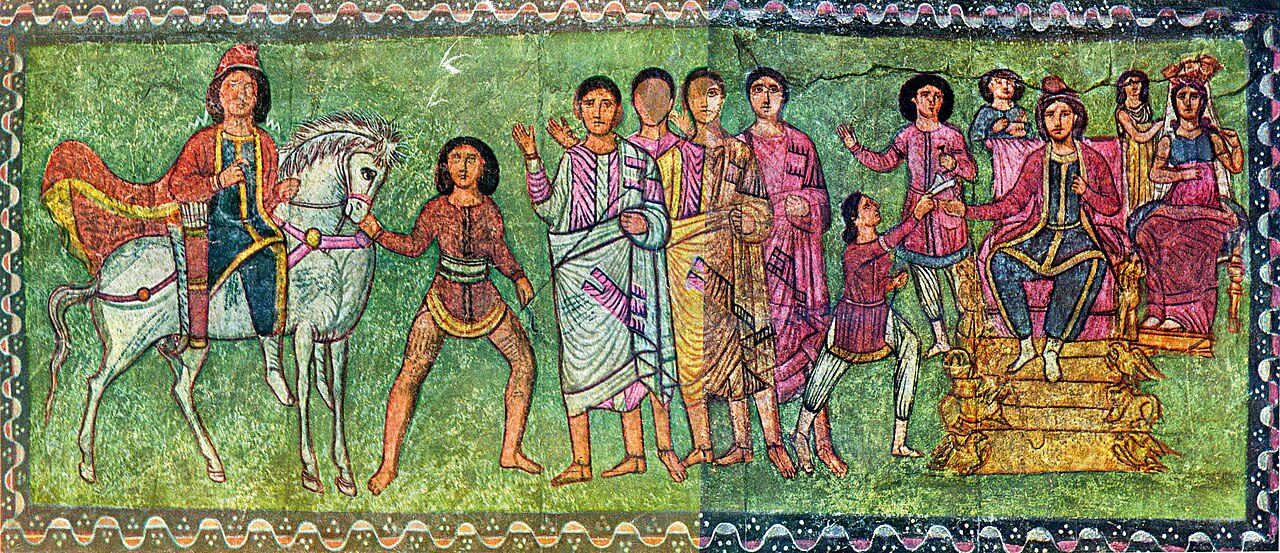
In the Second Temple period, Jewish art was heavily influenced by the Biblical injunction against graven images, leading to a focus on geometric, floral, and architectural motifs rather than figurative or symbolic representations. This artistic restraint was a response to the Hellenistic cultural pressures that threatened Jewish religious practices, notably the imposition of idolatry. Symbolic elements like the menorah and the shewbread table were sparingly used, primarily reflecting their significance in priestly duties. However, the rise of Christianity and its establishment as the dominant religion of the Roman Empire marked a turning point in Jewish artistic expression. This period, known as Late Antiquity, witnessed Jewish communities gradually incorporating symbolic motifs into their synagogal and funerary art. The expansion of these symbols beyond the menorah and the shewbread table to include other ritual objects and emblems signified a broader expression of Jewish identity. This shift in cultural representation aimed to affirm Jewish faith and community following the rise of Christian dominance in the Mediterranean region, making symbols like the menorah emblematic of national identity as well as religious faith. The menorah, initially a representation of priestly duties in the Second Temple, evolved into a central symbol of Jewish identity, especially after the Temple's destruction. Its depiction in Jewish art, ranging from synagogue mosaics to catacombs, signified not only the religious importance of the Temple but also served as a distinguishing marker of Jewish places of worship and burial. 1
Medieval Jewish art
During the medieval period (roughly the 5th to 15th centuries), Jewish communities continued to produce works of Jewish art, with most of the art centered around religious life, notably synagogues and religious texts. Jewish scholars and texts, including works by luminaries like Rashi and Maimonides, often featured illustrations, some of which were crafted by artists who also served Christian clients, with notable connections between Jewish and Christian artists. The Florentine artist Mariano del Buono and the Master of the Barbo Missal, known for their work for Christian patrons, also created significant Jewish pieces. Ritual objects such as Hanukkah lamps and kiddush cups, while prescribed by Jewish law, evolved in form and decoration over time, often mirroring the luxury items and aesthetic preferences of their Christian counterparts. This adaptability and integration are further evidenced in medieval synagogue architecture, which frequently borrowed elements from contemporary Christian buildings, as seen in the synagogues in Central Europe such as those in Regensburg and Prague, which incorporate Gothic styles and motifs. 1
Interplay with the Muslim world
From the time of the Muslim Conquests to the Renaissance in Europe, most Jews lived in the Muslim world. Jewish art made there reflected the characteristics of Islamic art. A 2024 exhibition at The Magnes Collection of Jewish Art and Life explored how the two cultures "shared graphic forms and visual landscapes, attitudes towards sacred texts and human bodies, and networks of trade and knowledge exchange." A 2025 exhibition at the Grolier Club of material from the Jewish Theological Seminary displayed manuscript pages from Jewish communities in Yemen, North Africa, Iran, and Iraq. Jewish art from the Islamic world, like Islamic art, featured "elaborate patterns, floral motifs and very few depictions of people." 1
Interplay with Christian Europe
Artifacts from this era reflected the cultural exchanges between Jews and Christians, often as a result of intense theological dialogue and mutual curiosity between the two faiths. Christian scholars' efforts to learn Hebrew, challenge Jewish beliefs, or the portrayal of Jews and Jewish practices in Christian art with remarkable accuracy, suggest according to the Met, an interaction that was both intellectual and artistic. Objects such as the bronze menorah in the Cathedral of Essen and the head of King David from Notre-Dame de Paris are pointed to as examples of such artworks. 1
The text above is adapted from the Wikipedia article “Jewish art”, available under the Creative Commons Attribution-ShareAlike 4.0 licence. 1
Jewish art is art of the Jewish people, according to the structured record cited below. This entry was generated automatically from that record and has not yet been reviewed by a person familiar with the tradition. 2
The source record links this tradition to 13 external registers, which can be verified through the citation. 2