The tradition & historical record
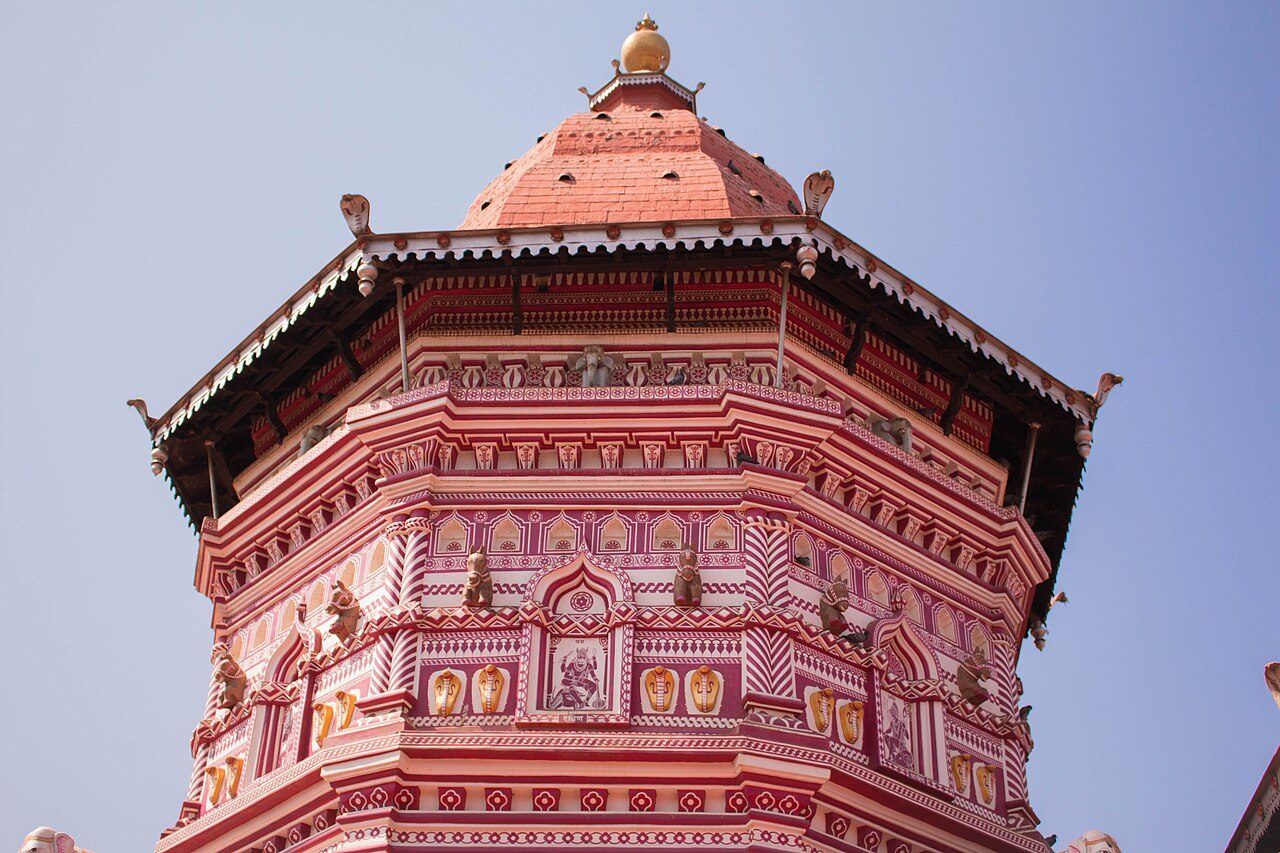
3 min read · 2 sourcesKaavi art is a traditional mural technique indigenous to the Konkan coast of India, especially in Goa, parts of coastal Maharashtra and Karnataka. It is distinguished by its use of a single reddish‑brown pigment, known locally as “kaav” (laterite red oxide), incised into a white lime‑plastered surface to create intricate motifs and murals in religious and secular buildings. Kaavi murals can also be seen in old houses, small shrines. 1
Etymology
The term kaav in Konkani refers to the maroon‑red pigment derived from locally available laterite soil, while kalé means “art form.” Together, Kaavi Kalé denote the art of red‑oxide incised work on lime‑plastered walls. 1
History
Kaavi art is believed to have originated around 400–600 years ago, possibly introduced by Saraswat communities migrating from the Saraswati plains to Goa. Its development was driven by the need for a durable decorative medium capable of withstanding the region’s high humidity and heavy monsoon rains, which made conventional painted murals prone to rapid deterioration. 1
Technique
On the wet walls on which Kaavi pictures are to be etched, a buttery smooth mixture of lime and uramunji is smeared with a steel trowel. To cover larger areas, a wooden float is also employed. After an hour, engraving work commences. A well-trained Kaavi art mason can etch a small mural without any aids. For geometrical designs he employs rulers and compasses. Large and complicated motifs are first drawn on paper, perforated with pinholes and then traced on the wall by dusting the pinholes with dry lime. Kanthas or the steel bodkins of different sizes and dimensions are used for etching. The ridges, platforms and niches are decorated with rows of spirals, spades, semi-circles and curves. The V-shaped parallel bands are used for twin pseudo-pillars. Artists first apply a white plaster made from shell‑lime, sand and jaggery to the architectural surface. Once this layer sets, a paste of finely ground laterite red oxide mixed with lime putty—known as the kaav layer—is spread to a butter‑like consistency and left to partially cure. While the kaav remains moist, designs are incised using steel bodkins (kanta), stencils, rulers and compasses, revealing the white plaster beneath and creating a striking two‑tone effect. The finished work is then cured by periodic misting and polishing with smooth river pebbles to enhance durability. 1
Motifs and distribution
Common motifs include floral medallions, geometric patterns (circles, semi‑circles, hexagons), mythological figures and deities, as well as scenes from daily life. Kaavi art decorates temple interiors and exteriors, church walls, mosques, Jain basadis, small shrines and affluent residences. Notable examples survive in Pernem, Sattari, Canacona, Ponda and Morjim in Goa, as well as in Honavar and Kumta in Karnataka. 1
Materials
The term Kaav (Devanagari:काव) in Konkani refers to Indian red pigment which is the only color used in this painting, is obtained from the laterite soil. Artistically drawn and well executed, reddish brown murals against white sandblasted backgrounds are the specialties of Kaavi art. Snow white lime, obtained by burning seashells, and washed sand from river beds were mixed with jaggery and allowed to ferment for two weeks. The mixture is then hand-pounded to obtain a homogeneous substance, which hardens when applied to the walls. 1
The text above is adapted from the Wikipedia article “Kaavi art”, available under the Creative Commons Attribution-ShareAlike 4.0 licence. 1
Kaavi art is art created by Konkani people in India, according to the structured record cited below. This entry was generated automatically from that record and has not yet been reviewed by a person familiar with the tradition. 2
The source record links this tradition to 1 external register, which can be verified through the citation. 2