The tradition & historical record
6 min read · 25 sourcesKabuki (歌舞伎; Japanese pronunciation: [ka.bɯ.kʲi]) is a classical form of Japanese theatre, mixing dramatic performance with traditional dance. Kabuki theatre is known for its heavily stylised performances, its glamorous, highly decorated costumes, and for the elaborate kumadori make-up worn by some of its performers. Kabuki is thought to have originated in the early Edo period, when the art's founder, Izumo no Okuni, formed a female dance troupe that performed dances and light sketches in Kyoto. The art form later developed into its present all-male theatrical form after women were banned from performing in kabuki theatre in 1629. Kabuki developed throughout the late 17th century and reached its zenith in the mid-18th century. In 2005, kabuki theatre was proclaimed by UNESCO as an intangible heritage possessing outstanding universal value. In 2008, it was inscribed in the UNESCO Representative List of the Intangible Cultural Heritage of Humanity. 1
Etymology
The individual kanji that make up the word kabuki can be read as 'sing' (歌), 'dance' (舞), and 'skill' (伎). Kabuki is therefore sometimes translated as 'the art of singing and dancing'. These are, however, ateji characters which do not reflect actual etymology. The kanji of 'skill' generally refers to a performer in kabuki theatre. Since the word kabuki is believed to derive from the verb kabuku, meaning 'to lean' or 'to be out of the ordinary', the word kabuki can also be interpreted as 'avant-garde' or 'bizarre' theatre. The expression kabukimono (歌舞伎者) referred originally to those who were bizarrely dressed. It is often translated into English as 'strange things' or 'the crazy ones', and referred to the style of dress worn by gangs of samurai. Another explanation attributes the word kabuki to a verb that was used to describe young samurai patrons, meaning "being weird" or "offbeat." 1
1603–1629: Kabuki
The history of kabuki began in 1603 during the Edo period when former shrine maiden Izumo no Okuni, possibly a miko of Izumo-taisha, began performing with a troupe of young female dancers a new, simple style of dance drama in pantomime, on a makeshift stage in the dry bed of the Kamo River in Kyoto. In the earliest forms of kabuki, female performers played both men and women in comic playlets about ordinary life. It did not take long for the style to become popular, and Okuni was asked to perform before the Imperial Court. In the wake of such success, rival troupes quickly formed, and kabuki was born as ensemble dance and drama performed by women. A heavy influence on the culture of early Kabuki is due to the recruitment of willing volunteers which happen to consist mostly of beggars, prostitutes and social outcast to make up much or all of the cast. The social popularization of the art form comes from its relatability, comedic effect, vulgarness and uncensored nature. For these reasons, kabuki was seen as a very taboo form of entertainment as well as a very sought after event for the community; Furthermore being known as 'prostitute kabuki' (遊女歌舞妓) during this period, since the background of the actors often muddied into the art form, this is what becomes responsible for creating Kabuki's promiscuous nature. Kabuki became a common form of entertainment in the red-light districts of Japan, especially in Yoshiwara, the registered red-light district in Edo. The widespread appeal of kabuki often meant that a diverse crowd of different social classes gathered to watch performances, a unique occurrence that happened nowhere else in the city of Edo. 1
1629–1673: Transition to yarō-kabuki
During the time period of 1628–1673, the modern version of all-male kabuki actors, a style of kabuki known as yarō-kabuki (lit., "young man kabuki"), was established, following the ban on women and young boys. Cross-dressing male actors, known as "onnagata" (lit., "woman role") or "oyama" took over previously female- or wakashu-acted roles. Young (adolescent) men were still preferred for women's roles due to their less obviously masculine appearance and the higher pitch of their voices. The roles of adolescent men in kabuki, known as wakashu, were also played by young men, often selected for their attractiveness; this became a common practice, and wakashu were often presented in an erotic context. The focus of kabuki performances also increasingly began to emphasize drama alongside dance. With the laws of shogunate continuing to get stricter in order to censor and maintain societal norms Kabuki began to shift into a position where it adapted to popularize even more taboo behavior to maintain business. It continued to center political frustration, struggles of everyday life, and erotic performance was always a factor in catching the attention of audiences despite the shift from female to male performers early on. However, the ribald nature of kabuki performances continued, with male actors also engaging in sex work for both female and male customers. Audiences frequently became rowdy, and brawls occasionally broke out, sometimes over the favors of a particularly popular or handsome actor, leading the shogunate to ban first onnagata and then wakashū roles for a short period of time; both bans were rescinded by 1652. 1
1673–1841: Genroku period kabuki
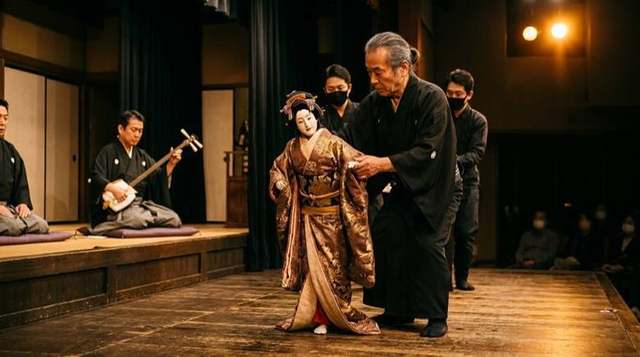
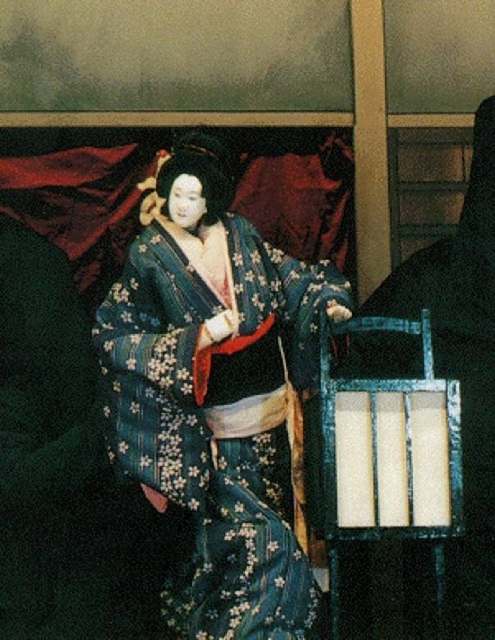
During the Genroku period, kabuki thrived, with the structure of kabuki plays formalising into the structure they are performed in today, alongside many other elements which eventually came to be recognised as a key aspect of kabuki tradition, such as conventional character tropes. Kabuki theater and ningyō jōruri, an elaborate form of puppet theater later known as bunraku, became closely associated with each other, mutually influencing the other's further development. The famous playwright Chikamatsu Monzaemon, one of the first professional kabuki playwrights, produced several influential works during this time, though the piece usually acknowledged as his most significant, Sonezaki Shinjū (The Love Suicides at Sonezaki), was originally written for bunraku. Like many bunraku plays, it was adapted for kabuki, eventually becoming popular enough to reportedly inspire a number of real-life "copycat" suicides, and leading to a government ban on shinju mono (plays about love suicides) in 1723. Also during the Genroku period was the development of the mie style of posing, credited to kabuki actor Ichikawa Danjūrō I, alongside the development of the mask-like kumadori makeup worn by kabuki actors in some plays. In the mid-18th century, kabuki fell out of favor for a time, with bunraku taking its place as the premier form of stage entertainment among the lower social classes. That occurred partly because of the emergence of several skilled bunraku playwrights in that time. Little of note would occur in the further development of kabuki until the end of the century, when it began to reemerge in popularity. 1
1842–1868: Saruwaka-chō kabuki
In the 1840s, repeated periods of drought led to a series of fires affecting Edo, with kabuki theatres—traditionally made of wood—frequently burning down, forcing many to relocate. 1
The text above is adapted from the Wikipedia article “Kabuki”, available under the Creative Commons Attribution-ShareAlike 4.0 licence. 1
kabuki is classical Japanese dance-drama, according to the structured record cited below. This entry was generated automatically from that record and has not yet been reviewed by a person familiar with the tradition. 2
The source record links this tradition to 50 external registers, which can be verified through the citation. 2