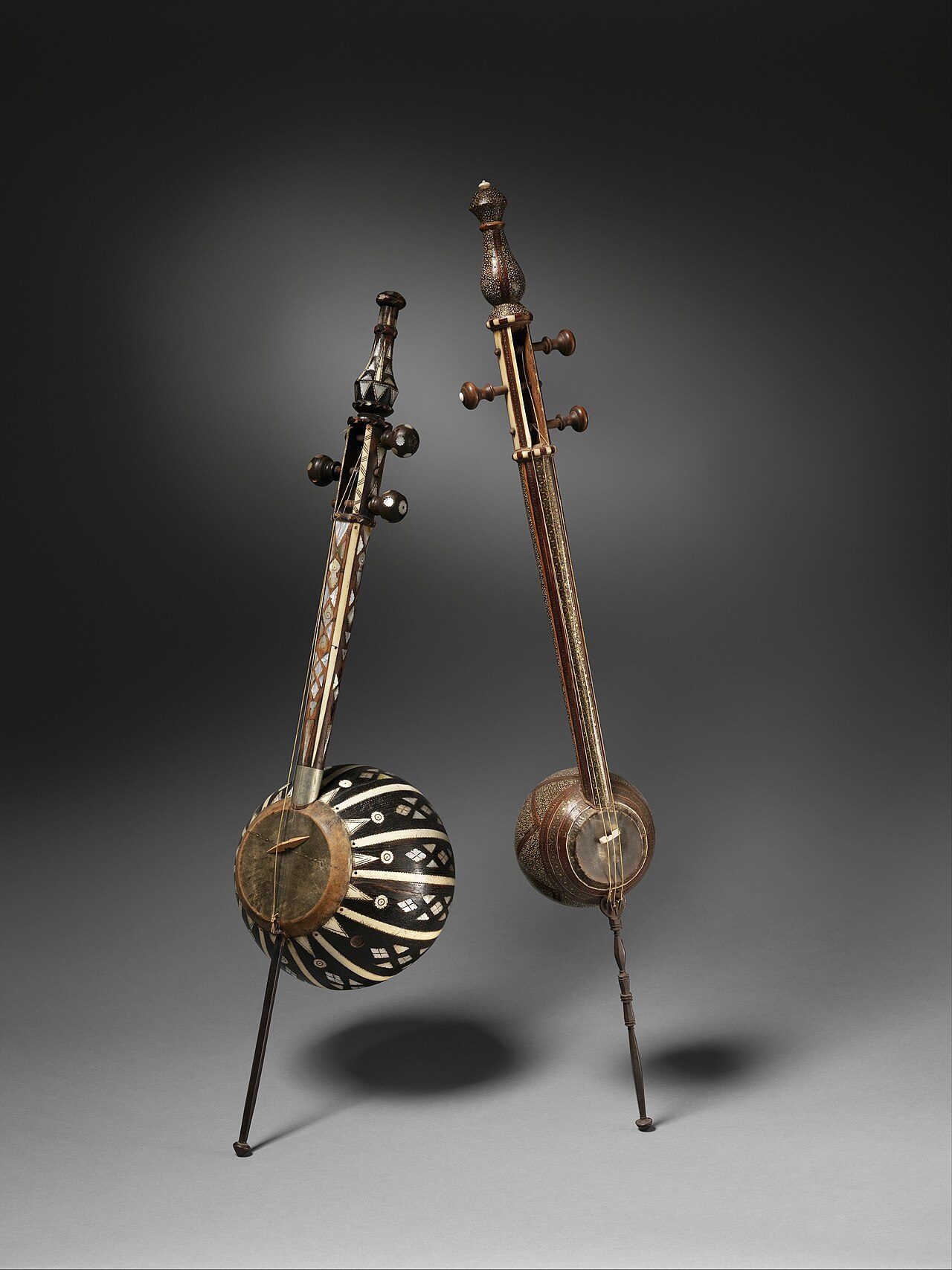
The tradition & historical record
3 min read · 2 sourcesThe kamancheh is an Iranian bowed string instrument used in Persian, Azerbaijani, Armenian, Kurdish, Georgian, Turkmen, and Uzbek music with slight variations in the structure of the instrument. The kamancheh is related to the rebab which is the historical ancestor of the kamancheh and the bowed Byzantine lyra. The strings are played with a variable-tension bow. In 2017, the art of crafting and playing with Kamantcheh/Kamancha was included into the UNESCO Intangible Cultural Heritage Lists of Iran and Azerbaijan. 1
Name and etymology
The word "kamancheh" means "little bow" in Persian (kæman, bow, and -cheh, diminutive). The Turkish word kemençe is borrowed from Persian, with the pronunciation adapted to Turkish phonology. It also denotes a bowed string instrument, but the Turkish version differs significantly in structure and sound from the Persian kamancheh. There is also an instrument called kabak kemane (literally, "pumpkin-shaped bow instrument"), used in Turkish music, which is only slightly different from the Iranian kamancheh. 1
Structure
The kamancheh has a long neck including the fingerboard, which the kamancheh maker shapes as a truncated inverse cone for easy bow movement in the down section, pegbox in both sides of which four pegs are placed, and finial. Traditionally kamanchehs had three silk strings, but modern instruments have four metal strings. Kamanchehs may have highly ornate inlays and elaborately carved ivory tuning pegs. The body has a long upper neck and a lower bowl-shaped resonating chamber made from a gourd or wood, usually covered with a membrane made from the skin of a lamb, goat or sometimes a fish, on which the bridge is set. From the bottom protrudes a spike to support the kamancheh while it is being played, hence in English, the instrument is sometimes called the spiked fiddle. It is played sitting down held like a cello though it is about the length of a viola. The end-pin can rest on the knee or thigh while the player is seated in a chair. Kamancheh is usually tuned like an ordinary violin (G, D, A, E). 1
Notable kamancheh players
Habil Aliyev Mehdi Bagheri Ali-Asghar Bahari Mark Eliyahu Kayhan Kalhor Ardeshir Kamkar Kourosh Babaei Sayat-Nova Mostafa Taleb Yaara Beeri Mehrnam Rastegari 1
The text above is adapted from the Wikipedia article “Kamancheh”, available under the Creative Commons Attribution-ShareAlike 4.0 licence. 1
kamancheh is Bowed string instrument of Iranian origin used in Persian, Azerbaijani, Armenian, Kurdish, Georgian, Turkmen, and Uzbek music with slight variations in the structure of the instrument, according to the structured record cited below. This entry was generated automatically from that record and has not yet been reviewed by a person familiar with the tradition. 2
The source record links this tradition to 16 external registers, which can be verified through the citation. 2