The tradition & historical record
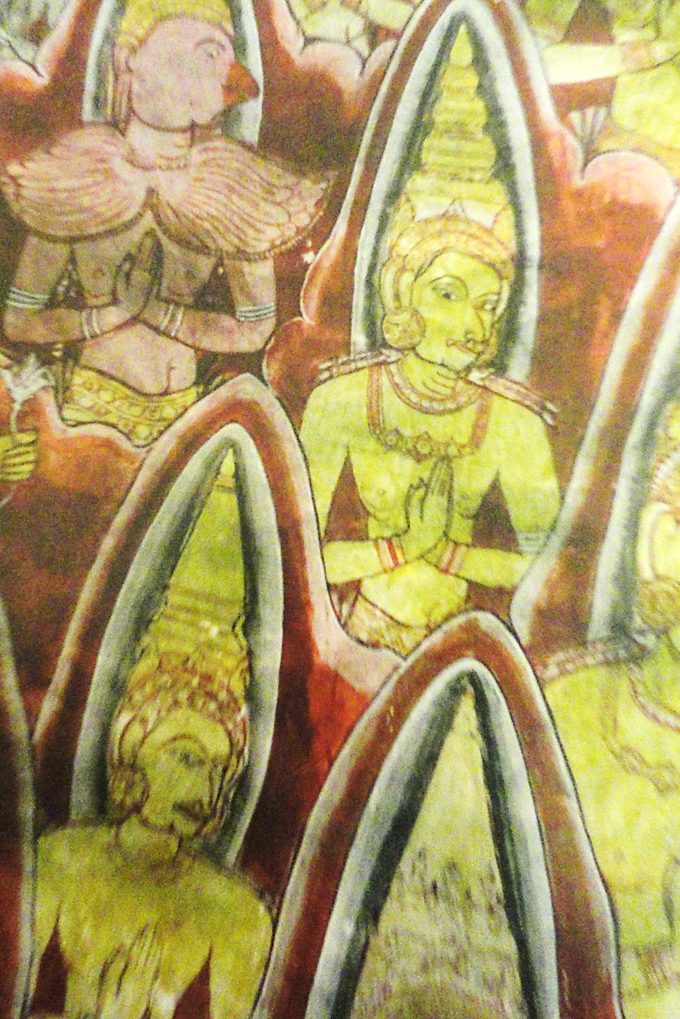
3 min read · 2 sourcesKandyan period paintings are predominantly mural paintings created during the Kandyan period (1592–1815) in Sri Lanka. The monarchs of the Kingdom of Kandy gave a special place to arts and literature during this time period. 1
Special features of Kandyan frescoes
The walls of the Kandyan Era were built by clay which was stuck in between sticks. Then after they used Makulu Meti, a white colored clay, to smooth the walls in temples and palaces as it was only allowed for palaces and temples to build in white color at that time. The frescoes were drawn after dividing the wall of the image house into horizontal rows. After dividing, drawing the whole Jataka Story was started from right to left, then left to right in the next row (Zigzag) in Akhanda Kathana Kramaya [akhaṇḍa-kathana-kramaya] or painting the whole story in fresco. To separate different scenes, the artists have drawn a tree, a river, or a house. The pictures of people were drawn in Parshawa Darshi Kramaya [pārśava-darśī-kramaya], or drawing the faces and legs facing to a side. The background of the frescoes were painted in a dark red color, and flowers like Lotus, Pandanus flowers are used to fill the blanks. These frescoes were drawn in very fine lining. 1
Paints
Almost all the paints which were used in Kandyan Frescoes were natural. Those were made up from trees, fruits, etc. mixed together with juices or oils. These were made by artists themselves. 1
Red color Sadilingam, Ixora was mixed to get red color. Red color was also taken from red clay and rocks. 1
Yellow color Yellow was made from mud limestone. Sometimes it was also made from Clusiaciae juice. 1
Blue color Blue color was made from Fabaceae. Sometimes sea sand was heated and mixed with Arrack to make black color. 1
Green color This was made from mixing some blue powder with yellow color. 1
White color White color was always taken by Makulu Meti, a white clay. 1
Golden color Golden was made by mixing limestone and golden limestone in same amounts. Or else it was made by mixing limestone with milk of CLUSIACEAE, mercury, white lead, Seenakkaran, and Salt. 1
Black color Black color was made by mixing charcoal of coconut shells with Dorana Oil. 1
Brushes
Brushes was made by the artists themselves. A grass type called Theli was used for this. The hair from the tails of cats and squirrels, hair from downside of deer, horses and stags, beard of cats have been used for this. Even camel hair sometimes. These were tied to a handle and then used. Some popular artists have been offered from golden handles from king. 1
Plastering
First, if it is in a cave, then it is roughed and then plastered. This plastering was made by clay and hay. Then a layer of white clay is plastered. Then after clothes were pasted and then started to paint. 1
Dividing the wall
The wall was divided into horizontal rows in Kandyan Era Frescoes. A small space was left between two rows to write the story. Sometimes it was written in the fresco in a rectangle. The height of the row varies from 30" to 40" range in Low country, while some upcountry temples have range of 5"–6". Then after the fresco was painted. 1
The text above is adapted from the Wikipedia article “Kandyan period painting”, available under the Creative Commons Attribution-ShareAlike 4.0 licence. 1
Kandyan Era Frescoes is mural paintings created during the Kingdom of Kandy, Sri Lanka, according to the structured record cited below. This entry was generated automatically from that record and has not yet been reviewed by a person familiar with the tradition. 2
The source record links this tradition to 1 external register, which can be verified through the citation. 2