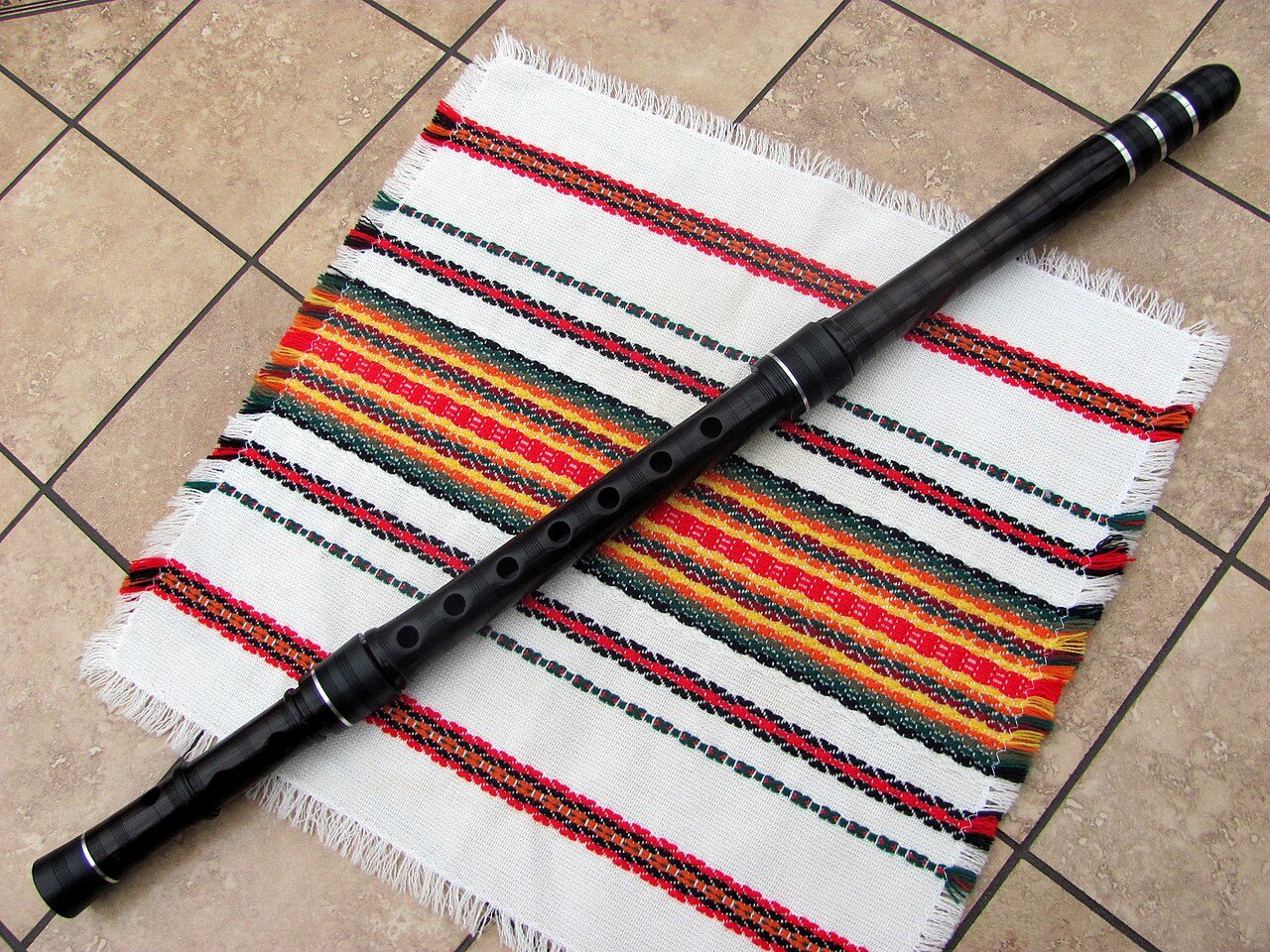
The tradition & historical record
6 min read · 2 sourcesThe kaval is a chromatic end-blown oblique flute traditionally played throughout the Balkans (including Albania, Bosnia and Herzegovina, Bulgaria, Croatia, Greece, Hungary, Kosovo, Moldova, Montenegro, North Macedonia, Romania, Serbia and Slovenia) and Anatolia (including Turkey and Armenia). The kaval is primarily associated with mountain shepherds. Unlike the transverse flute, the kaval is fully open at both ends, and is played by blowing on the sharpened edge of one end. The kaval has eight playing holes (seven in front and one in the back for the thumb) and usually four more unfingered intonation holes near the bottom of the kaval. As a wooden rim-blown flute, kaval is similar to the kawala of the Arab world and ney of the Middle East. 1
Construction
While typically made of wood (cornel cherry, apricot, plum, boxwood, mountain ash, etc.), kavals are also made from water buffalo horn, Arundo donax Linnaeus 1753 (Persian reed), metal and plastic. A kaval made without joints is usually mounted on a wooden holder, which protects it from warping and helps keep the interior walls oiled. According to the key, the kaval can be in the high register (C, C#)???, middle (D, H) or low (A, B). The kaval plays two octaves and a fifth, in the chromatic scale. Its sound is warm, melancholic and pleasant. 1
History
The kaval is primarily associated with mountain shepherds throughout the Balkans and Anatolia. Musician Pat MacSwyney suggests that the kaval spread with the Yoruks from the Taurus Mountains of southern Anatolia into the southern Balkans of southeast Europe. While in the past it was almost entirely a shepherd's instrument, today it is widely used in folk songs and dances as part of ensembles or solo. 1
Playing
Unlike the transverse flute, the kaval is fully open at both ends, and is played by blowing on the sharpened edge of one end. The kaval has eight playing holes (seven in front and one in the back for the thumb) and usually four more near the bottom of the kaval. These holes are not used for playing the instrument, but determine the lowest tone's pitch and timbre and are supposed to improve tone and intonation. In Bulgaria they are known as "devil's holes", based on a folk tale in which the devil tries to out-play a shepherd in a musical duel. While the shepherd is sleeping, the devil drilled holes in the shepherd's kaval but instead of ruining the kaval, this only served to enhance the shepherd's kaval playing thus thwarting the devil. In North Macedonia they are known as "glasnici" (гласници) meaning "giving voice to/of". When played, the kaval is held with both hands, at an angle of approximately 45° to the side, with the four fingers of the one hand covering the lower holes; the upper three holes and the thumbhole are covered with the other hand. The mouth covers approximately three quarters of the end. Change of the breath air pressure also changes the pitch. 1
Bulgaria
The kaval that is most common in Bulgaria is the one in middle (D) register. The kaval in lower (C) register is also not uncommon for this country. What is characteristic for the Bulgarian style of kaval performance is the diversity of sound shades and techniques. According to the pitch there are four different registers that can be achieved with the Bulgarian kaval. What controls which register the performer works in is mostly the air flow and to some extent the position of the mouth and the lips on the end of the kaval. A very characteristic sound of kaval is achieved in the lowest register. It could sound very mild and gentle if blown lightly while by changing the air stream a deeper (flageolet like) sound is achieved. This sound is so outstanding that some consider it another register that they call - kaba. It is also very interesting to notice that the technique of circular breathing is successfully utilized while playing the kaval. This technique lets the performer play without interrupting the air flow, while taking a breath through the nose. In the past it has been considered an extraordinary skill while nowadays it is used by more and more young performers. The Bulgarian kaval, once made of a single piece of wood, is now constructed of three separate sections (of cornel, walnut, plum or boxwood), with a total length of 60 to 90 cm. Bone rings cover the joints, to prevent the wood from cracking. Metal decoration is also found. 1
Romania and Moldova
In Romania and Moldova there are three types of cavals: cavals from Moldova (with 6 holes), cavals from Oltenia (with 5 holes) and cavals from Dobrogea (similar to Bulgarian cavals). Their fundamental sound may be A, but for some instruments the lowest sound they can perform may vary between G and C. The Romanian cavals are ethnic instruments built by artisans (usually using two pieces, but there are older models made from a single piece) and therefore each instrument is unique in its own way. The Romanian caval in A has a playing range of two octaves (which lacks certain sounds). The first five sounds belong to a minor scale with stage IV ascending chromatically. Grouped in this way they represent the low register of the instrument. These five sounds reappear one octave higher, complemented with the sounds F#, G and A, which complete the upper side of a mode of minor-melodic origin on A. The low pitched sounds between E and A cannot be obtained on the Romanian caval in A, which confers the instrument the special individualization of an “elliptic ambitus”. The last and most used octave is obtained without using the lip to cover the orifice by the head. The upper part of the playing range requires an increase in the pressure of the air column. The last four sounds also require more pressure. In the middle of the higher octave, the E2 sound can be obtained by two different pressure techniques, resulting in specific timbral effects. 1
The text above is adapted from the Wikipedia article “Kaval”, available under the Creative Commons Attribution-ShareAlike 4.0 licence. 1
kaval is chromatic end-blown blocked-end flute, according to the structured record cited below. This entry was generated automatically from that record and has not yet been reviewed by a person familiar with the tradition. 2
The source record links this tradition to 14 external registers, which can be verified through the citation. 2