The tradition & historical record
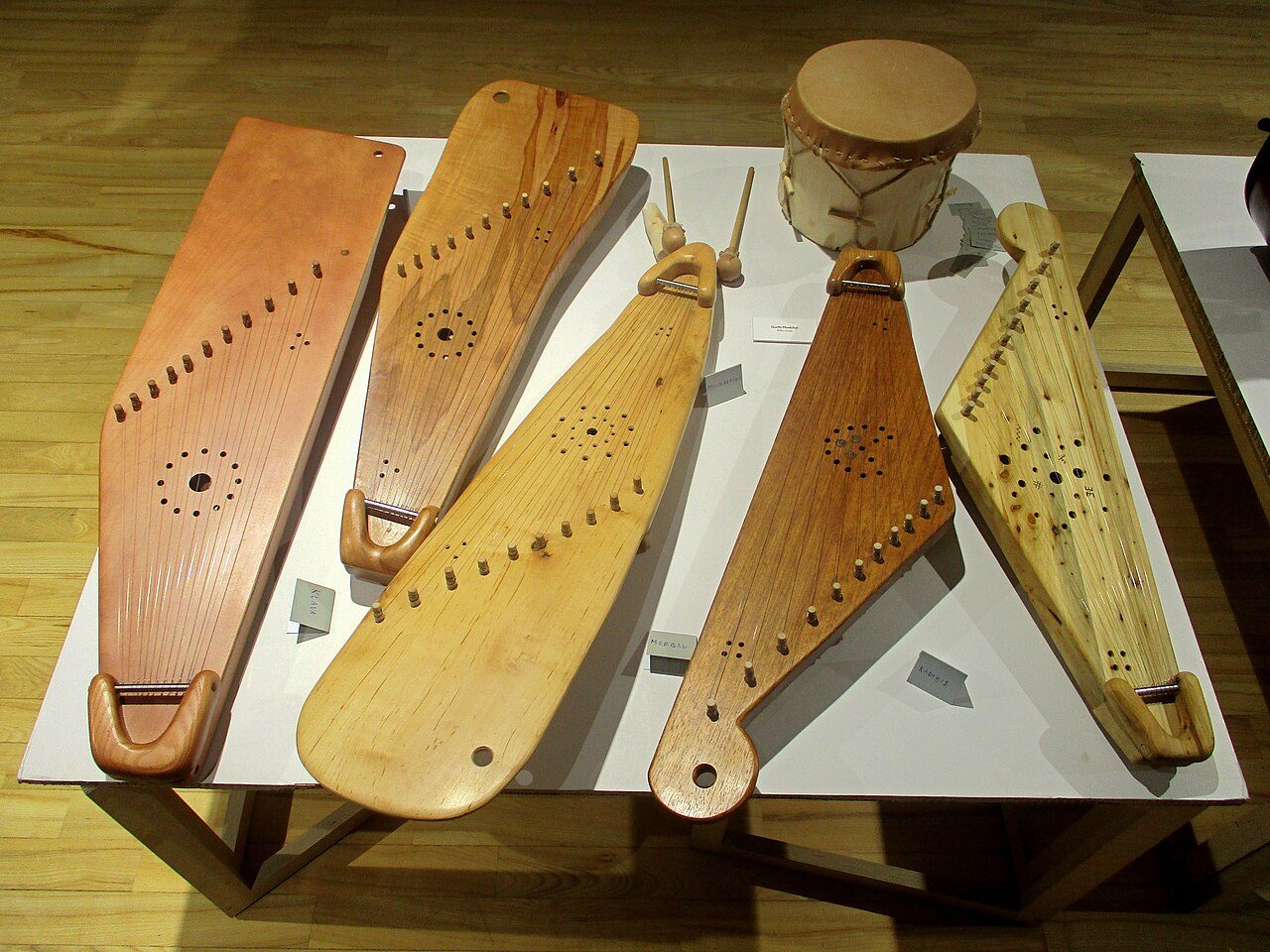
4 min read · 2 sourcesKokle (Latvian pronunciation: ['kʊ͡ɔk.le]; Latgalian: kūkle) or historically kokles (kūkles) is a Latvian plucked string instrument (chordophone) belonging to the Baltic box zither family known as the Baltic psaltery along with Lithuanian kanklės, Estonian kannel, Finnish kantele, and Russian krylovidnye gusli. The first possible kokles related archaeological findings in the territory of modern Latvia are from the 13th century, while the first reliable written information about kokles playing comes from the beginning of the 17th century. The first known kokles tune was notated in 1891, but the first kokles recordings into gramophone records and movies were made in the 1930s. Both kokles and kokles playing are included in the Latvian Culture Canon. 1
Etymology
According to Finnish linguist Eino Nieminen, the name of the instrument, along with the names of most of its neighbouring counterparts (Lithuanian kanklės, Finnish kantele, Estonian kannel and Livonian kāndla), possibly comes from the proto-Baltic form *kantlīs/*kantlēs, which originally meant 'the singing tree', ultimately deriving from the Proto-European root *qan- ('to sing, to sound'). However, Lithuanian ethnologist Romualdas Apanavičius believes kokles could be derived from the Proto-European root *gan(dh)-, meaning 'a vessel; a haft (of a sword)', suggesting that it may be related to the Russian word gusli. 1
Construction
The kokles has a hollow trapezoidal body (ķermenis or korpuss) usually carved out of a single piece of wood (vienkocis) that's topped with a thin ornated wooden soundboard (skaņgaldiņš). A distinct feature that sets kokles apart from most of the other string instruments is that the strings don't rest on a bridge, making the sound quieter, but richer in timbre. Wooden (or sometimes metal) tuning pegs (tapas) are set into the wide tip of the body, while at the narrow tip is a metal rod (stīgturis) upon which the strings are secured, giving them a slightly fan-shaped arrangement. The strings may be of brass or steel. Traditionally, there were 6–9 strings which later increased to 10 and more. 1
Playing
The technique of kokles playing differs from most other plucked string instruments, including that of zither, harp and guitar. There are also some playing differences between the regional types of Latgale and Kurzeme instruments. In Kurzeme kokles was generally played while sitting on a stool, bench or chair without armrests and placing it horizontally in the lap with legs slightly parted. It could be played while laid on a table as well. For Latgale kokles the size and form of the instrument also allowed for it to be steadily placed in the lap in a vertical position, resting the shorter edge of kokles against the stomach and placing both arms on the instrument for extra comfort and stability. Strumming is done with the index finger of the right hand while the left hand is used for muting unwanted strings by lightly placing fingers on them. An alternative string muting technique found in Latgale features the fingers being inserted in-between the strings, but such option heavily restricts the movement of the left arm. The left hand can also be used for picking strings. 1
Tuning
Tuning of the kokles is a diatonic scale, with some lower strings traditionally functioning as drones. A few traditional tuning variations include D-G-A-H-C for 5-stringed kokles written down by Andrejs Jurjāns at the end of the 19th century, D-C-D-E-F-G-A for 7-stringed kokles and D-C-D-E-F-G-A-H-C for 9-stringed kokles both used by traditional suiti kokles player Jānis Poriķis. However, as kokles began to be constructed with more strings and Latgale kokles became the dominant type of kokles among many other factors, the drone strings have gradually lost their function and become just a lower range extension of the kokles' diapason. Since the 1980s, the most popular tunings among kokles players for 11-stringed kokles are G-A-C-D-E-F-G-A-B-C (GA) and G-A-C-D-E-F-G-A-B♭-C (GA-b♭). 1
Types
In his book "The Baltic Psaltery and Playing Traditions in Latvia" (Kokles un koklēšana Latvijā) Latvian ethnomusicologist Valdis Muktupāvels distinguishes 3 types of traditional kokles – Kurzeme kokles (Kurzemes kokles), Latgale kokles (Latgales kokles) and zither kokles (cītarkokles) – and 3 types of modernised kokles – the so-called 15-stringed Krasnopjorovs'-Ķirpis' diatonic kokles (Krasnopjorova-Ķirpja diatoniskās kokles) and the concert kokles (koncertkokles) both designed in the Latvian SSR in 1940s to 1960s, as well as the so-called 13-stringed Linauts'-Dravnieks'-Jansons' kokles (Linauta-Dravnieka-Jansona kokles) that emerged in the Latvian American community in the 1960s. 1
The text above is adapted from the Wikipedia article “Kokle”, available under the Creative Commons Attribution-ShareAlike 4.0 licence. 1
kokle is Latvian folk music instrument, according to the structured record cited below. This entry was generated automatically from that record and has not yet been reviewed by a person familiar with the tradition. 2
The source record links this tradition to 6 external registers, which can be verified through the citation. 2