The tradition & historical record
3 min read · 2 sourcesKorean drums play an important part in traditional Korean music, ranging from folk music to royal court music. There are a wide variety of shapes and sizes, for use both in accompanying other instruments and in special drumming performances. In the traditional Korean classification of instruments, drums are grouped with the hyeokbu (혁부, 革部), or instruments made with leather. A notable class of these leather drums are Korean barrel drums. 1
History
During the Joseon period, many types of drums were used for the royal court music, including the janggu, jwago, yonggo, gyobanggo, jingo, jeolgo, nogo, and others. Among these, the janggu was also used for folk music, and later became the most commonly used drum in Korean music. 1
Types
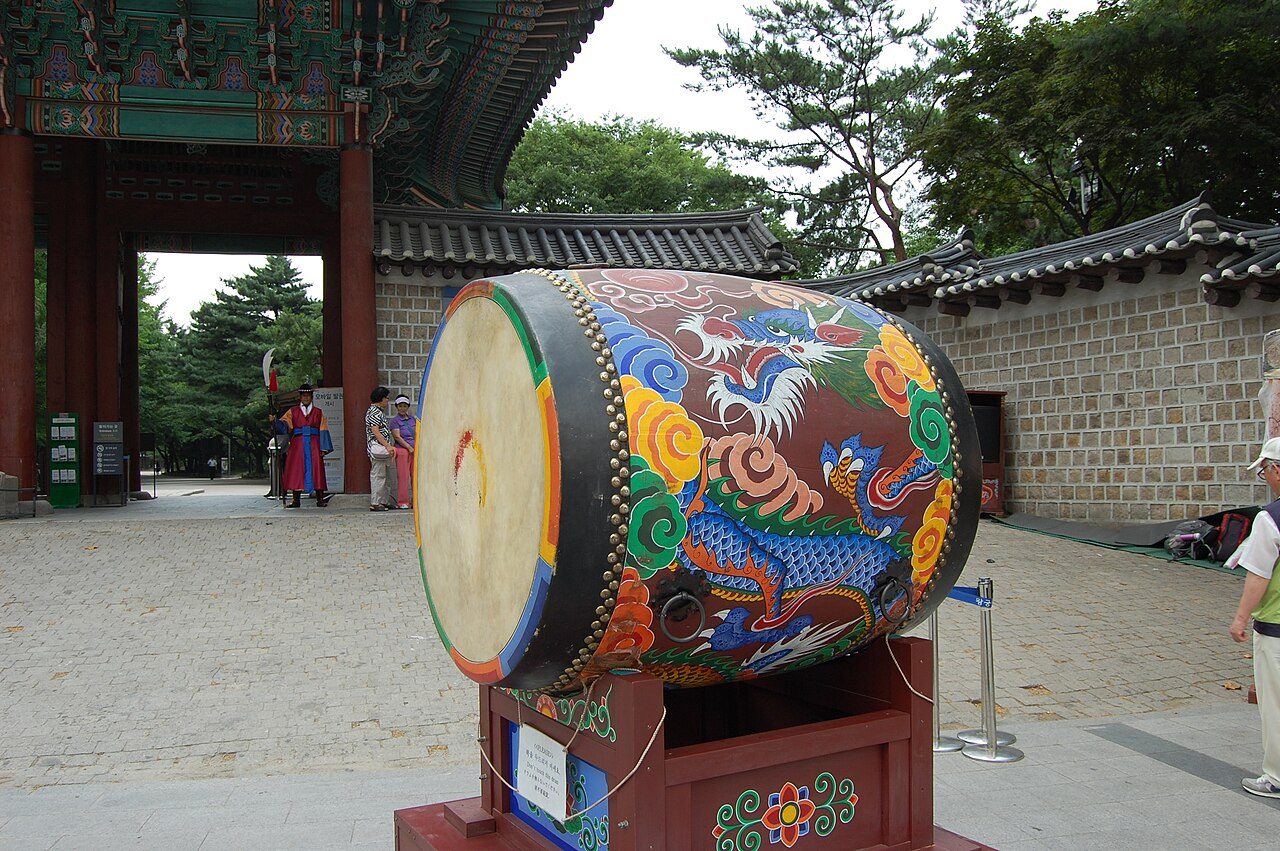
Buk (북) - Double-headed shallow barrel drum used in folk music and played with one stick or one hand and one stick; varieties of buk are used in pansori, pungmul, and samulnori Janggu or Janggo (장고 or 장구; 杖鼓 or 長鼓) - A double-headed hourglass-shaped drum generally played with one stick and one hand Galgo (갈고; 羯鼓) - Double-headed hourglass-shaped drum similar to the janggo but played with two sticks and thinner drum heads; sometimes called yanggo or yangjanggo; no longer commonly used [1] Jingo (진고; 晉鼓) - Largest barrel drum Jeolgo (절고; 節鼓) - Barrel drum Jwago (좌고; 座鼓) - A barrel drum in a wooden frame Geongo (건고; 建鼓) - Huge barrel drum Yonggo (용고; 龍鼓) - A barrel drum with a dragon painted on its shell; used in daechwita Eunggo (응고; 應鼓) - Barrel drum suspended from a frame Sakgo - (삭고; 朔鼓) - A long barrel drum suspended from a wooden frame Gyobanggo (교방고; 敎坊鼓) - Flat drum suspended from a frame Junggo (중고; 中鼓) - Flat drum suspended from a frame; similar to the gyobanggo but larger Sogo (소고; 小鼓) - A small hand-held drum Nogo (노고; 路鼓) - A set of two drums pierced by a pole Nodo (노도; 路鼗) - A set of two small drums on a pole, which is twisted to play; used in ritual music Yeongdo (노도; hanja:靈鼗) - Four drums on a pole, which is twisted to play; used in ritual music Noedo (뇌도; 雷鼗)) - six small drums hung in a frame; used in ritual music Noego (뇌고; 雷鼓) - Three small barrel drums on a pole, which is twisted to play; used in ritual music Do (도) - single pellet drum on a pole 1
Video
Video showing sori-buk used in pansori Video showing pungmul-buk used in samulnori Video showing yonggo used in daechwita 1
The text above is adapted from the Wikipedia article “Korean drum”, available under the Creative Commons Attribution-ShareAlike 4.0 licence. 1
Korean drum is Family of percussion instruments, according to the structured record cited below. This entry was generated automatically from that record and has not yet been reviewed by a person familiar with the tradition. 2
The source record links this tradition to 1 external register, which can be verified through the citation. 2