The tradition & historical record
6 min read · 2 sourcesThe Kufic script (Arabic: الخط الكوفي, romanized: al-khaṭṭ al-kūfī) is a style of Arabic script that gained prominence early on as a preferred script for Quran transcription and architectural decoration, and it has since become a reference and an archetype for a number of other Arabic scripts. It developed from the Arabic alphabet in the city of Kufa, from which its name is derived. Kufic is characterized by angular, rectilinear letterforms and its horizontal orientation. There are many different versions of Kufic, such as square Kufic, floriated Kufic, knotted Kufic, and others. The artistic styling of Kufic led to its use in a non-Arabic context in Europe, as decoration on architecture, known as pseudo-Kufic. 1
Origin of the Kufic script
Calligraphers in the early Islamic period used a variety of methods to transcribe Quran manuscripts. Kufic is the oldest calligraphic form of the various Arabic scripts. The name of the script derives from Kufa, a city in southern Iraq which was considered as an intellectual center within the early Islamic period. Kufic is defined as a highly angular form of the Arabic alphabet originally used in early copies of the Quran. Sheila S. Blair suggests that "the name Kufic was introduced to Western scholarship by Jacob Georg Christian Adler (1756–1834)". Furthermore, the Kufic script plays an important role in the development of Islamic calligraphy. In fact, "it is the first style of Islamic period writings in which the manifestation of art, delicacy and beauty are explicitly evident", says Salwa Ibraheem Tawfeeq Al-Amin. The rule set for this writing was about the angular, linear shapes of the characters. In fact, "the rules that were defined at the outset of the Kufic tradition essentially remained the same throughout its lifespan", says Alain George. 1
Usage of Kufic script
The Quran was first written in a plain, slanted, and uniform script but, when its content was formalized, a script that denoted authority emerged. This coalesced into what is now known as Primary Kufic script. Kufic was prevalent in manuscripts from the 7th to 10th centuries. Around the 8th century, it was the most important of several variants of Arabic scripts with its austere and fairly low vertical profile and a horizontal emphasis. Until about the 11th century it was the main script used to copy the Quran. Professional copyists employed a particular form of Kufic for reproducing the earliest surviving copies of the Quran, which were written on parchment and date from the 8th to 10th centuries. It is distinguished from Thuluth script in its use of decorative elements whereas the latter was designed to avoid decorative motifs. In place of the decorations in Kufic scripts, Thuluth used vowels. 1
Characteristics of Kufic script
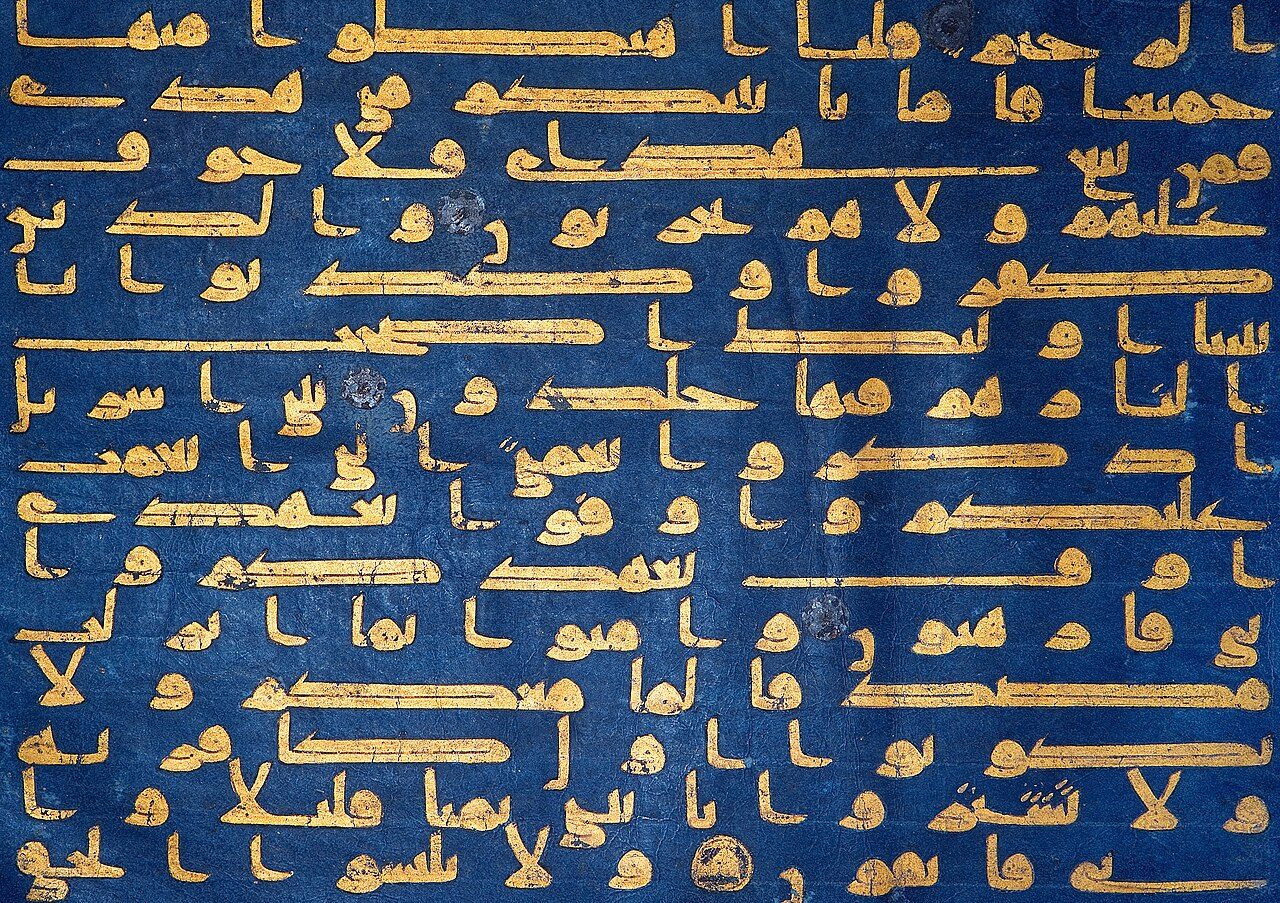
The main characteristic of the Kufic script "appears to be the transformation of the ancient cuneiform script into the Arabic letters", according to Enis Timuçin Tan. Moreover, it was characterized by figural letters that were shaped in a way to be nicely written on parchment, building and decorative objects like lusterware and coins. Kufic script is composed of geometrical forms like straight lines and angles along with verticals and horizontals. Originally, Kufic did not have what is known as a differentiated consonant, which means, for example, that the letters "t", "b", and "th" were not distinguished by diacritical marks and looked the same. However, it is still used in Islamic countries. In later Kufic Qurans of the ninth and early tenth century, "the sura headings were more often designed with the sura title as the main feature, often written in gold, with a palmette extending into the margin", comments Marcus Fraser. Its use in transcribing manuscripts has been important in the development of Kufic Script. Earlier kufic was written on manuscripts with precision which contributed to its development. For instance, "the precision achieved in practice is all more remarkable because Kufic manuscripts were not ruled", says Alain George. Moreover, he explains that Kufic manuscripts were laid out with a stable number of lines per page, and these were strictly parallel and equidistant. One impressive example of an early Quran manuscript, known as the Blue Quran, features gold Kufic script on parchment dyed with indigo. It is commonly attributed to the early Fatimid or Abbasid court. The main text of this Quran is written in gold ink, thus the effect on looking at the manuscript is of gold on blue. 1
Ornamental use of Kufic script
Ornamental Kufic became an important element in Islamic art as early as the eighth century for Quranic headings, numismatic inscriptions and major commemorative writings. The Kufic script is inscribed on textiles, coins, lusterware, building and so on. Coins were very important in the development of the Kufic script. In fact, "the letter strokes on coins, had become perfectly straight, with curves tending toward geometrical circularity by 86", observes Alain George. As an example, Kufic is commonly seen on Seljuk coins and monuments and on early Ottoman coins. Its decorative character led to its use as a decorative element in several public and domestic buildings constructed prior to the Republican period in Turkey. Also, the current flag of Iraq (2008) also includes a kufic rendition of the takbir. 1
Similarly, the flag of Iran (1980) has the takbir written in white square kufic script a total of 22 times on the fringe of both the green and red bands. Kufic inscriptions were important in the emergence of textiles too, often functioning as decoration in the form of tiraz bands. According to Maryam Ekhtiar, "tiraz inscriptions were written in Kufic or floriated Kufic script, and later, in naskhi or throughout the islamic world". Those inscriptions include the name of God or the ruler. As an example, the inscription inside the Dome of the Rock is written in Kufic. Throughout the text, we can notice the calligraphic line created by the reed pen which is usually a steady stroke with various thicknesses based on the changes in direction of the movement that has created it. Square or geometric Kufic is a very simplified rectangular style widely used for tiling. 1
Square Kufic
Square Kufic (Arabic: ٱلْكُوفِيّ ٱلمُرَبَّع), also sometimes known as banna'i (بَنَائِيّ, "masonry" script), is a bare Arabic writing form that developed in the 12th century. Invented in Iraq, it was prominently used in Iranian architecture with bricks and tiles functioning as pixels. Legibility is not a priority of this script. The Syrian calligrapher Mamoun Sakkal described its development as an "exceptional step towards simplification in Kufic styles that evolved towards more complexity in the preceding centuries". 1
In recent years, this calligraphy form has been receiving more popularity for use in ornaments (such as in decorated clocks, frames, stickers), logos (that usually implies Islamic enterprises in government and private sectors), and even in freestyle Arabic calligraphy competitions. There has been a disciplined approach of creating Square Kufic calligraphy. 1
The text above is adapted from the Wikipedia article “Kufic”, available under the Creative Commons Attribution-ShareAlike 4.0 licence. 1
Kufic is style of Arabic script, according to the structured record cited below. This entry was generated automatically from that record and has not yet been reviewed by a person familiar with the tradition. 2
The source record links this tradition to 16 external registers, which can be verified through the citation. 2