The tradition & historical record
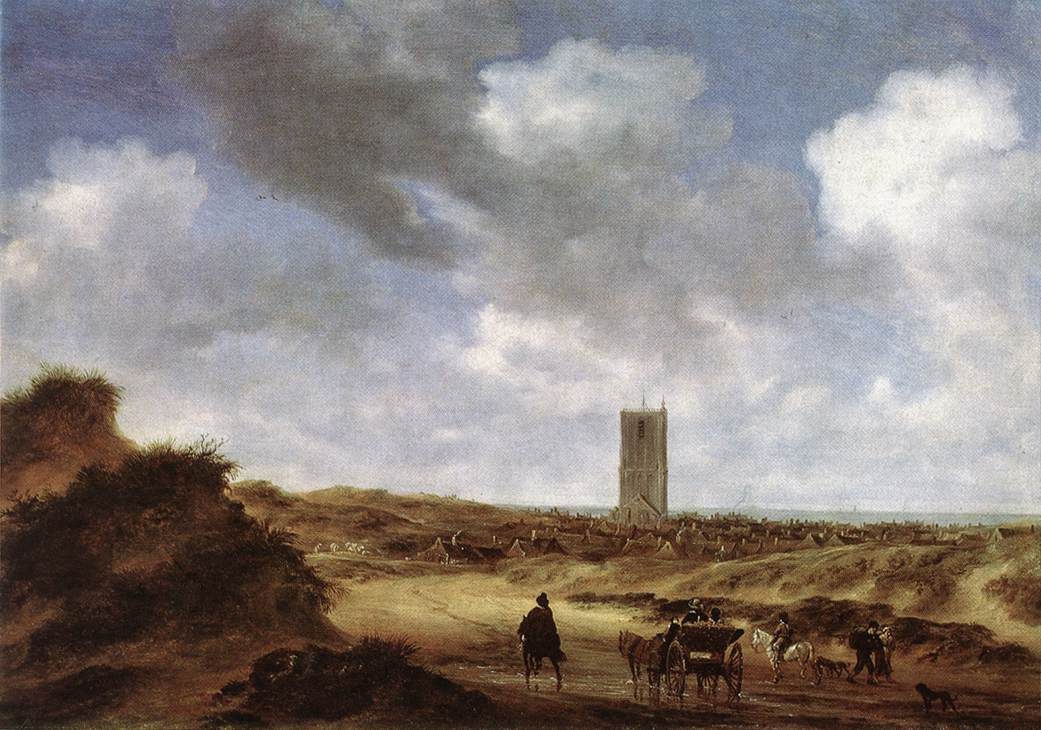
6 min read · 2 sourcesLandscape painting, also known as landscape art, is the depiction in painting of natural scenery such as mountains, valleys, rivers, trees, and forests, especially where the main subject is a wide view—with its elements arranged into a coherent composition. In other works, landscape backgrounds for figures can still form an important part of the work. Sky is almost always included in the view, and weather is often an element of the composition. Detailed landscapes as a distinct subject are not found in all artistic traditions, and develop when there is already a sophisticated tradition of representing other subjects. Two main traditions spring from Western painting and Chinese art, going back well over a thousand years in both cases. The recognition of a spiritual element in landscape art is present from its beginnings in East Asian art, drawing on Daoism and other philosophical traditions, but in the West only becomes explicit with Romanticism. Landscape views in art may be entirely imaginary, or copied from reality with varying degrees of accuracy. If the primary purpose of a picture is to depict an actual, specific place, especially including buildings prominently, it is called a topographical view. 1
History
The earliest forms of art around the world depict little that could really be called landscape, although ground-lines and sometimes indications of mountains, trees, or other natural features are included. The earliest "pure landscapes" with no human figures are frescos from Minoan art of around 1500 BCE. Hunting scenes, especially those set in the enclosed vista of the reed beds of the Nile Delta from Ancient Egypt, can give a strong sense of place, but the emphasis is on individual plant forms and human and animal figures rather than the overall landscape setting. The frescos from the Tomb of Nebamun, now in the British Museum (c. 1350 BC), are a famous example. For a coherent depiction of a whole landscape, some rough system of perspective, or scaling for distance, is needed, and this seems from literary evidence to have first been developed in Ancient Greece in the Hellenistic period, although no large-scale examples survive. More ancient Roman landscapes survive, from the 1st century BCE onwards, especially frescos of landscapes decorating rooms that have been preserved at archaeological sites of Pompeii, Herculaneum, and elsewhere, and mosaics. 1
The Chinese ink painting tradition of shan shui ("mountain-water"), or "pure" landscape, in which the only sign of human life is usually a sage, or a glimpse of his hut, uses sophisticated landscape backgrounds to figure subjects, and landscape art of this period retains a classic and much-imitated status within the Chinese tradition. Both the Roman and Chinese traditions typically show grand panoramas of imaginary landscapes, generally backed with a range of spectacular mountains – in China often with waterfalls and in Rome often including sea, lakes, or rivers. 1
Medieval
In early Western medieval art interest in landscape disappears almost entirely, kept alive only in copies of Late Antique works such as the Utrecht Psalter; the last reworking of this source, in an early Gothic version, reduces the previously extensive landscapes to a few trees filling gaps in the composition, with no sense of overall space. A revival in interest in nature initially mainly manifested itself in depictions of small gardens such as the Hortus Conclusus or those in millefleur tapestries. The frescos of figures at work or play in front of a background of dense trees in the Palace of the Popes, Avignon are probably a unique survival of what was a common subject. Several frescos of gardens have survived from Roman houses like the Villa of Livia. 1
During the 14th century Giotto di Bondone and his followers began to acknowledge nature in their work, increasingly introducing elements of the landscape as the background setting for the action of the figures in their paintings. Early in the 15th century, landscape painting was established as a genre in Europe, as a setting for human activity, often expressed in a religious subject, such as the themes of the Rest on the Flight into Egypt, the Journey of the Magi, or Saint Jerome in the Desert. Luxury illuminated manuscripts were very important in the early development of landscape, especially series of the Labours of the Months such as those in the Très Riches Heures du Duc de Berry, which conventionally showed small genre figures in increasingly large landscape settings. A particular advance is shown in the less well-known Turin-Milan Hours, now largely destroyed by fire, whose developments were reflected in Early Netherlandish painting for the rest of the century. 1
Renaissance
Landscape backgrounds for various types of painting became increasingly prominent and skillful during the 15th century. The period around the end of the 15th century saw pure landscape drawings and watercolours from Leonardo da Vinci, Albrecht Dürer, Fra Bartolomeo, and others, but pure landscape subjects in painting and printmaking, still small, were first produced by Albrecht Altdorfer and others of the German Danube School in the early 16th century. However, the outsides of the wings of a triptych by Gerard David, dated to "about 1510–15", are the earliest from the Low Countries, and possibly in Europe. At the same time Joachim Patinir in the Netherlands developed the "world landscape" a style of panoramic landscape with small figures and using a high aerial viewpoint, that remained influential for a century, being used and perfected by Pieter Brueghel the Elder. The Italian development of a thorough system of graphical perspective was now known all over Europe, which allowed large and complex views to be painted very effectively. 1
Landscapes were idealized, mostly reflecting a pastoral ideal drawn from classical poetry which was first fully expressed by Giorgione and the young Titian, and remained associated above all with hilly wooded Italian landscape, which was depicted by artists from Northern Europe who had never visited Italy, just as plain-dwelling literati in China and Japan painted vertiginous mountains. Though often young artists were encouraged to visit Italy to experience Italian light, many Northern European artists could make their living selling Italianate landscapes without ever bothering to make the trip. 1
17th and 18th centuries
The popularity of exotic landscape scenes can be seen in the success of the painter Frans Post, who spent the rest of his life painting Brazilian landscapes after a trip there in 1636–1644. 1
19th and 20th centuries
The Romantic movement intensified the existing interest in landscape art, and remote and wild landscapes, which had been one recurring element in earlier landscape art, now became more prominent. The German Caspar David Friedrich had a distinctive style, influenced by his Danish training, where a distinct national style, drawing on the Dutch 17th-century example, had developed. To this he added a quasi-mystical Romanticism. 1
The text above is adapted from the Wikipedia article “Landscape painting”, available under the Creative Commons Attribution-ShareAlike 4.0 licence. 1
landscape painting is depiction of landscapes in painting, according to the structured record cited below. This entry was generated automatically from that record and has not yet been reviewed by a person familiar with the tradition. 2
The source record links this tradition to 39 external registers, which can be verified through the citation. 2