The tradition & historical record
6 min read · 2 sourcesLandscape painting in Scotland includes all forms of painting of landscapes in Scotland since its origins in the sixteenth century to the present day. The earliest examples of Scottish landscape painting are in the tradition of Scottish house decoration that arose in the sixteenth century. Often said to be the earliest surviving painted landscape created in Scotland is a depiction by the Flemish artist Alexander Keirincx undertaken for Charles I. The capriccios of Italian and Dutch landscapes undertaken as house decoration by James Norie and his sons in the eighteenth century brought the influence of French artists such as Claude Lorrain and Nicolas Poussin. Students of the Nories included Jacob More, who produced Claudian-inspired landscapes. This period saw a shift in attitudes to the Highlands and mountain landscapes to interpreting them as aesthetically pleasing exemplars of nature. Watercolours were pioneered in Scotland by Paul Sandby and Alexander Runciman. Alexander Nasmyth has been described as "the founder of the Scottish landscape tradition", and produced both urban landscapes and rural scenes that combine Claudian principles of an ideal landscape with the reality of Scottish topography. His students included major landscape painters of the early nineteenth century such as Andrew Wilson, the watercolourist Hugh William Williams, John Thompson of Duddingston, and probably the artists that would be most directly influenced by Nasmyth, John Knox. 1
Origins to the eighteenth century
The earliest examples of Scottish landscape painting are in the tradition of Scottish house decoration for burgesses, lairds and lords, that arose after the Reformation in the sixteenth century, partly as a response to the loss of religious patronage. Most were of heraldry, classical myths and allegory, but there were a number of painted landscape scenes. These included the landscapes of four seasons in the Skelmorlie Aisle (1638) in the memorial chapel of the Montgomery family in Largs undertaken by James Stalker (fl. 1632–1638). They indicate an awareness of contemporaneous Dutch landscape painting. The Flemish artist Alexander Keirincx (1600–1652) was active in England and Scotland where he undertook commissions for Charles I, mainly of royal castles in Northern England and Scotland. These included one showing Seton House (1636–37) in its landscape, which is often said to be the earliest surviving painted landscape created in Scotland. The theme of house decoration with landscapes was taken up in the eighteenth century by James Norie (1684–1757), who worked beside the architect William Adam (1689–1748). Norie, with his sons James (1711–36) and Robert (d. 1766), painted the houses of the peerage with capriccios or pastiches of Italian and Dutch landscapes, bringing to Scotland the influence of French artists such as Claude Lorrain and Nicolas Poussin. The Nories were also important figures in professionalisation of Scottish art and the development of art education. 1
Probably a student of the Nories was Charles Steuart (fl. 1762–90), who produced a series of Perthshire landscapes for the Duke of Atholl at Blair Castle, including The Black Lynn, Fall on the Brann (1766). 1
Nineteenth century
Nasmyth was also a highly influential teacher at the Trustee's Academy in Edinburgh. Among his students were painters who took the landscape tradition into the nineteenth century. They included Andrew Wilson (1780–1840), who would become Master of the Academy in 1818, the watercolourist Hugh William Williams (1773–1829), clergyman and artist John Thompson of Duddingston (1778–1840) and probably the artist that would be most directly influenced by Nasmyth, John Knox (1778–1845). Williams' most famous work are interpretive versions of Greek landscapes, based on sketches taken on his travels there, among them The Temple of Poseidon, Cape Sunium (1828). His close friend John Thompson focused on a dark dramatic version of Scottish landscape, as in his most famous work Fast Castle from Below (1824). Knox directly linked Nasmyth's style with the Romantic literature of Walter Scott. Knox's Landscape with Tourists at Lock Katrine (c. 1820), was a commentary on the tourist trade that grew up in the Trossachs in the aftermath of the publication of Scott's poem The Lady of the Lake in 1810. He was also among the first artists to take a major interest in depicting the urban landscape of Glasgow. Towards the end of his career he undertook panoramic works of the views from the top of Ben Lomond, which played a part in opening up the Highlands as a spectacle that would be taken up by artists in the second half of the century. 1
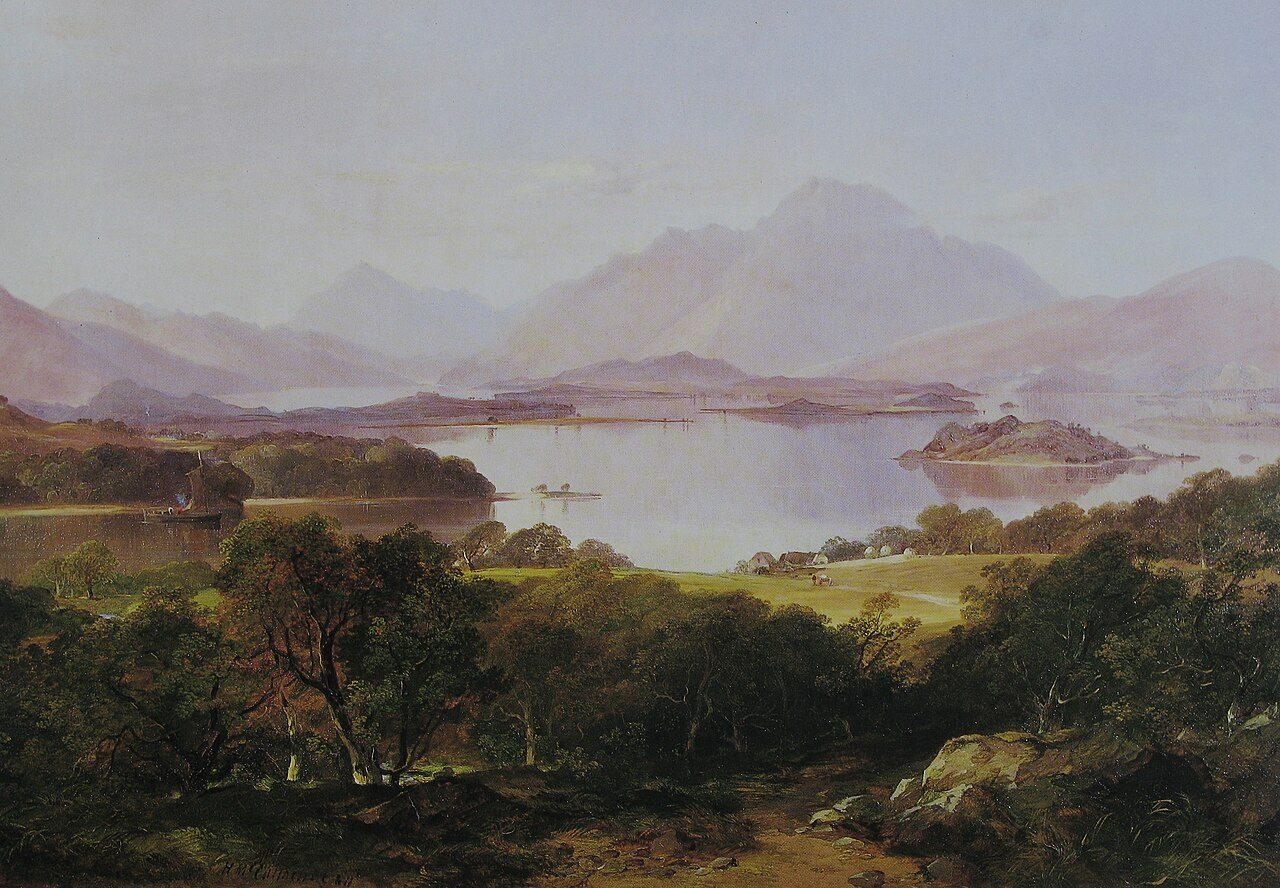
In the Victorian era, the tradition of Highland landscape painting was continued by figures such as Horatio McCulloch (1806–1867), Joseph Farquharson (1846–1935) and William McTaggart (1835–1910). McCulloch was a student of Knox. 1
Twentieth century to present
The first significant group of Scottish artists to emerge in the twentieth century were the Scottish Colourists in the 1920s. The name was later given to four artists who knew each other and exhibited together, but did not form a cohesive group. All had spent time in France between 1900 and 1914 and all looked for inspiration to Paris, particularly to the Fauvists, such as Monet, Matisse and Cézanne, whose techniques they combined with the painting traditions of Scotland. They were John Duncan Fergusson (1874–1961), Francis Cadell (1883–1937), Samuel Peploe (1871–1935) and Leslie Hunter (1877–1931). They have been described as the first Scottish modern artists and were the major mechanism by which Post-Impressionism reached Scotland. From 1912 Cadell visited Iona annually to paint and he was joined there by Peploe from 1920. They produced a number of works using the west-coast light and Iona landscape, particularly views of Ben More, which both painted several times. John Duncan, the arts and crafts artist, was still active in the early twentieth century and painted several landscapes similar in style to those of Cadell and Peploe. Hunter used a vibrant palette to create notable paintings of the landscape around Balloch on Loch Lomond. Leading architect Charles Rennie Mackintosh (1868–1928) abandoned architecture for painting after World War I and created a number of landscapes, particularly of southern France. He became associated with Fergusson, who pursued also experimental landscape in the inter-war years, many of which were around his home in the Highlands, like that at Craigcornash (c. 1925). 1
The text above is adapted from the Wikipedia article “Landscape painting in Scotland”, available under the Creative Commons Attribution-ShareAlike 4.0 licence. 1
landscape painting in Scotland is overview of landscape art in Scotland, according to the structured record cited below. This entry was generated automatically from that record and has not yet been reviewed by a person familiar with the tradition. 2
The source record links this tradition to 2 external registers, which can be verified through the citation. 2