The tradition & historical record
2 min read · 2 sourcesThe lavta is a plucked string music instrument from Istanbul. 1
Description
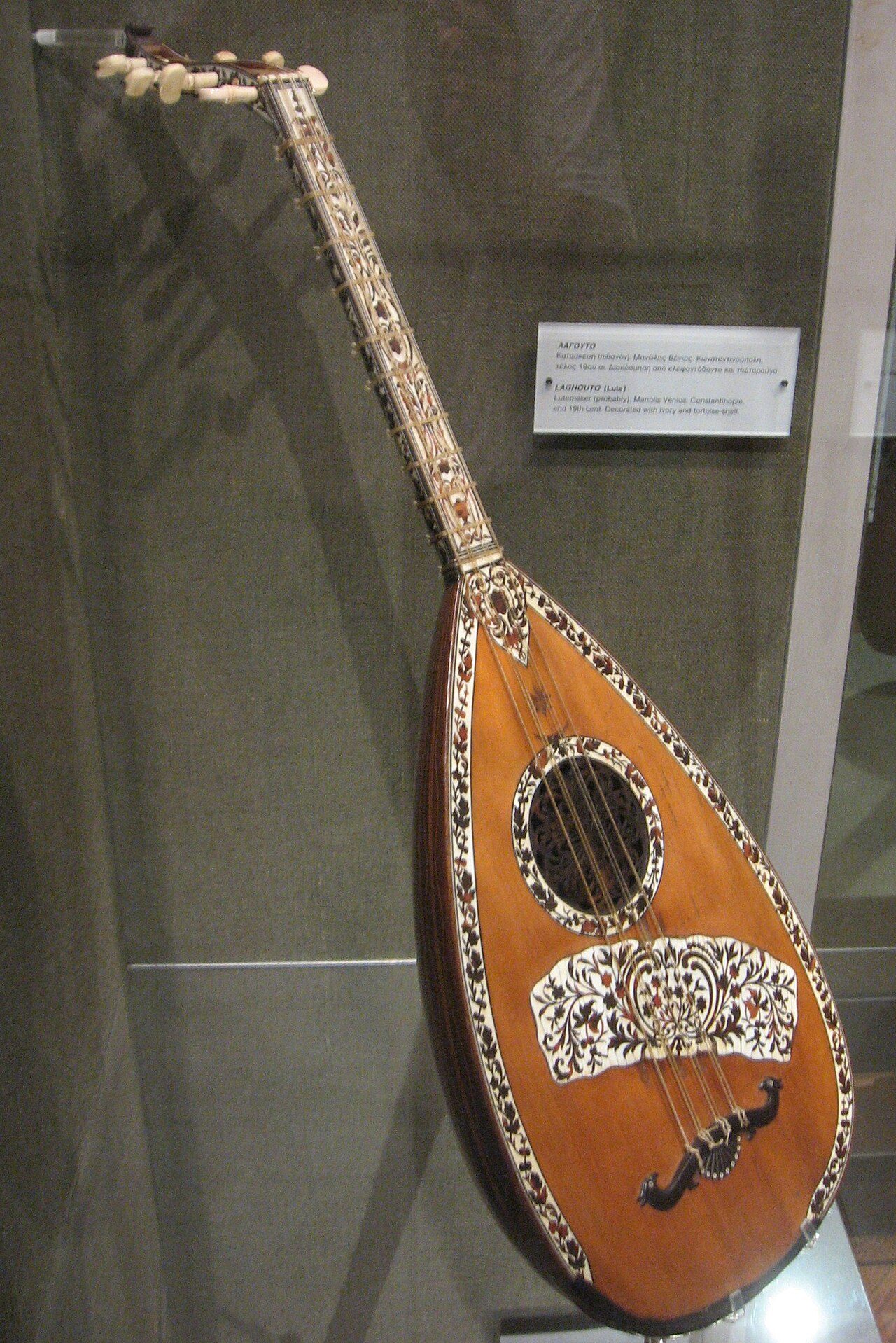
The Politiko Laouto has a small body made of many ribs made using carvel bending technique. Its appearance is somewhat like a small (Turkish) oud - the strings are made from gut like an oud but it has only 7 strings in 4 courses and is tuned D AA dd aa, it is also sometimes tuned to Turkish Bolahenk tuning C G D A. The adjustable frets are made from tied bits of gut on the fingerboard, at the microtonal intervals of the makam system. This is more closely related to instruments like tanbur than to the fretless oud and the 12-frets of the octave laouto. The bridge usually has peacock-shaped ends. The fingerboard is flush with the soundboard, is often unvarnished, and has a carved and inlaid rosette. The politiko laouto have a pegbox like the oud (angling down), The tuning pegs are shaped like those of the violin, with 3 on the right side and 4 on the left side of the open tuning head. 1
History
Known as a lavuta (լավութա) in Armenian, also occasionally called Politiko Laouto (Lute from Constantinople) in Greek, is an instrument that was popular in the early 20th century, particularly among the Greek, Armenian, and the Turkish community, it was one of the many instruments played by noted Turk Tanburi Cemil Bey. It was gradually replaced by the oud and survived until this day. From the 1980s there has been a revival of interest in this instrument, and now It is possibile to find the lavta again both in Turkey and in Greece. Right hand technique is similar to an oud, with a long thin plectrum. 1
The text above is adapted from the Wikipedia article “Lavta”, available under the Creative Commons Attribution-ShareAlike 4.0 licence. 1
lavta is plucked string instrument from İstanbul, according to the structured record cited below. This entry was generated automatically from that record and has not yet been reviewed by a person familiar with the tradition. 2
The source record links this tradition to 4 external registers, which can be verified through the citation. 2