The tradition & historical record
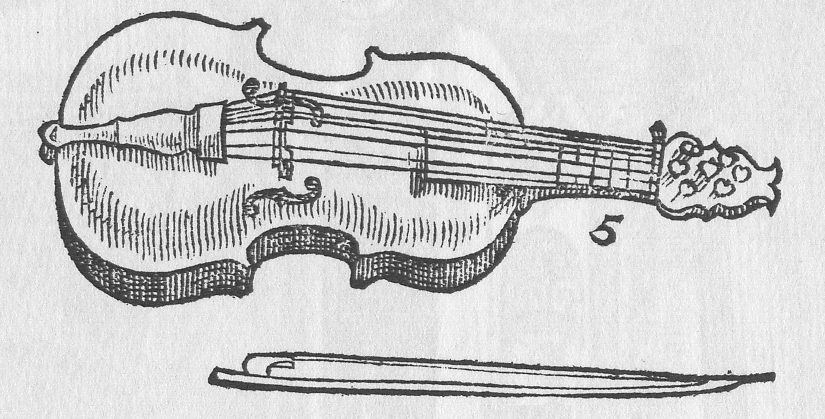
3 min read · 2 sourcesThe lira da braccio (or lira de braccio or lyra de bracio) was a European bowed string instrument of the Renaissance. It was used by Italian poet-musicians in court in the 15th and 16th centuries to accompany their improvised recitations of lyric and narrative poetry. It is most closely related to the medieval fiddle, or vielle, and like the vielle had a leaf-shaped pegbox with frontal pegs. Fiddles with drone strings are seen beginning in the 9th century (Byzantine lyra), and the instrument continued to develop through the 16th century. In many depictions of the instrument, it is being played by mythological characters, frequently members of angel consorts, and most often by Orpheus and Apollo. The lira da braccio was occasionally used in ensembles, particularly in the intermedi, and may have acted as a proto-continuo instrument. The instrument was shaped essentially like a violin, but with a wider fingerboard and flatter bridge. Generally, it had seven strings, five of them tuned like a violin with a low d added to the bottom (that is, d–g–d'–a'–e'') with two strings off the fingerboard which served as drones and were usually tuned in octaves. Michael Praetorius shows the instrument with frets, although he is the only one to do so (see image at right). The wide fingerboard and flat bridge, along with long, strongly curved bows, facilitated chordal playing on the instrument. 1
History
The lira da braccio was first cited in 1533 by Giovanni Maria Lanfranco (using the term "seven-stringed lyra"), also describing its tuning: [c-c' / g-g'-d'-a'-e]. Lira was devised to accompany humanist sung verse by poets, such as the 14th century Petrarch and his later imitators, and was popular in the North Italian city-states such as Florence, Ferrara, Mantua, Venice and so on. In this role, the Lira enjoyed a prestige among instruments that it was never quite to achieve again. Amongst its exponents at the time were several great painters, notably Leonardo da Vinci, who according to Emmanuel Winternitz, was widely held to be the doyen among performers upon the Lira. 1
The rise of the madrigal, and its counterpart, the instrumental consort, as well as the meteoric rise of the more vocal Violin, soon toppled the Lira from its pre-eminent position at court, and by the 1530s it had been relegated to stage use, in the great Renaissance festivals held by the city states and their powerful ruling dynasties. Here it was typically found onstage associated with the presence of the god Apollo, or blended in proto-continuo offstage ensembles. The Pesaro Manuscript, from the mid-16th century, an important document in the history of the Lira, records a Passemezzo Moderno, (contemporary dance measure) written in lira tablature. Discovered in the town of Pesaro, on the Adriatic coast, this strange, mutilated script is the sole surviving example of written music for the Lira. It suggests at least the possibility that the instrument was being used as a dance instrument by this time. 1
The text above is adapted from the Wikipedia article “Lira da braccio”, available under the Creative Commons Attribution-ShareAlike 4.0 licence. 1
lira da braccio is musical instrument, according to the structured record cited below. This entry was generated automatically from that record and has not yet been reviewed by a person familiar with the tradition. 2
The source record links this tradition to 17 external registers, which can be verified through the citation. 2