The tradition & historical record
4 min read · 2 sourcesLubang Jeriji Saléh is a limestone cave complex in Indonesia, located within the Sangkulirang-Mangkalihat Karst in the remote jungle of the Bengalon district of East Kutai Regency, East Kalimantan province, on the island of Borneo. In 2018, a team of researchers announced the discovery of what was then believed to be the oldest known work of figurative art in the world among the cave paintings, dating back 40,000 years. However, the same team has since found and dated an elaborate therianthrope rock art panel in the Leang Bulu' Sipong 4 cave in Sulawesi's Maros-Pangkep karst to approximately 44,000 years ago. 1
Cave paintings
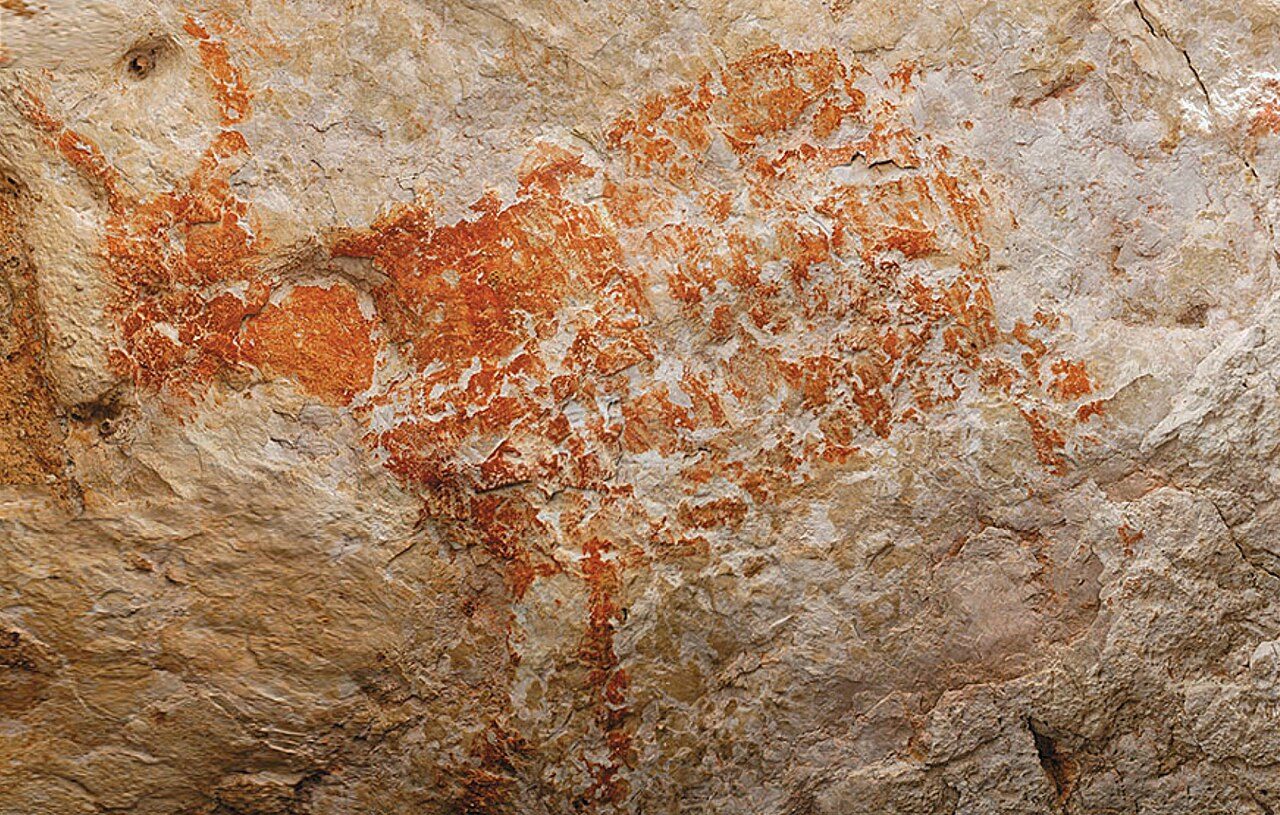
The Lubang Jeriji Saléh site is one of many caves embedded in the steep mountains of East Kalimantan. Its walls and ceiling are covered with hundreds of hand outlines and outstretched fingers within bursts of red-orange ochre or iron oxide paint, as well as figurative cave paintings. An updated analysis of the cave walls suggests that the oldest of the finger stencils date back approximately 52,000 years, and the earliest actual painting, a depiction of a banteng bull, was created around 40,000 years ago, tens of thousands of years earlier than previous estimates. The bull, part of a trio of rotund bovine creatures, is over 5 ft (1.5 m) across and also made from reddish-orange ochre on the cave's limestone walls. Based on 2018 Uranium dating of small limestone crust samples, three phases of decoration were identified. The oldest phase includes the bull depiction and red-orange ochre hand stencils. During the second phase, stencils in a mulberry colour hue, along with intricate motifs and human figures, were created. Human figures, boats, and geometric designs are attributed to the third and youngest phase. 1
Investigation
The Kalimantan caves were explored in 1994, and the paintings were first spotted by French caver Luc-Henri Fage. Lubang Jeriji Saléh (initially called Ilas Kenceng in the Kalimanthrope publications) was discovered by Pindi Setiawan, Luc-Henri Fage, and Jean-Michel Chazine in September 1998, guided by Pak Saleh, a Dayak swallow nest hunter. The surveys and the study of the paintings were carried out during three subsequent missions. This vast fossil cavity, located 300 meters above a small river, runs parallel to the cliff and connects to the outside through three successive porches beneath a summit called Ilas Kenceng. 1
The paintings, which are highly varied, are located in ten specific zones. In addition to the ceiling with bovids, a notable element is a "Bouquet of hands". 1
Luc-Henri Fage's 2003 inventory lists 328 negative hands and 43 representations, primarily anthropomorphs, mammals, and zoomorphs, along with a few signs (stick, barbed wire signs, etc.). Dating published in 2003 on a calcite formation covering two handprints indicated an age of 9900 years (U/Th combined with C14), providing the first evidence of this Borneo rock expression dating back to the Pleistocene. The 2018 team of researchers and scientists, led by Maxime Aubert from Griffith University, Australia, and Pindi Setiawan from the Bandung Institute of Technology, Indonesia, investigated the site, identified the rock paintings as the world's oldest known figurative art, and published the results in the Nature journal by the end of the year. According to a 2019 publication, the team has since discovered and dated an elaborate therianthrope rock art panel in the Leang Bulu’ Sipong 4 cave in Sulawesi to around 44,000 years old. 1
Importance
The discovery of the cave paintings is significant within human cultural history, as it supports the view that cave art was created simultaneously in Southeast Asia and Europe. However, the identity of the people who created the paintings and their subsequent fate remain unknown. Francesco d'Errico, an expert in prehistoric art at the University of Bordeaux, described the investigation as a "major archaeological discovery", but also suggested that the discovery offered little information on the geographical origins of art. 1
The text above is adapted from the Wikipedia article “Lubang Jeriji Saléh”, available under the Creative Commons Attribution-ShareAlike 4.0 licence. 1
Lubang Jeriji Saléh is limestone cave in East Kalimantan, Borneo, Indonesia, according to the structured record cited below. This entry was generated automatically from that record and has not yet been reviewed by a person familiar with the tradition. 2
The source record links this tradition to 1 external register, which can be verified through the citation. 2