The tradition & historical record
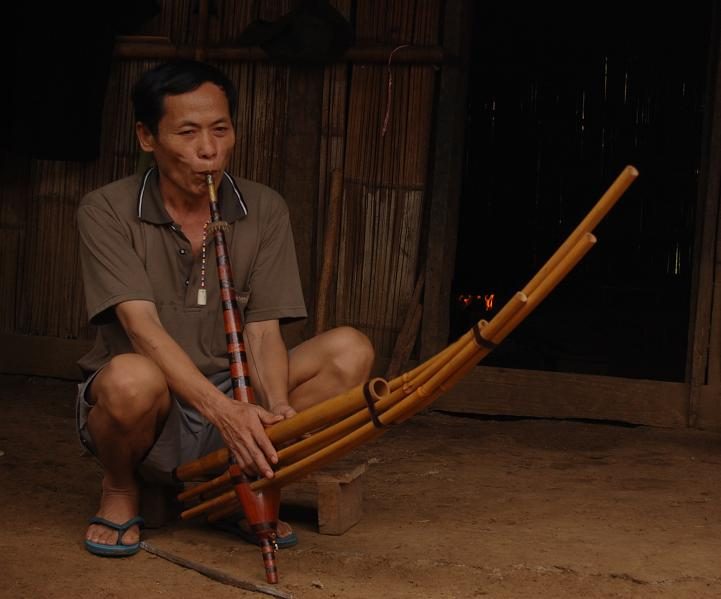
5 min read · 2 sourcesThe lusheng (simplified Chinese: 芦笙; traditional Chinese: 蘆笙; pinyin: lú shēng, pronounced [lǔʂə́ŋ]; Vietnamese: Khèn Mông; also spelled lu sheng; spelled ghengx in standard Hmong and qeej in Laotian RPA Hmong) is a Hmong musical instrument. It has a long history of 3000 years in China, traced back to the Tang Dynasty. It is a mouth organ with multiple bamboo pipes, each fitted with a free reed, which are fitted into a long blowing tube made of hardwood. It most often has five or six pipes of different pitches and is thus a polyphonic instrument. Its construction includes six parts (mouthpiece, air feed pipe, sheng dou (笙斗; "body"), sheng guan (笙管; "pipes"), reed, and resonator tube). It comes in sizes ranging from very small to several meters in length. The lusheng is used primarily in the rural regions of southwestern China (e.g. Guizhou, Guangxi, and Yunnan) and in nearby countries such as Laos and Vietnam, where it is played by such ethnic groups as the Miao (Hmong-Hmyo-Hmao-Hmu-Xong) and Dong. The lusheng has special cultural significance in the Miao regions due to its role in marriage and religious ceremonies. At the lusheng festival (September 27–29), performers often dance or swing the instrument from side to side while playing. Since the late 20th century, a modernized version of the instrument has been used in compositions, often as a solo instrument. 1
History
The lusheng can be traced back to the Tang Dynasty with a history of 3000 years in China. It is originated from the Central Plains Region of China. After spreading to the rural regions of southwestern China, lusheng became one of the favorite traditional instruments in several Chinese minority ethnic groups (in particular, the Miao, Yao, Dong, and Yi). It is believed to have evolved from the Yu (wind instrument), which is a free-reed wind instrument originated in the Han nationality. 1
In the Miao region, there is a folk legend about the origin of the lusheng. According to the legend, the world had nine suns in ancient times that caused heavy drought. People struggled to survive and built huge bows and arrows, shooting down eight of the nine suns. This scared the last sun, which kept itself hidden in the clouds. Without the sunshine, there was always night and crops failed to grow. To induce the last sun to come out, people produced the lusheng and played music. The beautiful melody from the lusheng successfully attracted the sun to come out again. After that, playing lusheng became a tradition and cultural expression of the Miao people. 1
Modern development of lusheng
On May 20, 2006, the production techniques on lusheng of the Miao nationality group was approved by China State Council and listed in the State-Level Non-Material Cultural Heritage List. The production techniques used to produce the lusheng advanced techniques of reed musical instruments production in ancient China, connecting Chinese Miao and other Miao ethnic groups around the world. 1
Construction
A traditional lusheng consists of six parts: mouthpiece, air feed pipe, sheng dou, sheng guan, reed, and resonator tube. The mouthpiece is thin bamboo, which is connected to the air feed pipe and the sheng dou; six bamboo-made sheng guan of different lengths and with reeds at the bottom are inserted into the sheng dou, each of which has a press hole and is equipped with a bamboo resonator tube at the upper or lower end of the different bamboo pipes. 1
Sheng dou
The sheng dou (笙斗), which is also called a gas box, is the body of the lusheng. It is mostly made of cedar, pine or wu tong (梧桐) wood. It has a spindle shape, with 46~56 cm in length, 4 ~ 9 cm in width, and 3.5 ~ 8 cm in height. During the production, a whole piece of blank material is split into two halves, and each inner chamber will be hollowed out respectively. Then two halves will be glued after loading into the sheng guan with seven turns of thin gabions around the outer part. The sheng dou is often light yellow, decorated with tung oil on the outside. Its beautiful appearance made lusheng has the reputation of "golden sheng". 1
Sheng guan
The pipes (sheng guan) are mostly made out of white bamboo, which has a thin diameter (1.2 cm), long joints (40~50 cm), uniform thickness, and thin walls. They are inserted longitudinally at an angle of 75° to 90° into the sheng dou. The height of sheng guan varied based on a different level of tones: soprano lusheng is 14.5 cm ~ 30 cm high, alto lusheng is 30 cm ~ 58 cm high, bass lusheng is 58 cm ~ 105 cm high, times bass lusheng is 105 cm ~ 210 cm high. 1
The text above is adapted from the Wikipedia article “Lusheng”, available under the Creative Commons Attribution-ShareAlike 4.0 licence. 1
lusheng is free-reed six-pipe bamboo mouthorgan of the Hmong people, according to the structured record cited below. This entry was generated automatically from that record and has not yet been reviewed by a person familiar with the tradition. 2
The source record links this tradition to 1 external register, which can be verified through the citation. 2