The tradition & historical record
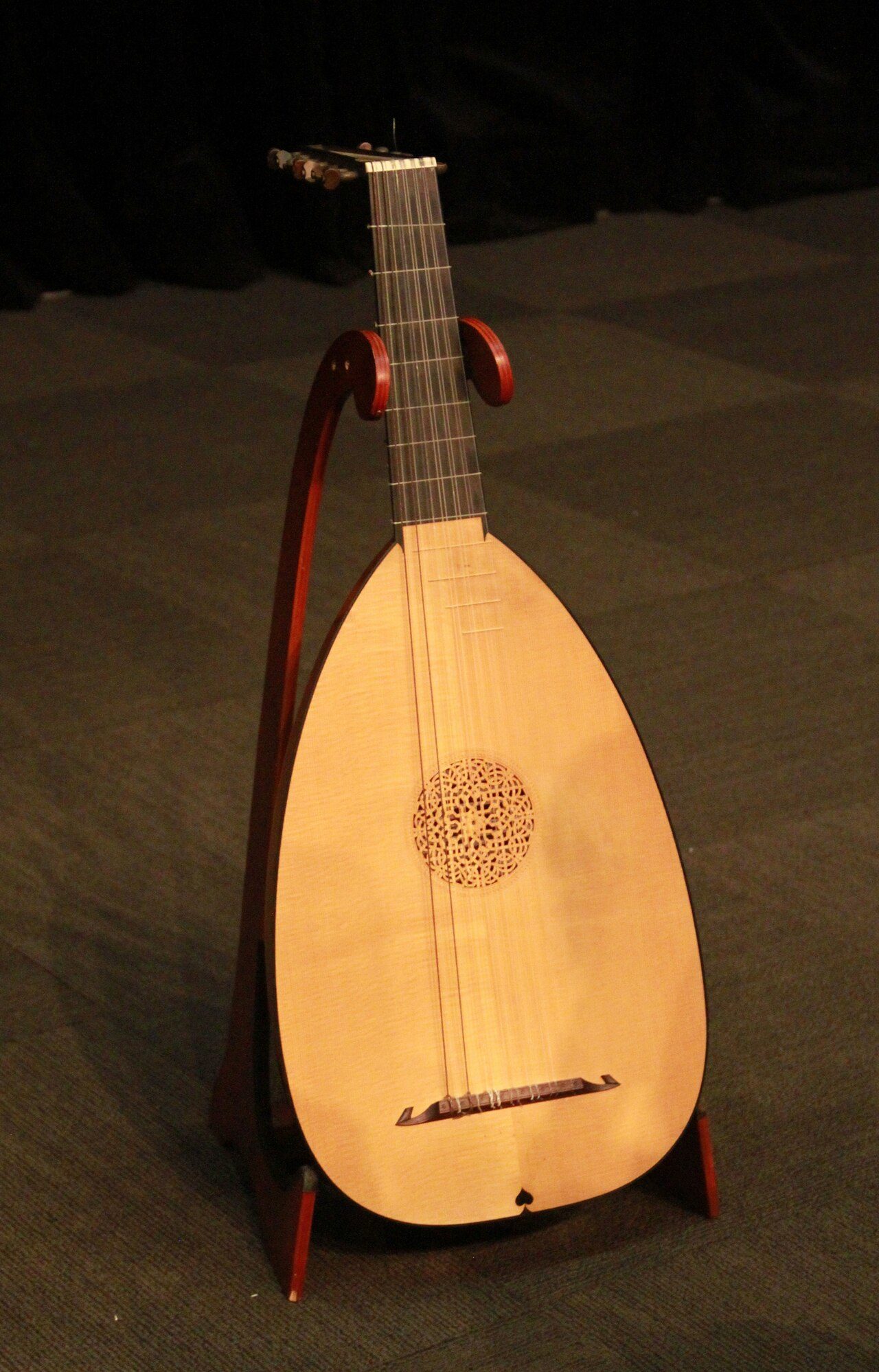
6 min read · 2 sourcesA lute ( or ) is any plucked string instrument with a neck and a deep round back enclosing a hollow cavity, usually with a sound hole or opening in the body. It may be either fretted or unfretted. More specifically, the term "lute" commonly refers to an instrument from the family of European lutes, which were themselves influenced by short-necked lutes in Gandhara which became the predecessor of the Islamic, the Sino-Japanese and the European lute families. The term also refers generally to any necked string instrument having the strings running in a plane parallel to the sound table (in the Hornbostel–Sachs system). The strings are attached to pegs or posts at the end of the neck, which have some type of turning mechanism to enable the player to tighten the tension on the string or loosen the tension before playing (which respectively raise or lower the pitch of a string), so that each string is tuned to a specific pitch (or note). The lute is plucked with one hand while the other hand "frets" (presses down) the strings on the neck's fingerboard. By pressing the strings on different places of the fingerboard, the player can shorten or lengthen the part of the string that is vibrating, thus producing higher or lower pitches (notes). The European lute and the modern Near-Eastern oud descend from a common ancestor via diverging evolutionary paths. 1
Etymology
The words lute and oud possibly derive from Arabic al-ʿoud (العود - literally means "the wood"). It may refer to the wooden plectrum traditionally used for playing the oud, to the thin strips of wood used for the back, or to the wooden soundboard that distinguished it from similar instruments with skin-faced bodies. Many theories have been proposed for the origin of the Arabic name. Music scholar Eckhard Neubauer suggested that oud may be an Arabic borrowing from the Persian word rōd or rūd, which meant string. Another researcher, archaeomusicologist Richard J. Dumbrill, suggests that rud came from the Sanskrit rudrī (रुद्री, meaning "string instrument") and transferred to Arabic and European languages by way of a Semitic language. However another theory, according to Semitic language scholars, is that the Arabic ʿoud is derived from Syriac ʿoud-a, meaning "wooden stick" and "burning wood"—cognate to Biblical Hebrew 'ūḏ, referring to a stick used to stir logs in a fire. Henry George Farmer notes the similarity between al-ʿūd and al-ʿawda ("the return" – of bliss). 1
First lutes
Curt Sachs defined lute in the terminology section of The History of Musical Instruments as "composed of a body, and of a neck which serves both as a handle and as a means of stretching the strings beyond the body". His definition focused on body and neck characteristics and not on the way the strings were sounded, so the fiddle counted as a "bowed lute". Sachs also distinguished between the "long-necked lute" and the short-necked variety. The short-necked variety contained most of our modern instruments, "lutes, guitars, hurdy-gurdies and the entire family of viols and violins". The long lutes were the more ancient lutes; the tanbūr ... faithfully preserved the outer appearance of the ancient lutes of Babylonia and Egypt". He further categorized long lutes with a "pierced lute" and "long neck lute". The pierced lute had a neck made from a stick that pierced the body (as in the ancient Egyptian long-neck lutes, and the modern African gunbrī). The long lute had an attached neck, and included the sitar, tanbur and tar: the dutār had two strings, setār three strings, čārtār four strings, pančtār five strings. Sachs's book is from 1941, and the archaeological evidence available to him placed the early lutes at about 2000 BC. Discoveries since then have pushed the existence of the lute back to c. 3100 BC. Musicologist Richard Dumbrill today uses the word lute more categorically to discuss instruments that existed millennia before the term "lute" was coined. Dumbrill documented more than 3,000 years of iconographic evidence of the lutes in Mesopotamia, in his book The Archaeomusicology of the Ancient Near East. According to Dumbrill, the lute family included instruments in Mesopotamia before 3000 BC. 1
Persian barbat
Bactria and Gandhara became part of the Sasanian Empire (224–651). Under the Sasanians, a short almond-shaped lute from Bactria came to be called the barbat or barbud, which was developed into the later Islamic world's oud or ud. When the Moors conquered Andalusia in 711, they brought their ud or quitra along, into a country that had already known a lute tradition under the Romans, the pandura. During the 8th and 9th centuries, many musicians and artists from across the Islamic world flocked to Iberia. Among them was Abu l-Hasan 'Ali Ibn Nafi' (789–857), a prominent musician, who had trained under Ishaq al-Mawsili (d. 850) in Baghdad and was exiled to Andalusia before 833. He taught and has been credited with adding a fifth string to his oud and with establishing one of the first schools of music in Córdoba. By the 11th century, Muslim Iberia had become a center for the manufacture of instruments. These goods spread gradually to Provence, influencing French troubadours and trouvères and eventually reaching the rest of Europe. While Europe developed the lute, the oud remained a central part of Arab music, and broader Ottoman music, undergoing a range of transformations. Beside the introduction of the lute to Spain (Andalusia) by the Moors, another important point of transfer of the lute from Arabian to European culture was Sicily, where it was brought either by Byzantine or later by Muslim musicians. There were singer-lutenists at the court in Palermo after the Norman conquest of the island from the Muslims, and the lute is depicted extensively in the ceiling paintings in the Palermo's royal Cappella Palatina, dedicated by the Norman King Roger II of Sicily in 1140. 1
From Middle Ages to Baroque
Medieval lutes were four- and five-course instruments, plucked with a quill as a plectrum. There were several sizes and, by the end of the Renaissance, seven sizes (up to the great octave bass) are documented. Song accompaniment was probably the lute's primary function in the Middle Ages, but very little music securely attributable to the lute survives from before 1500. Medieval and early-Renaissance song accompaniments were probably mostly improvised, hence the lack of written records. In the last few decades of the fifteenth century, to play Renaissance polyphony on a single instrument, lutenists gradually abandoned the quill in favor of plucking the instrument with the fingers. The number of courses grew to six and beyond. The lute was the premier solo instrument of the sixteenth century, but continued to accompany singers as well. About 1500, many Iberian lutenists adopted vihuela de mano, a viol-shaped instrument tuned like the lute; both instruments continued in coexistence. 1
Soundboard
Lutes are made almost entirely of wood. The soundboard is a teardrop-shaped thin flat plate of resonant wood (typically spruce). 1
The text above is adapted from the Wikipedia article “Lute”, available under the Creative Commons Attribution-ShareAlike 4.0 licence. 1
lute is musical instrument, according to the structured record cited below. This entry was generated automatically from that record and has not yet been reviewed by a person familiar with the tradition. 2
The source record links this tradition to 39 external registers, which can be verified through the citation. 2