The tradition & historical record
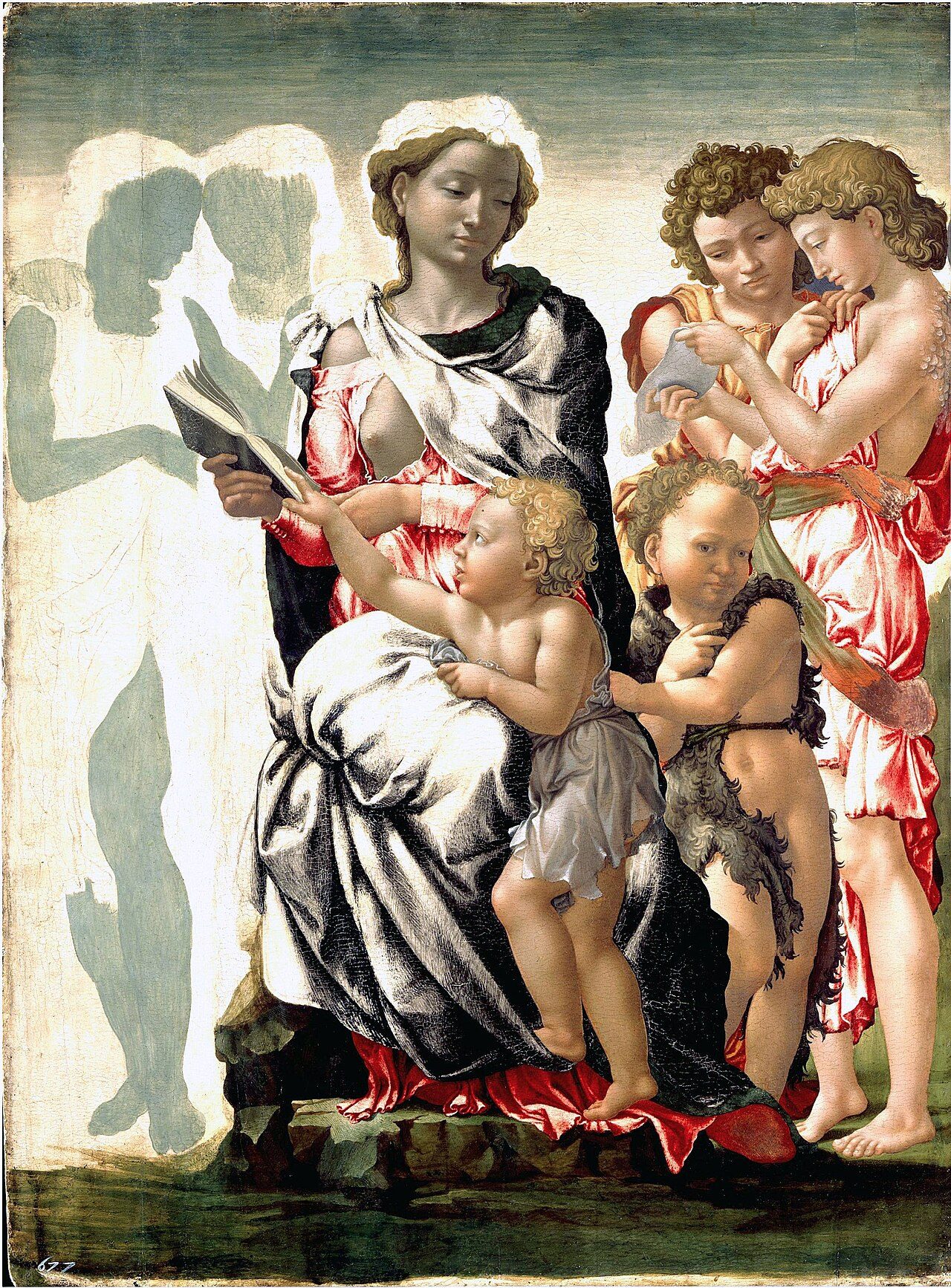
2 min read · 2 sourcesThe Madonna and Child with St John and Angels (c. 1497), also known as The Manchester Madonna, is an unfinished painting in the National Gallery, London, attributed to Michelangelo. It is one of three surviving panel paintings attributed to the artist and has been dated to his first period in Rome. The work first came to public attention in the Art Treasures Exhibition in Manchester in 1857, hence the title the "Manchester Madonna". Attribution of the painting to Michelangelo was in doubt for much of the nineteenth and twentieth centuries, but now most scholars are in agreement. Like other Renaissance paintings of the Madonna and Child that include John the Baptist, the subject arises from a non-Biblical tradition that the Virgin Mary and the Child Jesus met Christ's cousin, St John the Baptist, on the Holy Family's Flight into Egypt. The Virgin is depicted with one breast bared, as if she has recently been suckling her infant son, which recalls the theme of the Virgin breastfeeding which was common in medieval painting. In her hands is a book (traditionally Isaiah chapter 53) which she attempts to hold away from her son, the contents of which probably foretell his future sacrifice and his taking to himself the evil of the world. She looks over her left shoulder to a scroll being read by a pair of angels, which is likely to read Ecce Agnus Dei ("Behold the Lamb of God"), usually an attribute of John the Baptist. 1
Attribution
The completed angel nearest the Virgin is noted as being similar to a sketch the young Michelangelo made while he was apprenticed to Domenico Ghirlandaio. 1
The text above is adapted from the Wikipedia article “Manchester Madonna”, available under the Creative Commons Attribution-ShareAlike 4.0 licence. 1
Manchester Madonna is unfinished painting attributed to Michelangelo in the National Gallery, London, according to the structured record cited below. This entry was generated automatically from that record and has not yet been reviewed by a person familiar with the tradition. 2
The source record links this tradition to 6 external registers, which can be verified through the citation. 2