The tradition & historical record
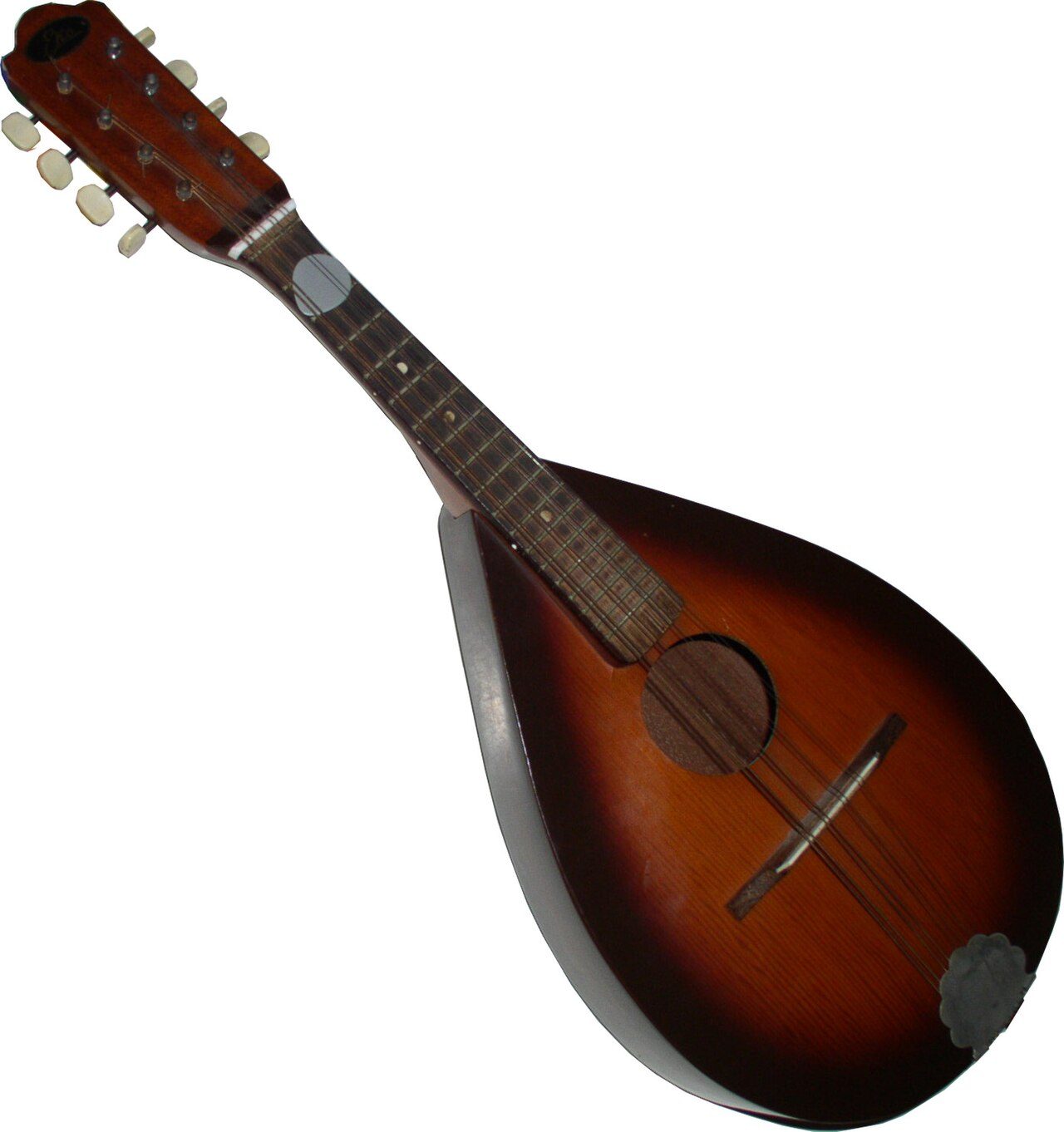
5 min read · 2 sourcesA mandolin (Italian: mandolino, pronounced [mandoˈliːno]; literally "small mandola") is a stringed musical instrument in the lute family and is generally plucked with a pick. It most commonly has four courses of doubled strings tuned in unison, thus giving a total of eight strings. A variety of string types are used, with steel strings being the most common and usually the least expensive. The courses are typically tuned in an interval of perfect fifths, with the same tuning as a violin (G3, D4, A4, E5). Also, like the violin, it is the soprano member of a family that includes the mandola, octave mandolin, mandocello and mandobass. There are many styles of mandolin, but the three most common types are the Neapolitan or round-backed mandolin, the archtop mandolin and the flat-backed mandolin. The round-backed version has a deep bottom, constructed of strips of wood, glued together into a bowl. The archtop, also known as the carved-top mandolin, has an arched top and a shallower, arched back both carved out of wood. The flat-backed mandolin uses thin sheets of wood for the body, braced on the inside for strength in a similar manner to a guitar. Each style of instrument has its own sound quality and is associated with particular styles of music. Neapolitan mandolins feature prominently in European classical music and in traditional music like the Andean music of Peru. Archtop instruments are common in American folk music, old-time music, and bluegrass music. 1
History
Mandolins evolved from lutes, a family of instruments in Europe. Predecessors include the gittern and mandore or mandola in Italy during the 17th and 18th centuries. There were a variety of regional variants, but the two most widespread ones were the Neapolitan mandolin and the Lombard mandolin. The Neapolitan style has spread worldwide. 1
Construction
Mandolins have a body that acts as a resonator, attached to a neck. The resonating body may be shaped as a bowl (necked bowl lutes) or a box (necked box lutes). Traditional Italian mandolins, such as the Neapolitan mandolin, meet the necked bowl description. The necked box instruments include archtop mandolins and the flatback mandolins. Strings run between mechanical tuning machines at the top of the neck to a tailpiece that anchors the other end of the strings. The strings are suspended over the neck and soundboard and pass over a floating bridge. The bridge is kept in contact with the soundboard by the downward pressure from the strings. The neck is either flat or has a slight radius, and is covered with a fingerboard with frets. The action of the strings on the bridge causes the soundboard to vibrate, producing sound. Like any plucked instrument, mandolin notes decay to silence rather than sound out continuously as with a bowed note on a violin, and mandolin notes decay faster than larger chordophones like the guitar. This encourages the use of tremolo (rapid picking of one or more pairs of strings) to create sustained notes or chords. The mandolin's paired strings facilitate this technique: the plectrum (pick) strikes each of a pair of strings alternately, providing a more full and continuous sound than a single string would. Various design variations and amplification techniques have been used to make mandolins comparable in volume with louder instruments and orchestras, including the creation of mandolin-banjo hybrids with the drum-like body of the louder banjo, adding metal resonators (most notably by Dobro and the National String Instrument Corporation) to make a resonator mandolin, and amplifying electric mandolins through amplifiers. 1
Tuning
A variety of different tunings are used. Usually, courses of 2 adjacent strings are tuned in unison. By far the most common tuning is the same as violin tuning, in scientific pitch notation G3–D4–A4–E5, or in Helmholtz pitch notation: g–d′–a′–e″. 1
fourth (lowest tone) course: G3 (196.00 Hz) third course: D4 (293.66 Hz) second course: A4 (440.00 Hz; A above middle C) first (highest tone) course: E5 (659.25 Hz) The numbers of Hz shown above assume a 440 Hz A, standard in most parts of the western world. Some players use an A up to 10 Hz above or below a 440, mainly outside the United States. 1
Other tunings exist, including cross-tunings, in which the usually doubled string runs are tuned to different pitches. Additionally, guitarists may sometimes tune a mandolin to mimic a portion of the intervals on a standard guitar tuning to achieve familiar fretting patterns. 1
Soprano
The mandolin is the soprano member of the mandolin family, as the violin is the soprano member of the violin family. Like the violin, its scale length is typically about 13 inches (330 mm). Modern American mandolins modelled after Gibsons have a longer scale, about 13+7⁄8 inches (350 mm). The strings in each of its double-strung courses are tuned in unison, and the courses use the same tuning as the violin: G3–D4–A4–E5. 1
Piccolo
The piccolo or sopranino mandolin is a rare member of the family, tuned one octave above the mandola and one fourth above the mandolin (C4–G4–D5–A5); the same relation as that of the piccolo (to the western concert flute) or violino piccolo (to the violin and viola). One model was manufactured by the Lyon & Healy company under the Leland brand. A handful of modern instruments makers build piccolo mandolins. 1
The text above is adapted from the Wikipedia article “Mandolin”, available under the Creative Commons Attribution-ShareAlike 4.0 licence. 1
mandolin is musical instrument in the lute family, according to the structured record cited below. This entry was generated automatically from that record and has not yet been reviewed by a person familiar with the tradition. 2
The source record links this tradition to 49 external registers, which can be verified through the citation. 2