The tradition & historical record
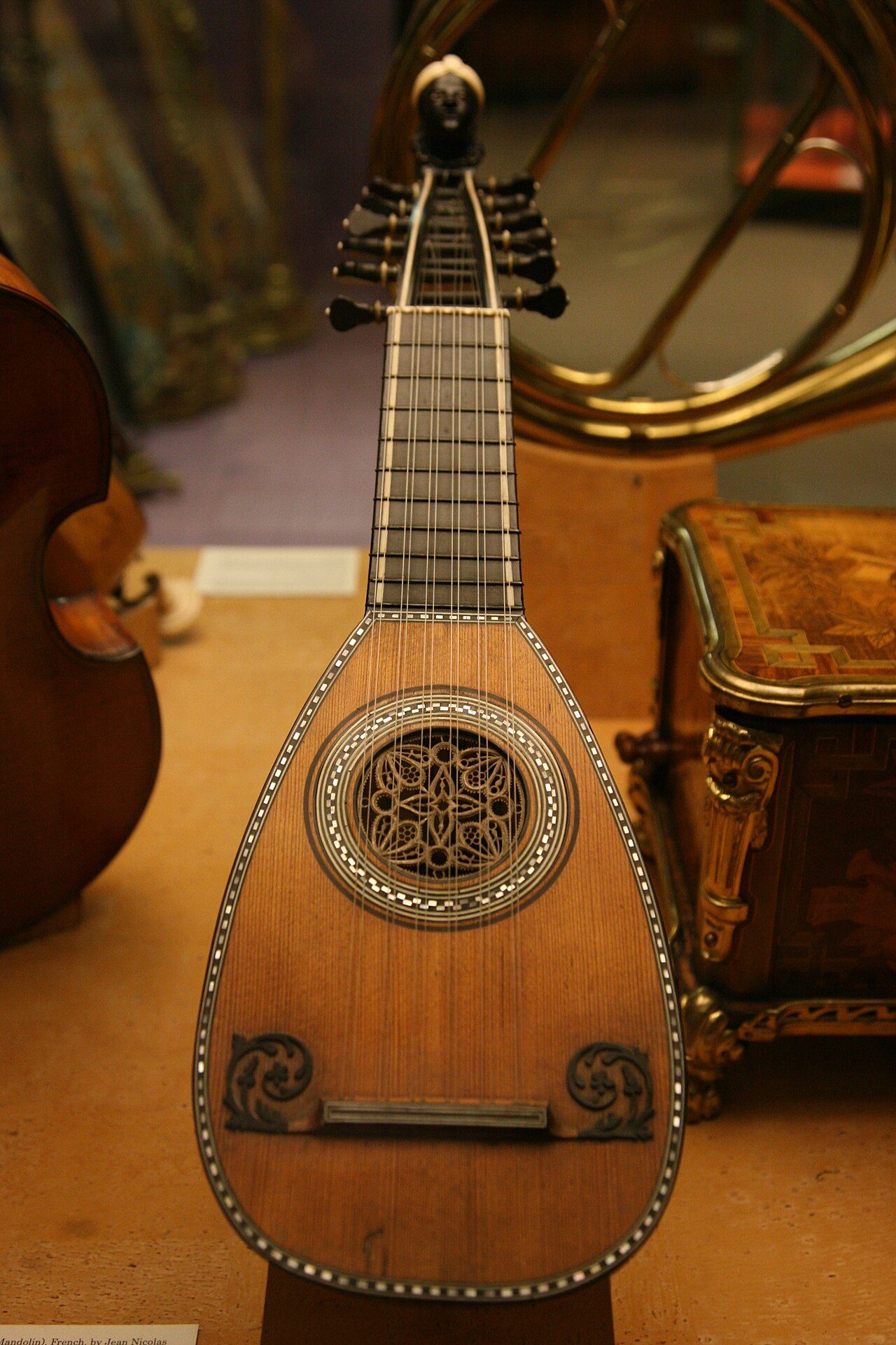
5 min read · 2 sourcesThe mandore is a musical instrument, a small member of the lute family, teardrop shaped, with four to six courses of gut strings and pitched in the treble range. Considered a French instrument, with much of the surviving music coming from France, it was used across "Northern Europe" including Germany and Scotland. Although it went out of style, the French instrument has been revived for use in classical music. The instrument's most commonly played relatives today are members of the mandolin family and the bandurria. The mandore arrived in France from Spain, and was considered a new instrument in French music books from the 1580s, but can be seen as a development of the gittern. In Spain the mandore was called vandola. Musicologist James Tyler said that the Spanish bandurria with three strings was the mandore, although it had four strings when it arrived in France. In its Spanish form the bandurria may have resembled the rebec. The mandore was played widely across Europe, just as the earlier gittern had been. The Italians called it the mandola and even as the instrument became obsolete elsewhere, by the mid 17th century they had developed it into "an instrument with its own distinct tuning, technique and music." In Milan, Italy as the mandore or Lombardo, it remained in use into the late 19th century. That variant is known today as the Milanese or Lombardic mandolin, and retains the mandore's tuning. The Italians also called it the mandora or mandola. 1
History
Illustrations in the 13th-century Cantigas de Santa Maria show instruments similar to lutes, mandores, mandolas and guitars, being played by European and Islamic players. The instruments moved from Spain northward to France and eastward towards Italy by way of Provence. Beside the introduction of the lute to Spain (Andalusia) by the Moors, another important point of transfer of the lute from Arabian to European culture was Sicily, where it was brought either by Byzantine or later by Muslim musicians. There were singer-lutenists at the court in Palermo following the Norman conquest of the island from the Muslims, and the lute is depicted extensively in the ceiling paintings in the royal Cappella Palatina in Palermo, dedicated by the Norman King Roger II of Sicily in 1140. His Hohenstaufen grandson Frederick II, Holy Roman Emperor (1194 - 1250) continued integrating Muslims into his court, including Moorish musicians. By the fourteenth century, lutes had disseminated throughout Italy and, probably because of the cultural influence of the Hohenstaufen kings and emperor, the lute made significant inroads into German-speaking lands. 1
Construction
Like the earlier gittern, the mandore's back and neck were in earlier forms carved out of a block of wood. This "hollowed out construction" did still exist in the 16th century, according to James Tyler, but was becoming rare. The method was being replaced by gluing curved staves together to form back, and adding a neck and peg box. From Mersenne: The normal length of a mandore is 11⁄2 feet long. It is built as a lute, with "strips of fir or other wood" ... "cut and bent into melon shape" to make a rounded back. The fingerboard is on the same plane as the soundboard, with a bridge glued onto the soundboard. Strings are secured in the pegboard in the neck, pass over the fingerboard and soundboard and are tied to a flat bridge, which is glued to the soundboard. The instrument may have as few as four strings or as many as six. It could also have four to six courses of two strings. The soundhole was covered with a rose, either carved directly into the soundboard or glued in. 1
Methods of playing
From Marin Mersenne, 1635: A musician plays the mandore "with the finger or the tip of a feather between thumb and index finger or tied to one of the other fingers." "Those who make perfect use of the mandore would move the pick so fast over the strings that they seem to form even chords as they would be if played at the same time." Another early 17th-century author, Michael Praetorius, agreed. He said, "They play either with a cittern-type quill plectrum, or with one finger - and this with the speed, clarity, and precision that we would expect from the use of three or four fingers. There are some players, however, who start to use two or more fingers once they are familiar with the instrument." 1
According to Praetorius
Michael Praetorius detailed four tunings for the Mandore in his book Syntagma Musicum in 1619. He listed three tunings (with one repeated) for tuning the mandore. His tuning illustrates tuning for both 4-stringed instruments and 5-stringed instruments. 1
Fifths and fourths
The listed tunings using fifths and fourths between strings are: 1
C-G-C-G C-G-C-G-C G-D-G-D 1
The text above is adapted from the Wikipedia article “Mandore (instrument)”, available under the Creative Commons Attribution-ShareAlike 4.0 licence. 1
mandore is musical instrument, according to the structured record cited below. This entry was generated automatically from that record and has not yet been reviewed by a person familiar with the tradition. 2
The source record links this tradition to 7 external registers, which can be verified through the citation. 2