The tradition & historical record
7 min read · 2 sourcesMarine art or maritime art is a form of figurative art (i.e. painting, drawing, printmaking, and sculpture) that portrays or draws its main inspiration from the sea. Maritime painting is a genre that depicts ships and the sea, being particularly strong from the 17th to the 19th centuries. In practice, the term often covers art showing shipping on rivers and estuaries, beach scenes and all art showing boats, without any rigid distinction—for practical reasons subjects that can be drawn or painted from dry land in fact feature strongly in the genre. Strictly speaking, "maritime art" should always include some element of human seafaring, whereas "marine art" would also include pure seascapes without any human element, though this distinction may not be observed in practice. 1
Ships and boats have been included in art from almost the earliest times, but marine art only began to become a distinct genre, with specialized artists, towards the end of the Middle Ages, mostly in the form of the "ship portrait", a type of work that is still popular and concentrates on depicting a single vessel. As landscape art emerged during the Renaissance, what might be called the marine landscape became a more important element in works, but pure seascapes were rare until later. 1
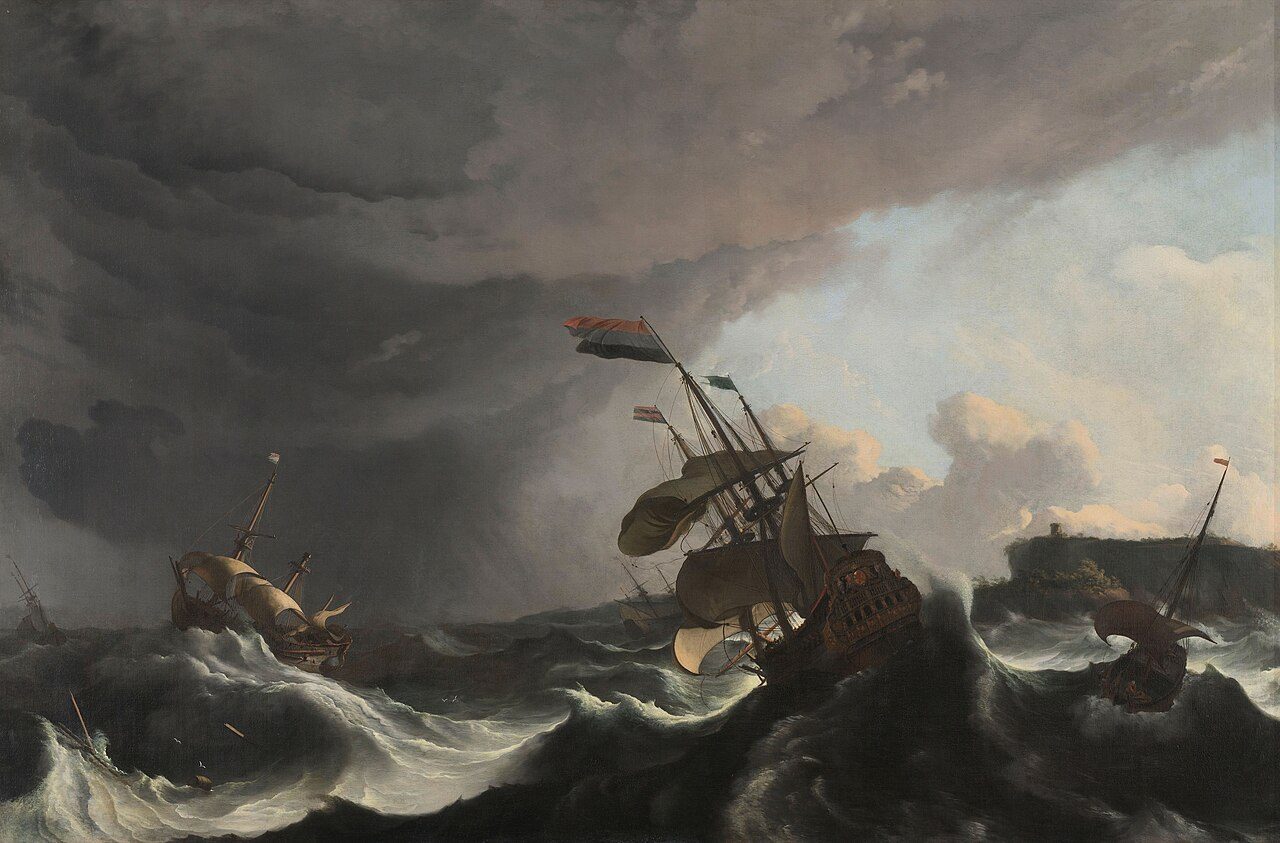
Maritime art, especially marine painting—as a particular genre separate from landscape—actually began with Dutch Golden Age painting in the 17th century. 1
Earliest times to 1400
Vessels on the water have featured in art from the earliest times. The earliest known works are petroglyphs from 12,000 BCE showing reed boats in the Gobustan Petroglyph Reserve in modern Azerbaijan, which was then on the edge of the much larger Caspian Sea. Rock carvings and carved objects depicting ships have been found on several islands of the Aegean (Andros, Naxos, Syros, Astypalaia, Santorini) as well as mainland Greece (Avlis), dating from 4,000 BCE onwards. Both men and gods are shown on river "barges" in Ancient Egyptian art; these boats were made of papyrus reed for most uses, but the vessels used by the pharaohs were of costly imported cedar wood, like the 43.6 m (143 ft) long and 5.9 m (19.5 ft) wide Khufu ship of c. 2,500. Nilotic landscapes in fresco in Egyptian tombs often show scenes of hunting birds from boats in the Nile delta, and grave goods include detailed models of boats and their crews for use in the afterlife. The central cult image in Egyptian temples was usually a small figure of the god, carried in a barge or "barque". 1
Ships sometimes appear in Ancient Greek vase painting, especially when relevant in a narrative context, and also on coins and other contexts, though with little attempt at a seascape setting. As in Egyptian painting, the surface of the water may be indicated by a series of parallel wavy lines. Ancient Roman painting, presumably drawing on Greek traditions, very often shows landscape views from the land across a lake or bay with distant land on the horizon, as in the famous "Ulysses" paintings in the Vatican Museums. The water is usually calm, and objects that are submerged, or partly so, may be shown through the water. 1
15th century
A distinct tradition begins to re-emerge in Early Netherlandish painting, with two lost miniatures in the Turin-Milan Hours, probably by Jan van Eyck in about 1420, showing a huge leap in the depiction of the sea and its weather. Of the seashore scene called The Prayer on the Shore (or Duke William of Bavaria at the Seashore, the Sovereign's prayer etc.) Kenneth Clark says: "The figures in the foreground are in the chivalric style of the de Limbourgs; but the sea shore beyond them is completely outside the 15th-century range of responsiveness, and we see nothing like it again until Jacob van Ruisdael's beach-scenes of the mid-17th century." There was also a true seascape, the Voyage of St Julian & St Martha, but both pages were destroyed in a fire in 1904, and only survive in black and white photographs. For the rest of the 15th century, illuminated manuscript painting was the main medium of marine painting, and in France and Burgundy in particular many artists became skilled in increasingly realistic depictions of both seas and ships, used in illustrations of wars, romances and court life, as well as religious scenes. Scenes of small pleasure boats on rivers sometimes feature in the calendar miniatures from books of hours by artists such as Simon Bening. During the Gothic period the nef, a large piece of goldsmith's work in the shape of a ship, used for holding cutlery, salt or spices, became popular among the grand. Initially just consisting of the "hull", from the 15th century the most elaborate had masts, sails and even crew. As the exotic nautilus shell began to reach Europe, many used these for their hull, like the Burghley Nef of about 1528. Lower down the social scale, interest in shipping was reflected in many early prints of ships. 1
16th century
The Netherlandish tradition of the "world landscape", a panoramic view from a very high viewpoint, pioneered by Joachim Patinir in the 1520s, once again begins to include a wide expanse of water in a rather similar way to the classical paintings, which these artists cannot have been aware of. These paintings were essentially landscapes in the guise of history paintings, with small figures usually representing a religious subject. A strong marine element was therefore present as landscape painting began to emerge as a distinct genre. The Protestant Reformation greatly restricted the uses of religious art, accelerating to the development of other secular types of art in Protestant countries, including landscape art and secular forms of history painting, which could both form part of marine art. 1
An important work by a Flemish "follower of Patenir" is the Portuguese Carracks off a Rocky Coast of about 1540 (787 x 1447 mm), in the National Maritime Museum, Greenwich, London, "which has justly been labelled the earliest known pure marine painting". This probably represents the meeting of two small fleets involved in escorting a Portuguese princess going to be married; a type of ceremonial maritime subject which remained very common in court art until the late 17th century, although more often set at the point of embarkation or arrival. Another example is the painting in the Royal Collection showing Henry VIII embarking for the Field of the Cloth of Gold, which is typical in clearly showing the ships side-on, with no attempt to adjust for the high view point. 1
A superb coloured drawing by Hans Holbein the Younger of a ship crowded with drunken lansquenets was perhaps done in preparation for a mural in London. 1
Maritime painting of the Dutch Golden Age
The Dutch Republic relied on fishing and trade by sea for its exceptional wealth, had naval wars with Britain and other nations during the period, and was criss-crossed by rivers and canals. 1
18th century
The century supplied an abundance of military actions to depict, much of them fought between the British and French navies. 1
The text above is adapted from the Wikipedia article “Marine art”, available under the Creative Commons Attribution-ShareAlike 4.0 licence. 1
marine art is form of figurative art that portrays or draws its main inspiration from the sea, according to the structured record cited below. This entry was generated automatically from that record and has not yet been reviewed by a person familiar with the tradition. 2
The source record links this tradition to 10 external registers, which can be verified through the citation. 2