The tradition & historical record
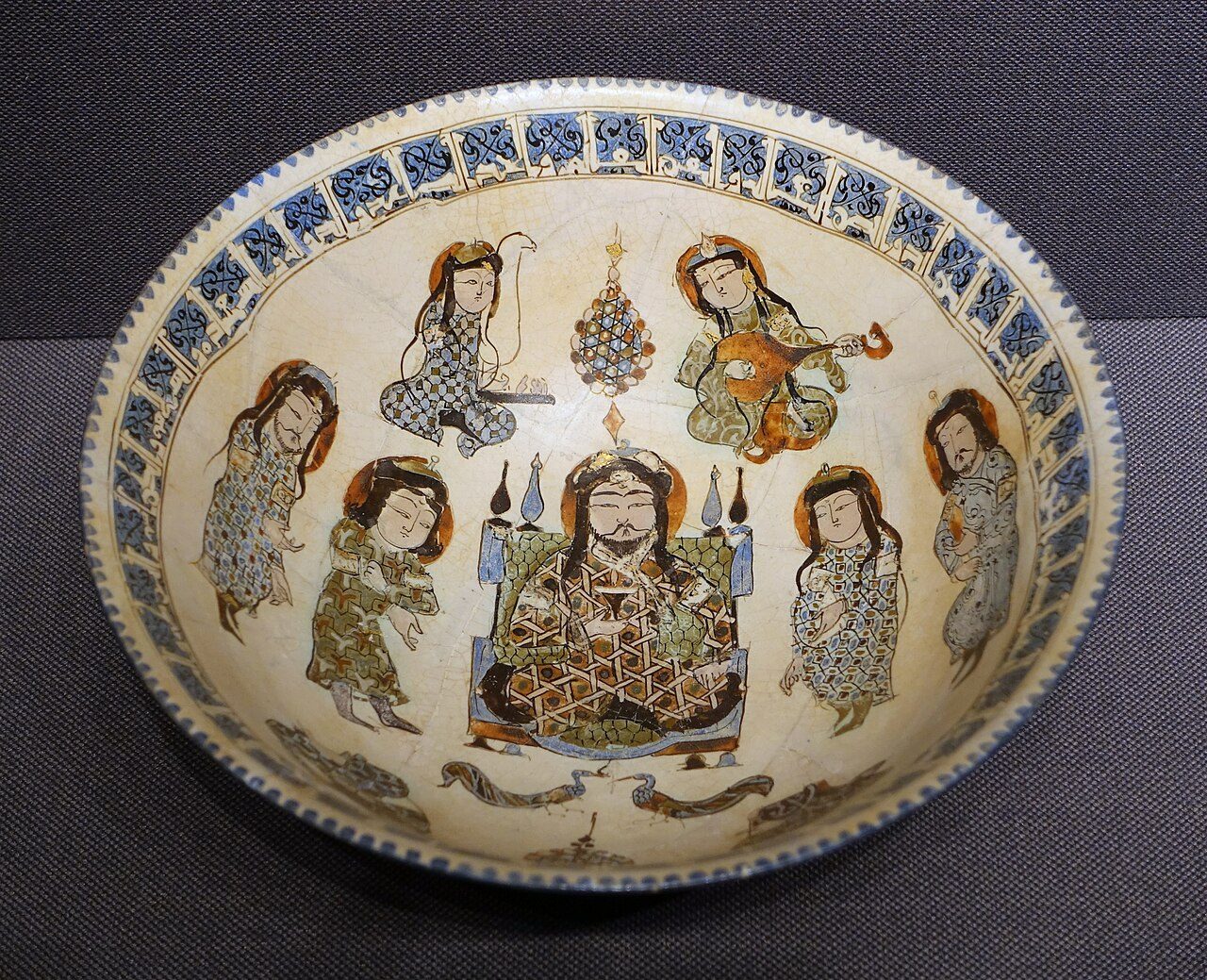
6 min read · 2 sourcesMina'i ware (Persian: سفال مینایی) is a type of Persian pottery developed in Kashan in the decades leading up to the Mongol invasion of Persia and Mesopotamia in 1219, after which production ceased. It has been described as "probably the most luxurious of all types of ceramic ware produced in the eastern lands during the medieval period". The ceramic body of white-ish fritware or stonepaste is fully decorated with detailed paintings using several colours, usually including figures. It is significant as the first pottery to use overglaze enamels, painted over the ceramic glaze fixed by a main glost firing; after painting the wares were given a second firing at a lower temperature. "Mina'i" (Persian: مینایی), a term only used for these wares much later, means "enamelled" in the Persian language. The technique is also known as haft-rang, "seven colours" in Persian. This term was used by the near-contemporary writer Abu al-Qasim Kasani, who had a pottery background. This technique much later became the standard method of decorating the best European and Chinese porcelain, though it is not clear that there was a connection between this and the earlier Persian use of the technique. 1
Wares and dates
Black and cobalt blue may be in underglaze, with a wider range of colours in overglaze. As well as the usual white glaze, a coloured turquoise glaze is used in some pieces, giving a background to the overglaze painting. The designs' outlines were black, with thin brushed lines. Some mina'i pieces, usually thought to be from the later part of the period, use gilding, sometimes on patterns on the body that are raised up (probably using slip). A few pieces combine lustre and mina'i painting in different zones. 1
A small proportion (smaller than for lustreware) of pieces are signed and dated. Watson records ten such pieces, signed by three potters, with dates from 1178 to 1219. For Kashan lustreware the equivalent numbers are "over ninety" pieces, "perhaps six" potters, and dates from 1178 and 1226; there are then no dated pieces until 1261, suggesting the long-lasting disruption of the Mongol invasion. Abū Zayd ibn Muḥammad ibn Abī Zayd, a Kashani potter in this period, demonstrated that the same workshop might produce the two techniques with the most signed pieces, with fifteen pieces. The earliest date on these is 1187, on a mina'i bowl, but most pieces are lustreware, where dates extend to 1219. In the Ilkhanate, overglaze painting continued in a rare new style called lajvardina wares, but these featured patterns rather than figures, with deep underglaze blue and gold leaf fixed in a second firing. The Persian name refers to lapis lazuli, though the usual cobalt blue was used., The study of mina'i ware is complicated by a lot of excessive restoration and embellishment by dealers after the pieces attracted the attention of collectors, mostly in the West, from the late 19th century onwards. 1
Iconography
A few pieces have entirely abstract or geometric patterns or designs, but in most pieces, there are figures, usually several small ones. Images of enthroned rulers flanked by attendants are standard, as are figures of riders, who are often engaged in princely pursuits such as hunting and falconry. The "inscrutable rulers were probably never meant to represent particular rulers or their consorts", any more than the loving couples. Similar motifs abound in other media; it is not clear to what extent they reflected the actual lifestyle of the owners or users of pieces; probably, these "may indicate a general middle-class aspiration or identification" with the princely lifestyle. Peacocks may accompany princes, and there are often numbers of the Islamic version of the sphinx, especially around the outer border of flat open shapes. Scenes and figures from the Persian literary classics can be seen. The outside of raised bowls is usually not painted with images, although some have relatively simple floral or abstract decoration, but inscriptions of text running around the piece are common. Many of these are from standard works of Persian poetry, possibly taken from anthologies that would have been available to the potters. 1
A well-known low bowl in the Freer Gallery of Art (reconstructed from fragments) is exceptional, both in its size of 47.8 cm across and in its design; it is the largest known plate in the mina'i technique. There are a vast number of figures, all at the small size typical of other, smaller, pieces. They are engaged in a battle, probably a specific event of the period when "an Assassin stronghold was attacked by a petty Iranian prince and his troops". 1
Context
Mina'i ware began to be made during the Seljuk era. Although generally described as belonging to the "Seljuk period", some of the "most iconic" productions of stonepaste vessels can be attributed to the Khwarazmian rulers after the end of Seljuk domination. The fifty years from 1150 saw great developments in Iranian ceramics. Firstly, the fritware body and the glazes used on it were greatly improved, allowing thinner walls and some translucency of Chinese porcelain, which was already imported into Persia and represented the main competition for local fine wares. This "white ware" body was used for various styles of decoration, all showing great advances in sophistication. Apart from Mina'i ware, the most luxurious was lustreware, which also required a light second firing; the earliest dated Persian piece is from 1179. The main colour of lustre paint used was gold; this needs to be distinguished from the overglaze application of gold leaf found in many later mina'i pieces. 1
The "white ware" body was, however, not able to match Chinese porcelain in strength, and though historians praise the delicacy and lightness of Mina'i and lustred pieces, they are dubious about the practicality of these expensive wares, because of their fragility. Ceramics were not grave goods in Islamic societies, and almost all the survivals that have come down to us were broken, and probably mostly discarded after breakage. Most find sites are unrecorded; some pieces were buried unbroken, perhaps to hide them from looters. However, there are also modern forgeries and Michelsen and Olafsdotter note that "one must now be rather suspicious of any piece of mina'i, especially those that appear to be whole and unscathed". 1
The text above is adapted from the Wikipedia article “Mina'i ware”, available under the Creative Commons Attribution-ShareAlike 4.0 licence. 1
Mina'i ware is type of Persian pottery, according to the structured record cited below. This entry was generated automatically from that record and has not yet been reviewed by a person familiar with the tradition. 2
The source record links this tradition to 2 external registers, which can be verified through the citation. 2