The tradition & historical record
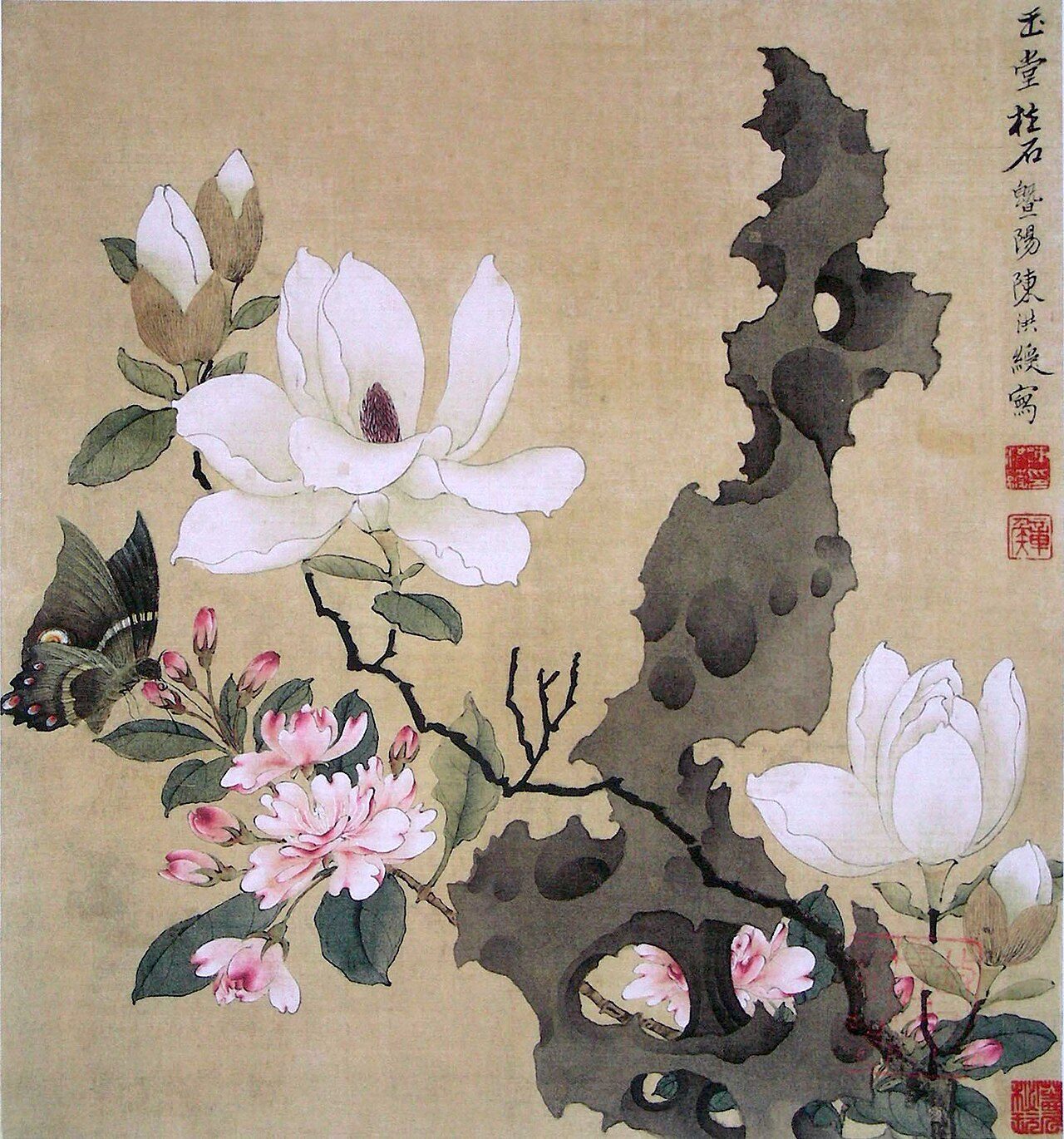
4 min read · 2 sourcesDuring the Ming dynasty (1368–1644), Chinese painting progressed further basing on the achievements in painted art during the earlier Song dynasty and Yuan dynasty. The painting techniques which were invented and developed before the Ming period became classical during this period. More colours were used in painting during the Ming dynasty. Seal brown became much more widely used, and even over-used during this period. Many new painting skills or techniques were innovated and developed, and calligraphy was much more closely and perfectly combined with the art of painting. Chinese painting reached another climax in the mid and late Ming. The painting was derived in a broad scale, many new schools were born, and many outstanding masters emerged. 1
Early Ming period
About 1368–1505, from the Hongwu era (洪武) to the Hongzhi era (弘治). The painting schools of the Yuan dynasty still remained in the early Ming period but quickly declined or changed their styles. The painting styles which were developed and matured during the Yuan period still heavily influenced the early Ming painting, but new schools of painting were born and grew. Zhe School and the school which was supported by the royal court (Yuanti School) were the dominant schools during the early Ming period. The scholar-artist style of painting (Renwen Painting, in Chinese: 人文畫) became more popular. Both these two new schools were heavily influenced by the traditions of both the Southern Song painting academy and the Yuan scholar-artist. 1
Mid Ming period
About 1465–1566, from the Chenghua era (成化) to the Jiajing era (嘉靖). 1
Classical Zhe School and Yuanti School declined. Wu School became the most dominant school nationwide. Suzhou, the activity center for Wu School painters, became the biggest center for Chinese painting during this period. The Wu painters mainly inherited the tradition of Yuan scholar-artist style of painting (Renwen painting, 人文畫) and further developed this style into a peak. Wu School was a large group of people, which included teacher-student relationships (e.g. Shen Zhou was the teacher of Tang Yin, Wen Zhengming, and so on) as well as family relationships (e.g. Wen family, including painters Wen Zhengming, Wen Jia (文嘉), Wen Boren (文伯仁), and so on). 1
Xu Wei (徐渭) from Shaoxing, Zhejiang Province developed the "enjoyable style" of Chinese painting (Xieyi, 寫意畫) considerably, especially the "great enjoyable style" (Daxieyi, 大寫意). As an outstanding scholar, his accomplishments are mainly in the field of scholar-artist painting, especially in bird-and-flower painting. Chen Chun (陳淳) followed the teaching from Wu School of painting during his early years and then developed his own "enjoyable" style in Shan shui painting (landscape painting, 山水畫). 1
Late Ming period
About 1567–1644, from the Jiajing era (嘉靖) to the Chongzhen era (崇禎). Songjiang School and Huating School were born and developed, and they formed the rudiments of the later Shanghai School. 1
Schools and painters
Zhejiang School of Painting (浙派, full name in Chinese: 浙江畫派) Jiangxia School (江夏畫派) Wulin School or Post-Zhejiang School (武林畫派, or 後浙派) Dai Jin (戴進), Wu Wei (吳偉), Lan Ying (藍瑛) (Lan family) The core place for this school was Hangzhou in Zhejiang Province. Jiangxia School from Hubei Province was a branch of this school. Dai Jin was the founder of this school, and he also kept a very close relationship with the Yuanti School. 1
Lan Ying was the last master of this school, along with his family members, and they formed a branch of Zhejiang School—Wulin School, because their family was located in Wulin (武林), a place in Hangzhou near the West Lake. Most of the painters from this school are Zhejiang natives. 1
Yuanti School (院體畫派)
Lin Liang (林良), Lv Ji (呂紀) This school was organized and supported by the Ming central government, and it served the Ming royal court. The activity center for this school was first located in Nanjing, then went to Beijing because of the change of Ming's capital. 1
The text above is adapted from the Wikipedia article “Ming dynasty painting”, available under the Creative Commons Attribution-ShareAlike 4.0 licence. 1
Ming dynasty painting is overview of Ming dynasty painting, according to the structured record cited below. This entry was generated automatically from that record and has not yet been reviewed by a person familiar with the tradition. 2
The source record links this tradition to 1 external register, which can be verified through the citation. 2