The tradition & historical record
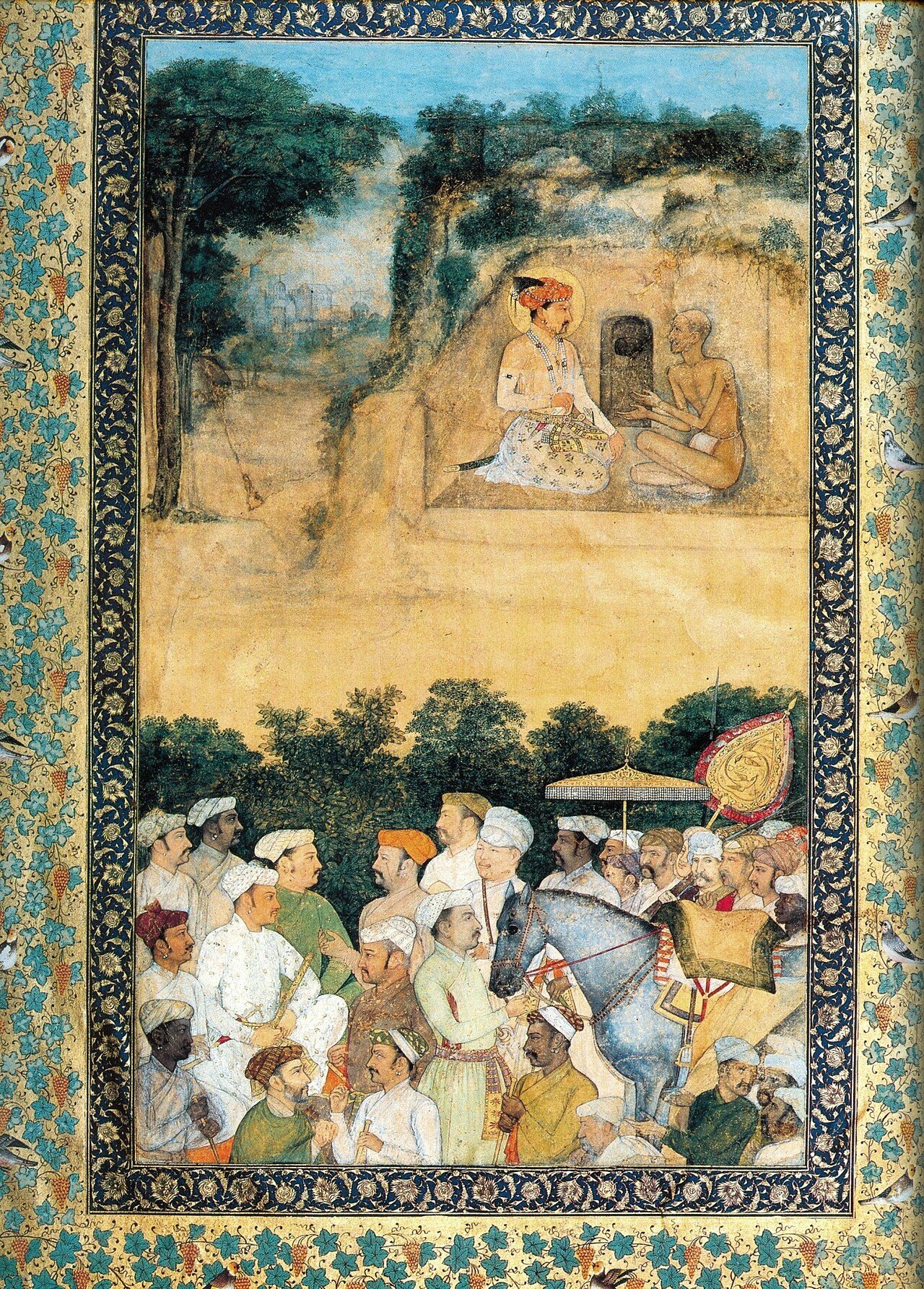
6 min read · 2 sourcesMughal painting is a style of miniature painting, used as either book illustrations or as single works to be kept in albums (muraqqa), which originated during the Mughal period in the Indian subcontinent. It originated from Persian miniature which itself was influenced heavily by Chinese and European art, Mughal paintings also feature Indian and Islamic influences in its development. As the name suggests, these paintings evolved as well as developed during the rule of Mughal emperors in India, between the 16th to 19th century. The Mughal emperors were Muslims and they are credited with consolidating Islam in the subcontinent, and spreading Islamic (and particularly Persian) art and culture as well as the faith. Mughal painting immediately took a much greater interest in realistic portraiture than was typical of Persian miniatures. Animals and plants were the main subject of many miniatures for albums, and were more realistically depicted. Although many classic works of Persian literature continued to be illustrated, as well as Indian literature, the taste of the Mughal emperors for writing memoirs or diaries, begun by Babur, provided some of the most lavishly decorated texts, such as the Padshahnama genre of official histories. Subjects are rich in variety and include portraits, events and scenes from court life, wild life and hunting scenes, and illustrations of battles. 1
Portraits
From fairly early the Mughal style made a strong feature of realistic portraiture, normally in profile, and influenced by Western prints, which were available at the Mughal court. This had never been a feature of either Persian miniature or earlier Indian painting. The pose, rarely varied in portraits, was to have the head in strict profile, but the rest of the body half turned towards the viewer. For a long time portraits were always of men, often accompanied by generalized female servants or concubines; but there is scholarly debate about the representation of female court members in portraiture. Some scholars claim there are no known extant likenesses of figures like Jahanara Begum and Mumtaz Mahal, and others attribute miniatures, for example from the Dara Shikoh album or the Freer Gallery of Art mirror portrait, to these famous noblewomen. The single idealized figure of the Riza Abbasi type was less popular, but fully painted scenes of lovers in a palace setting became popular later. Drawings of genre scenes, especially showing holy men, whether Muslim or Hindu, were also popular. Akbar had an album, now dispersed, consisting entirely of portraits of figures at his enormous court which had a practical purpose; according to chroniclers he used to consult it when discussing appointments and the like with his advisors, apparently to jog his memory of who the people being discussed were. Many of them, like medieval European images of saints, carried objects associated with them to help identification, but otherwise the figures stand on a plain background. 1
Illustrated books
In the formative period of the style, under Akbar, the imperial workshop produced a number of heavily illustrated copies of established books in Persian. One of the first, probably from the 1550s and now mostly in the Cleveland Museum of Art, was a Tutinama with some 250 rather simple and rather small miniatures, most with only a few figures. In contrast, Akbar's Hamzanama had unusually large pages, of densely woven cotton rather than the usual paper, and the images were very often crowded with figures. The work was "a continuous series of romantic interludes, threatening events, narrow escapes, and violent acts", supposedly telling the life of an uncle of Muhammad. Akbar's manuscript had a remarkable total of some 1400 miniatures, one on every opening, with the relevant text written on the back of the page, presumably to be read to the emperor as he looked at each image. This colossal project took most of the 1560s, and probably beyond. These and a few other early works saw a fairly unified Mughal workshop style emerge by around 1580. Other large projects included biographies or memoirs of the Mughal dynasty. Babur, its founder, had written a memoir in Chaghtai Turkic, which his grandson, Akbar had translated into Persian, as the Baburnama (1589), and then produced in four lavishly illustrated copies, with up to 183 miniatures each. The Akbarnama was Akbar's own commissioned biography or chronicle, produced in many versions, and the tradition continued with Jahangir's autobiography, Tuzk-e-Jahangiri (or Jahangirnama) and a celebratory biography of Shah Jahan, called the Padshahnama, which brought the era of the large illustrated imperial biography to an end, around 1650. 1
Origins
Mughal court painting, as opposed to looser variants of the Mughal style produced in regional courts and cities, These were Hindu and Jain, and earlier Buddhist, and almost entirely religious. They existed mainly in relatively small illustrations to texts, but also mural paintings, and paintings in folk styles on cloth, in particular ones on scrolls made to be displayed by popular singers or reciters of the Hindu epics and other stories, performed by travelling specialists; very few early examples of these last survive. A vivid Kashmiri tradition of mural paintings flourished between the 9th and 17th centuries, as seen in the murals of Alchi Monastery or Tsaparang: a number of Kashimiri painters were employed by Akbar and some influence of their art can be seen in various Mughal works, such as the Hamzanama. 1
In contrast, Mughal painting was "almost entirely secular", although religious figures were sometimes portrayed. Realism, especially in portraits of both people and animals, became a key aim, far more than in Persian painting, let alone the Indian traditions. There was already a Muslim tradition of miniature painting under the Sultanate of Delhi which the Mughals overthrew, and like the Mughals, and the very earliest of Central Asian rulers into the subcontinent, patronized foreign culture. These paintings were painted on loose-leaf paper, and were usually placed between decorated wooden covers. Although the first surviving manuscripts are from Mandu in the years either side of 1500, there were very likely earlier ones which are either lost, or perhaps now attributed to southern Persia, as later manuscripts can be hard to distinguish from these by style alone, and some remain the subject of debate among specialists. 1
Development
After a tentative start under Humayun, the great period of Mughal painting was during the next three reigns, of Akbar, Jahangir and Shah Jahan, which covered just over a century between them. 1
Humayun (1530–1540 and 1555–1556)
When the second Mughal emperor, Humayun was in exile in Tabriz in the Safavid court of Shah Tahmasp I of Persia, he was exposed to Persian miniature painting, and commissioned at least one work there (or in Kabul), an unusually large painting on cloth of Princes of the House of Timur, now in the British Museum. 1
The text above is adapted from the Wikipedia article “Mughal painting”, available under the Creative Commons Attribution-ShareAlike 4.0 licence. 1
Mughal painting is particular style of South Asian painting confined to miniatures, according to the structured record cited below. This entry was generated automatically from that record and has not yet been reviewed by a person familiar with the tradition. 2
The source record links this tradition to 12 external registers, which can be verified through the citation. 2