The tradition & historical record
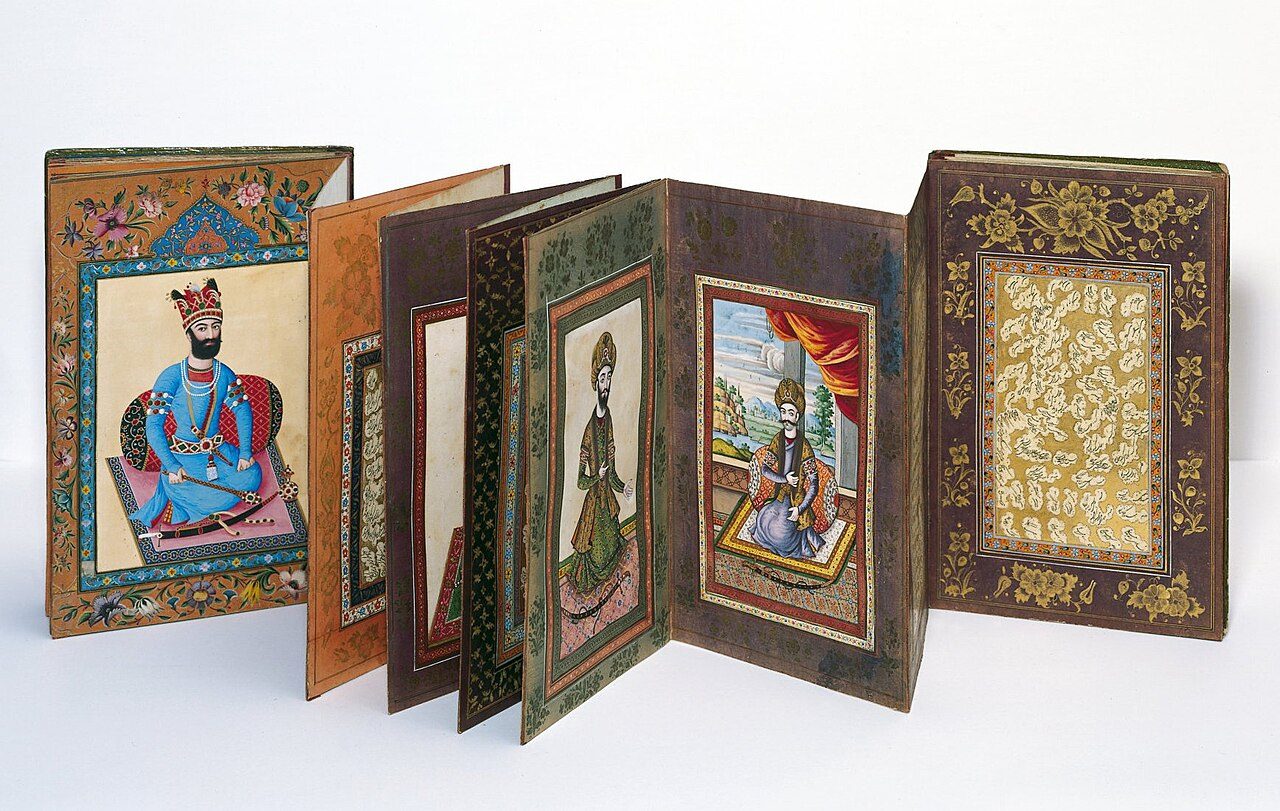
6 min read · 2 sourcesA Muraqqa (Persian: مُرَقّع, Arabic: مُرَقّع, Turkish: Murakka), meaning "patched" in Arabic, is an album in codex or concertina format, which can contain specimens of Islamic calligraphy and also paintings, often assembled from different sources and periods, and perhaps other matter. The album was popular among collectors in the Islamic world, and by the later 16th century became the predominant format for miniature painting in the Persian Safavid, Mughal Empire, and Ottoman Empire, greatly affecting the direction taken by the painting traditions of the Persian miniature, Ottoman miniature and Mughal miniature. The album largely replaced the full-scale illustrated manuscript of classics of Persian poetry, which had been the typical vehicle for the finest miniature painters up to that time. The great cost and delay of commissioning a top-quality example of such a work essentially restricted them to the ruler and a handful of other great figures, who usually had to maintain a whole workshop of calligraphers, artists and other craftsmen, with a librarian to manage the whole process. An album could be compiled over time, page by page, and often included miniatures and pages of calligraphy from older books that were broken up for this purpose, and allowed a wider circle of collectors access to the best painters and calligraphers, although they were also compiled by, or presented to, shahs and emperors. 1
Iran
The dominant tradition of miniature painting in the late Middle Ages was that of Persia, which had a number of centres, but all usually dependent on one key patron, whether the shah himself, or a figure either governing a part of the country from a centre such as Herat, where Baysunghur was an important patron in the early 15th century, or the ruler of a further part of the Persianate world in a centre like Bukhara. As the Safavid dynasty centralized Persian rule in the 16th century the number of potential patrons of a full-size atelier declined, but the atelier of the shah expanded and produced a number of superb illustrated books, using a variety of very talented artists on each. However, in the 1540s Shah Tahmasp I, previously a keen patron, lost interest in commissioning books, and thereafter the Persian miniature painting tradition lacked a steady source of commissions for books in the old style. After a gap of some years, Tahmasp's nephew Ibrahim Mirza established an atelier at Mashad, which produced the Freer Jami in the 1560s, and which Shah Ismail II took over after having its former patron killed in 1577. But Ismail's reign was very brief, and thereafter consistent large-scale patronage was lacking. 1
Ottoman Empire
The best Ottoman painting was heavily concentrated in the capital, which from 1453 was Istanbul, and the most important patron was always the Sultan. The royal library remains very largely intact in Turkey, mostly at Topkapi Palace, and was greatly enriched by Persian manuscripts, initially taken during the several Ottoman invasions of eastern Persia, and later, after a treaty in 1555, often received as diplomatic gifts. Many of these manuscripts were broken up to use the miniatures in albums. Persian artists were imported from virtually the start of the Ottoman tradition, but especially in the 16th century; sixteen artists were brought back just from the brief Ottoman conquest of Tabriz in 1514, though by 1558 the palace records list only nine foreign artists of all kinds, against twenty-six Turks. But a distinctively Ottoman style can be seen from the start of the 16th century, with pictures showing simpler landscape backgrounds, more sea and ships, neatly tented army camps, distant cityscapes, more individual characterization of faces, but also a less refined technique. There was strong European influence, mostly from Venice, but this was restricted to portraiture. Turkish albums include mixtures of collected miniatures similar to those in Persia, and often including Persian pieces, with the addition of rather more greatly elaborated pen drawings of an essentially decorative nature, of a foliage motif, or a bird or animal treated largely as such. 1
Mughal Empire & Indian Subcontinent
The Mughal dynasty in the Indian subcontinent was rather later in establishing a large court atelier, which did not begin until after the exile in Persia of the second emperor, Humayun, who on his return was joined from about 1549 by Persian artists including Abd as-Samad. The Mughal style developed under the next emperor, Akbar, who commissioned some very large illustrated books, but his artists produced single miniatures for albums as well. In the case of the Jahangirnama, the emperor Jahangir kept a diary and commissioned paintings separately, which were most likely held in the Kitabkhana, until his official contribution to the court chronicle genre could be assembled. From fairly early the Mughal style made a strong feature of realistic portraiture, usually in profile, and perhaps influenced by Western prints, which were available at the Mughal court. For a long time portraits were always of men, often accompanied by generalized female servants or concubines; but there is scholarly debate about the representation of female court members in portraiture. Some scholars claim there are no known extant likenesses of figures like Jahanara Begum and Mumtaz Mahal, and others attribute miniatures, for example from the Dara Shikoh album or the Freer Gallery of Art mirror portrait, to these famous noblewomen. Another popular subject area was realistic studies of animals and plants, mostly flowers; from the 17th century equestrian portraits, mostly of rulers, became another popular borrowing from the West. The single idealized figure of the Riza Abbasi type was less popular, but fully painted scenes of lovers in a palace setting became popular later. 1
Use of albums
Albums were often presented as gifts to mark a milestone in life. Chroniclers record that when the Persian Prince Ibrahim Mirza was killed in 1577, on the orders of Shah Tahmasp I, his wife, Tahmasp's sister, destroyed artworks including an album containing miniatures by Behzad among others, which her husband had compiled and given her for their wedding, washing the miniatures in water. Perhaps she did not want anything to fall into the hands of her brother, who had ordered his death, and who did take over the prince's atelier. Albums were often presented to rulers on their accession, or in Turkey at New Year. They could also be given as diplomatic gifts between rulers. A muraqqa was created for Sultan Murad III in 1572 when he ascended to the throne, which is unusual because the dedication is very detailed, including the date and place of creation, namely Istanbul, 980 AH/1572-73 AD. The dedication is to Murad III, also naming his compiler Mehmed Cenderecizade. The Murad III muraqqa was designed much more extravagantly than other Islamic muraqqa and with original nakkashane (Ottoman painting studio) border paintings. 1
Examples from the Mughal Court
Salim Album, produced in the reign of Akbar the Great, contain… 1
The text above is adapted from the Wikipedia article “Muraqqa”, available under the Creative Commons Attribution-ShareAlike 4.0 licence. 1
muraqqa is album in book form containing Islamic miniature paintings and calligraphy, according to the structured record cited below. This entry was generated automatically from that record and has not yet been reviewed by a person familiar with the tradition. 2
The source record links this tradition to 6 external registers, which can be verified through the citation. 2