The tradition & historical record
6 min read · 2 sourcesMusical notation is any system used to visually represent music. Systems of notation generally represent the elements of a piece of music that are considered important for its performance in the context of a given musical tradition. The process of interpreting musical notation is often referred to as reading music. Distinct methods of notation have been invented throughout history by various cultures. Much information about ancient music notation is fragmentary. Even in the same time frames, different styles of music and different cultures use different music notation methods. For example, classical performers most often use sheet music using staves, time signatures, key signatures, and noteheads for writing and deciphering pieces. But even so, there are far more systems than just that. For instance, in professional country music, the Nashville Number System is the main method, and for string instruments such as guitar, it is quite common for tablature to be used by players. Musical notation uses ancient and modern symbols made upon any media such as stone, clay tablets, papyrus, parchment or manuscript paper; printed using a printing press (c. 1400), a computer printer (c. 1980) or other printing or modern copying technology. Although many ancient cultures used symbols to represent melodies and rhythms, none of them were particularly comprehensive, which has limited today's understanding of their music. 1
Ancient Near East
The earliest form of musical notation can be found in a cuneiform tablet that was created at Nippur, in Babylonia (today's Iraq), in about 1400 BCE. The tablet represents fragmentary instructions for performing music, showing it was composed in harmonies of thirds using a diatonic scale. A tablet from about 1250 BCE shows a more developed form of notation. Although the interpretation of the notation system is still controversial, it is clear that the notation indicates the names of strings on a lyre, the tuning of which is described in other tablets. Research indicates these notations had dual purposes for liturgical and secular musical pieces since music was essential in both religious ceremonies and courtly activities. Although they are fragmentary, these tablets represent the earliest notated melodies found anywhere in the world. 1
Ancient Greece
Ancient Greek musical notation was in use from at least the 6th century BCE until approximately the 4th century CE; only few complete compositions (Seikilos epitaph, two Invocations to the Muse by Mesomedes, the Bellermann exercises) and around 40 fragmentary pieces using this notation survive. The notation for sung music consists of letter symbols for the pitches, placed above text syllables. Rhythm is indicated in a rudimentary way only, with long and short symbols. The Seikilos epitaph has been variously dated between the 2nd century BCE to the 2nd century CE. Three hymns by Mesomedes of Crete exist in manuscript. The Delphic Hymns, dated to the 2nd century BCE also use this notation, but they are not completely preserved. Ancient Greek notation appears to have fallen out of use around the time of the decline of the Western Roman Empire. 1
Byzantine Empire
Byzantine music once included music for court ceremonies, but has only survived as vocal church music within various Orthodox traditions of monodic (monophonic) chant written down in Byzantine round notation (see Macarie's anastasimatarion with the Greek text translated into Romanian and transliterated into its corresponding Cyrillic script). Since the 6th century, Greek theoretical categories (melos, genos, harmonia, systema) played a key role in the understanding and transmission of Byzantine music, The tradition of Damascus, especially, had a strong impact on the pre-Islamic Near East comparable to that of Persian music. The earliest evidence are papyrus fragments of Greek tropologia. These fragments present the hymn text following a modal signature or key (like "ΠΛ Α" for echos plagios protos or "Β" for echos devteros). Unlike Western notation, Byzantine neumes used since the 10th century were always related to modal steps (same modal degree, one degree lower, two degrees higher, etc.) in relation to such a clef or modal key (modal signatures). Originally this key or the incipit of a common melody was enough to indicate a certain melodic model given within the echos. Next to ekphonetic notation, only used in lectionaries to indicate formulas used during scriptural lessons, melodic notation developed not earlier than between the 9th and the 10th century, when a theta (θ), oxeia (/) or diple (//) were written under a certain syllable of the text whenever a longer melisma was expected. This primitive form was called "theta" or "diple notation". The evolution of this notation can be observed in Greek monastic chant books like those of the sticherarion and the heirmologion. 1
13th-century Near East
In 1252, Safi al-Din al-Urmawi developed a form of musical notation where rhythms were represented by geometric shapes. Many subsequent scholars of rhythm have sought to develop graphical geometrical notations. For example, a similar geometric system was published in 1987 by Kjell Gustafson, whose method represents a rhythm as a two-dimensional graph. Rhythmic notation during its early stages developed Eastern musical traditions while simultaneously establishing concepts that Western music used to build its notation systems later on. 1
Early Europe
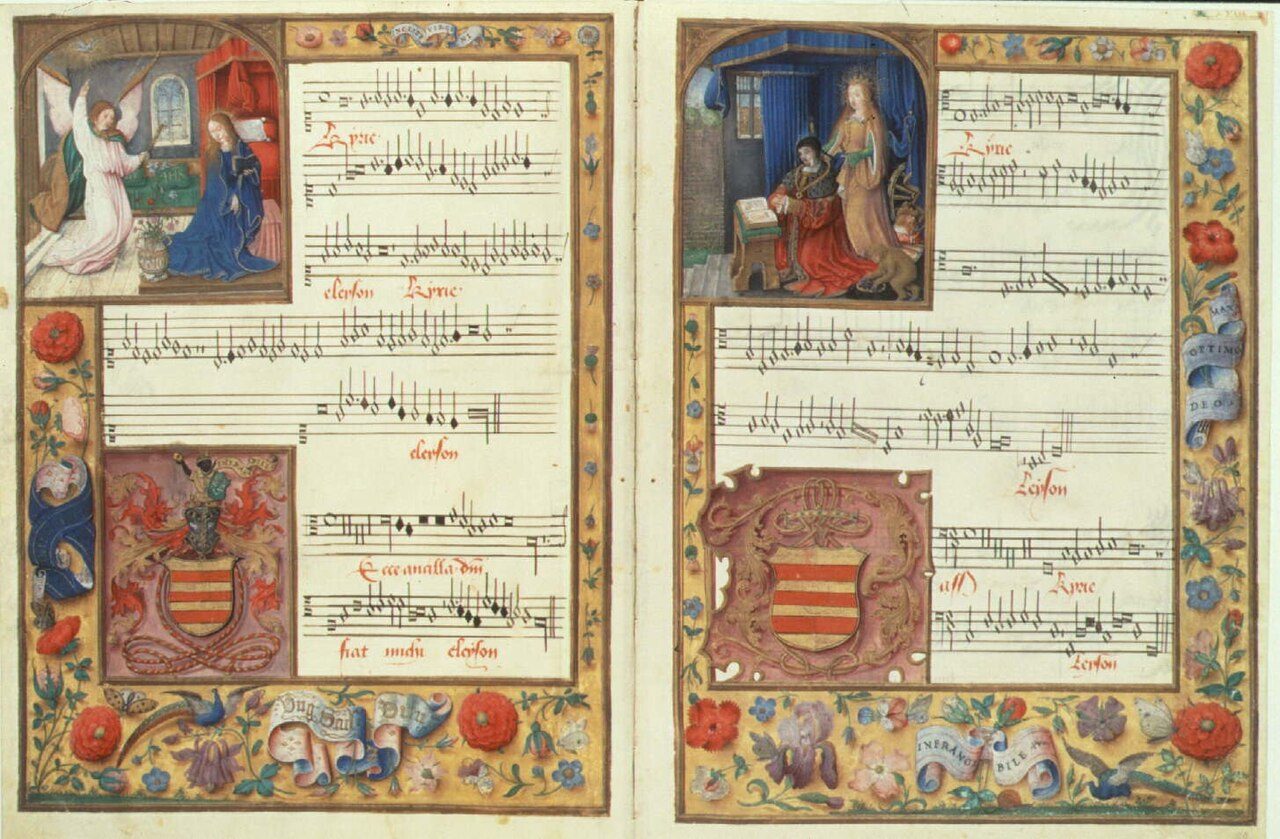
The scholar and music theorist Isidore of Seville, while writing in the early 7th century, wrote that "unless sounds are held by the memory of man, they perish, because they cannot be written down." By the middle of the 9th century, however, a form of neumatic notation began to develop in monasteries in Europe as a mnemonic device for Gregorian chant, using symbols known as neumes; the earliest surviving musical notation of this type is in the Musica Disciplina of Aurelian of Réôme, from about 850. There are scattered survivals from the Iberian Peninsula before this time, of a type of notation known as Visigothic neumes, but its few surviving fragments have not yet been deciphered. The problem with this notation was that it only showed melodic contours and consequently the music could not be read by someone who did not know the music already. 1
Notation had developed far enough to notate melody, but there was still no system for notating rhythm. A mid-13th-century treatise, De Mensurabili Musica, explains a set of six rhythmic modes that were in use at the time, although it is not clear how they were formed. These rhythmic modes were all in triple time and rather limited the rhythm in chant to six different repeating patterns. This was a flaw seen by German music theorist Franco of Cologne and summarised as part of his treatise Ars Cantus Mensurabilis (the art of measured chant, or mensural notation). He suggested that individual notes could have their own rhythms represented by the shape of the note. Not until the 14th century did something like the present system of fixed note lengths arise. 1
The text above is adapted from the Wikipedia article “Musical notation”, available under the Creative Commons Attribution-ShareAlike 4.0 licence. 1
musical notation is graphic writing of musical parameters, according to the structured record cited below. This entry was generated automatically from that record and has not yet been reviewed by a person familiar with the tradition. 2
The source record links this tradition to 47 external registers, which can be verified through the citation. 2