The tradition & historical record
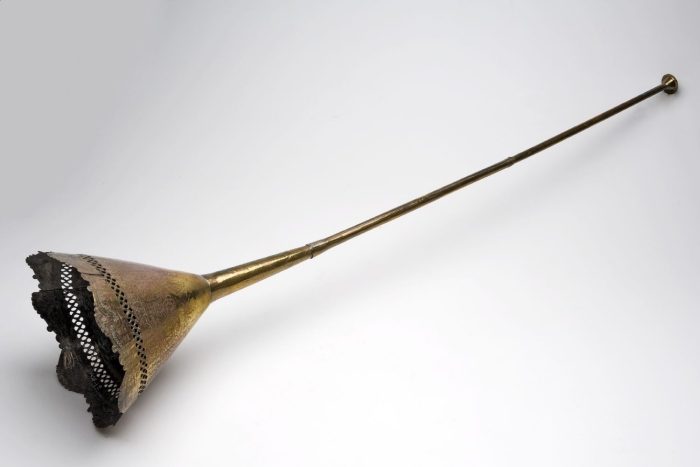
6 min read · 2 sourcesNafir (Arabic: نَفِير, DMG an-nafīr, also nfīr, plural anfār; Turkish: nefir) is a slender, shrill-sounding straight natural trumpet with a cylindrical tube and a conical metal bell, producing one or two notes. It was used as a military signaling instrument and as a ceremonial instrument in countries shaped by Islamic culture in North Africa, the Middle East, and South Asia. In Ottoman, Persian, and Mugulin miniatures, the nafīr is depicted in battle scenes. In Christian culture, it was displaced by or played alongside the curved tuba or horn, as seen in artwork dating to about the 14th century A.D. Similar straight signal trumpets have been known since ancient Egyptian times and among the Assyrians and Etruscans. After the fall of the Roman Empire, the straight-tubed Roman tuba continued to flourish in the Middle East among the Sassanids and their Arabic successors. The Saracens, whose long metal trumpets greatly impressed the Christian armies during the Crusades, were ultimately responsible for reintroducing the instrument to Europe after a lapse of six hundred years. 1
Nafir versus karnay
The nafir has been compared to another trumpet, the karnay. The two may have been the same instrument. However, today a difference can be stated in terms of the instruments' dimensions. The karnay in Tajikistan, which reaches 190–210 cm in length, tends to have a larger diameter, about 3.3 centimeters. The nafir in Morocco averages 150 centimeters in length and 1.6 cm in diameter on the outside of the tube. According to the Persian music theorist Abd al-Qadir Maraghi (bin Ghaybi, c. 1350–1435), the nafīr was 168 centimeters (two gaz) long. The difference is visible in miniatures, with artists depicting some instruments as thinner. Also visible in miniatures is the gradual increase in the bore size (conically), which some karnays have in the same way a Tibetan horn does. The Arabic nafīr was probably mostly a long, cylindrical metal trumpet with a high-pitched sound better suited to signaling than the deeper, duller sound of the conical trumpets such as the karna. The tonal difference was illustrated in the vocabulary of the Iraqi historian Ibn al-Tiqtaqa (1262–1310), according to which the nafīr player "shouted out" (sāha) the trumpet, while the player of the conical trumpet, here referred to as a būq, "blew" (nafacha). A writer in 1606, Nicot, said the trumpet was treble when compared with other trumpets that only played tenor and bass. Another confusing point about karna versus nafirs concerns S-curved trumpets. Abd al-Qadir al-Maraghi described the karnā as curved in an S-shape, formed from two semicircles that are turned towards each other in the middle, like today's sringa in India. However, unlike the sringa, the S-curve karna could be very long. The S-curved instrument was identified as a karrahnāy (or karnay) by ʿAbdalqādir ibn Ġaibī (died 1435). 1
Origin
In Arabic, būq is a term used for conical horns, whether curved or straight, and regardless of the construction material, including shell, bone, ivory, wood, and metal. This is important because in Islamic areas, būq could mean a number of different instruments, including the būq al-nafir (horn of battle). Conical horns have been common across many unassociated cultures, but the straight cylindrical tubed instruments had a narrow range of users who had ties to one another; the Greeks, Egyptians, and Romans interacted, as did the Egyptians and Assyrians and the Arabs, Persians, Turkmen, and Indians, all of whom had the cylindrical straight tubed trumpet, before medieval and early Renaissance Europeans further developed it. 1
Earliest trumpets and horns
Trumpet instruments originally consisted either of relatively short animal horns, bones, and snail horns or of long, rather cylindrical tubes of wood and bamboo. The former and their later replicas made of wood or metal (such as the Northern European Bronze Age lur) are attributed to the natural horns, while Curt Sachs (1930) suspected the origin of today's trumpets and trombones to be the straight natural trumpets made of bamboo or wood. 1
Egypt, Assyria, Rome, Greece, Israel
The simple, straight trumpets are called tuba-shaped, derived from the tuba used in the Roman Empire. Other straight trumpets in antiquity were the Etruscan-Roman lituus and the Greek salpinx. Tuba-shaped trumpets have been around since the mid-3rd millennium BC, as evidenced by illustrations from Mesopotamia and Ancient Egypt. According to written records, they were blown as signaling instruments in a military context or as ritual instruments in religious cults. As has been demonstrated with the ancient Egyptian sheneb, of which two specimens survive in good condition from the tomb of Tutankhamen (ruled c. 1332–1323), the long trumpets produced only one or two notes and were not built to sustain the pressure that a very high third note would produce. 1
Among the early ritual instruments mentioned in the Old Testament is the curved ram's horn, the shofar, and the straight metal trumpet chazozra (hasosrah) made of hammered silver sheet. In the Hebrew Bible, qeren also stands for an animal horn, which is used in different ways, but only in one place (Josh 6:5 EU) for a horn blown to produce sound. Queren is rendered in the Aramaic translations of the Bible (Targumim) as the etymologically derived qarnā, which later appears in the Book of Daniel (written 167–164 BC) as a musical instrument (a trumpet made of clay or metal). In the (Septuagint) Greek Bible, the original animal horn qarnā is rendered salpinx and in the Latin Vulgate tuba, thus reinterpreting it as a straight metal trumpet. 1
Persians, Arabs, Islam
The history of mounted military musicians begins with the Persian Sassanids (224–651), who banged kettledrums on elephants imported from India. Apart from little reliable evidence for the use of war elephants in the 3rd century, the sources indicate that the Sassanids used elephants in the 4th century against the Roman army and the Armenians, under Shapur II (ruled 309–379). The Sassanids also used trumpets to call the start of battle and the troops to order. In the Persian national epic Shahnameh, trumpet players and drummers are mentioned as playing on the backs of elephants during battles against the Arabs at the beginning of the 7th century. Possibly Firdausi took over the situation in his time, for which mounted war musicians are otherwise documented, in the historical account. The Fatimids maintained huge representative orchestras with trumpet players and drummers. The Fatimid Caliph al-ʿAzīz (r. 975–996) invaded Syria from Egypt in 978 with 500 musicians blowing bugles (abwāq or būqāt, singular būq). In 1171, Saladin resigned as the successor of the last Fatimid caliph. During his reign as Sultan of Egypt (until 1193), the historian Ibn at-Tuwair († 1120) wrote about a representative Fatimid orchestra that performed at the end of the 11th century, which included trumpeters and 20 drummers on mules. 1
The text above is adapted from the Wikipedia article “Nafir”, available under the Creative Commons Attribution-ShareAlike 4.0 licence. 1
Nafir is Natural trumpet, dates to ancient/medieval periods, straight tube with a bell, according to the structured record cited below. This entry was generated automatically from that record and has not yet been reviewed by a person familiar with the tradition. 2
The source record links this tradition to 2 external registers, which can be verified through the citation. 2