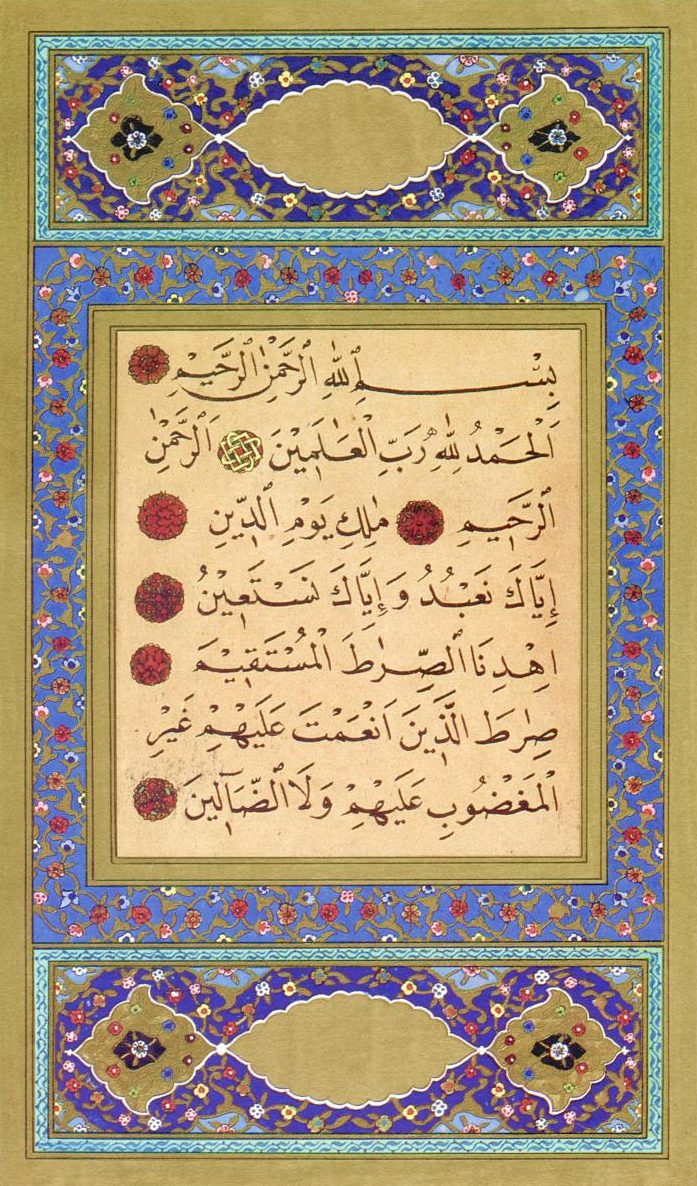
The tradition & historical record
3 min read · 2 sourcesNaskh is a small, round script of Islamic calligraphy. Naskh is one of the first scripts of Islamic calligraphy to develop, commonly used in writing administrative documents and for transcribing books, including the Qur’an, because of its easy legibility. In his 1617 Grammatica Arabica, Thomas van Erpe defined naskhī characters as the "noblest and true writing style". 1
Origin
The Naskh style of writing can be found as early as within the first century of the Islamic calendar. It was established at this time by order of Abd al-Malik ibn Marwan due to the presence of defects in the Kufic script. Ibn Muqla is credited with standardizing the "Six Pens" of Islamic calligraphy, also including thuluth, tawqi’, riqaaʿ, muhaqqaq, and rayhani. These are known as "the proportioned scripts" (al-khatt al-mansub) or "the six scripts" (al-aqlam al-sitta). Kufic is commonly believed to predate naskh, but historians have traced the two scripts as coexisting long before their codification by Ibn Muqla, as the two served different purposes. Kufic was used primarily in decoration, while Naskh served for everyday scribal use. The Naskh script is believed to have existed since the first century of the Islamic calendar. 1
Description
The alif is written as a straight stroke, bending to the lower left. Naskh differentiates various sounds through the use of diacritical points, in the form of 1–3 dots above or below the letter, which makes the script more easily legible. Naskh uses a horizontal base line; in situations where one character starts within the tail of the preceding letter, the base line is broken and raised. In sixteenth-century Constantinople, Şeyh Hamdullah (1429–1520) redesigned the structure of naskh, along with the other "Six Pens", in order to make the script appear more precise and less heavy. 1
Use
Naskh was historically used heavily in the transcription of books and in administrative courtly documents. Naskh allowed for the development of decorative elements into more supple, rounded designs, away from the common use of squared Kufic in decoration. Naskh's use in architecture first began in the tenth century and had been adopted in many Muslim countries by the eleventh century. The script is what is normally used electronically and as the default typeface. Examples on typefaces in naskh on Windows (W), iOS (M), Linux (L), and Google Fonts (G): 1
Simple types with nearly no complicated glyphs 1
Arial(W/M) (Arabic Transparent,(W) Times New Roman,(W/M) Arial Arabic) Simplified Arabic(W) Scheherazade New(G) Courier New(W/M) (monospace) Cascadia Mono(G) (monospace) Noto Naskh Arabic(G) SF Arabic(M) Layla Basic Arabic With some glyphs shared partly with ruqaa style 1
Damascus(M) KacstOne(L) Arabic Typesetting(W) Al Bayan(M) DecoType Naskh(M) Baghdad(M) Geeza Pro(M) Nadeem(M) Yakout Sakkal Majalla(W) Traditional Arabic(W) Amiri(G) Amiri is inspired by the Bulaq Press-inspired Amiri typeface or Monotype Imaging's Bustani font. 1
The text above is adapted from the Wikipedia article “Naskh (script)”, available under the Creative Commons Attribution-ShareAlike 4.0 licence. 1
Naskh is small, round script of Islamic calligraphy, according to the structured record cited below. This entry was generated automatically from that record and has not yet been reviewed by a person familiar with the tradition. 2
The source record links this tradition to 4 external registers, which can be verified through the citation. 2