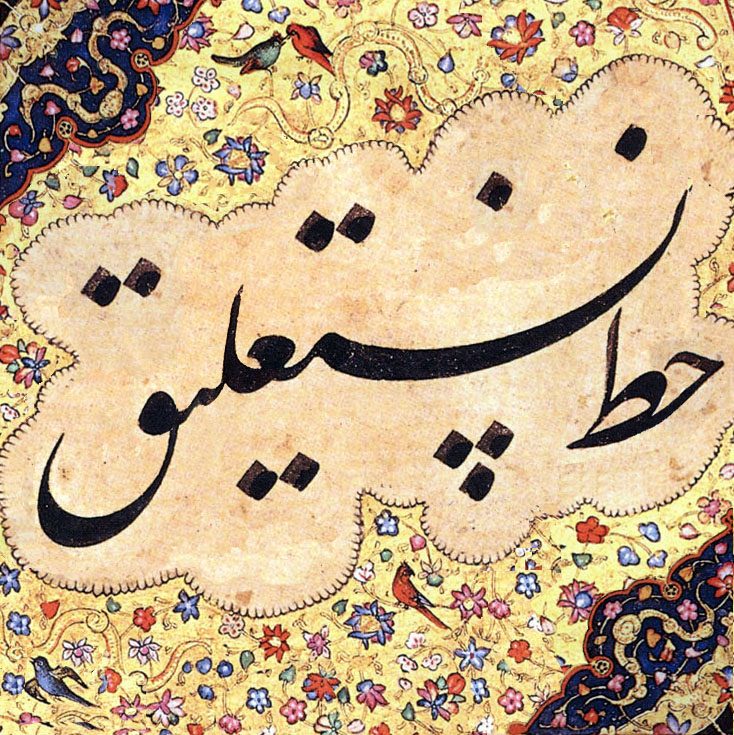
The tradition & historical record
6 min read · 2 sourcesNastaliq is one of the main calligraphic hands used to write the Persian and sometimes Arabic scripts, and is used for several significant Indo-Iranian languages, predominantly Persian, Urdu, Pashto, Balochi, Punjabi (in Pakistan), Kashmiri and Saraiki. It is also often used for Ottoman Turkish, but rarely for Arabic (particularly in Iraq) and Arwi. Nastaliq developed in Iran from a combination of Naskh and Ta'liq, beginning in the 13th century and it remains widely used in Iran, India, Pakistan, Afghanistan, and other countries for writing poetry and as a form of art. 1
History
The name Nastaliq "is a contraction of the Persian naskh-e ta'liq (Persian: نَسْخِ تَعلیق), meaning a hanging or suspended naskh." Virtually all Safavid authors (like Dust Muhammad or Qadi Ahmad) attributed the invention of nastaliq to Mir Ali Tabrizi, who lived at the end of the 14th and the beginning of the 15th century. That tradition was questioned by Elaine Wright, who traced the evolution of Nastaliq in 14th-century Iran and showed how it developed gradually among scribes in Shiraz. According to her studies, nastaliq has its origin from naskh alone, and not by combining naskh and taliq, as was commonly thought. In addition to study of the practice of calligraphy, Elaine Wright also found a document written by Jafar Tabrizi c. 1430, according to whom: 1
It must be known that nastaʿliq is derived from naskh. Some Shirazi [scribes] modified it [naskh] by taking out the flattened [letter] kaf and straight bottom part of [the letters] sin, lam and nun. From other scripts they then brought in a curved sin and stretched forms and introduced variations in the thickness of the line. So a new script was created, to be named nastaʿliq. After a while Tabrizi [scribes] modified what Shirazi [scribes] had created by gradually rendering it thinner and defining its canons, until the time when Khwaja Mir ʿAli Tabrizi brought this script to perfection. 1
Thus, "our earliest written source also credits Shirazi scribes with the development of nastaʿliq and Mir ʿAli Tabrizi with its canonization." Wright's proposed origin of nastaliq was complicated by studies of Francis Richard, who argued on the basis of some manuscripts from Tabriz that its early evolution was not confined to Shiraz. 1
Shekasteh Nastaliq
Shekasteh or Shekasteh Nastaliq (Persian: شکسته نستعلیق, شکسته نستعلیق, "cursive Nastaliq" or literally "broken Nastaliq") style is a "streamlined" form of Nastaliq. Its development is connected with the fact that "the increasing use of nastaʿlīq and consequent need to write it quickly exposed it to a process of gradual attrition." The shekasteh nastaliq emerged in the early 17th century and differed from proper nastaliq only in so far as some of the letters were shrunk (shekasteh, lit. "broken") and detached letters and words were sometimes joined. These unauthorized connections "mean that calligraphers can write shekasteh faster than any other script." Manuscripts from this early period show signs of the influence of shekasteh taliq; while having the appearance of a shrunken form of nastaliq, they also contain features of taliq "due to their being written by scribes who had been trained in taʿlīq." Shekasteh nastaliq (usually shortened to simply skehasteh), being more easily legible than taliq gradually replaced the latter as the script of decrees and documents. Later, it also came into use for writing prose and poetry. The first important calligraphers of shekasteh were Mohammad Shafiʿ Heravi (d. 1670–71) (he was known as Shafiʿa and hence shekasteh was sometimes called shafiʿa or shifiʿa) and Mortazaqoli Khan Shamlu (d. 1688–89). Both of them produced works of real artistic quality, which does not change the fact that in this early phase shekasteh still lacked consistency (it is especially visible in writing of Mortazaqoli Khan Shamlu). Most modern scholars consider that shekasteh reached its peak of artistic perfection under Abdol Majid Taleqani (d. 1
Nastaliq typesetting
Modern Nastaliq typography began with the invention of Noori Nastaliq which was first created as a digital font in 1981 through the collaboration of Ahmed Mirza Jamil (as calligrapher) and Monotype Imaging (formerly Monotype Corp & Monotype Typography). Although this employed over 20,000 ligatures (individually designed character combinations), it provided accurate results and allowed newspapers such as Pakistan's Daily Jang to use digital typesetting instead of a group of calligraphers. It suffered from two problems in the 1990s: its non-availability on standard platforms such as Microsoft Windows or Mac OS, and the non-WYSIWYG nature of text entry, whereby the document had to be created by commands in Monotype's proprietary page description language. 1
InPage
In 1994, InPage Urdu, which is a functional page layout software for Windows akin to QuarkXPress, was developed for Pakistan's newspaper industry by an Indian software company Concept Software Pvt Ltd. It offered the Noori Nastaliq font licensed from Monotype Imaging. This font is still used in current versions of the software for Windows. As of 2009, InPage has become Unicode based, supporting more languages and the Faiz Lahori Nastaliq font with Kasheeda has been added to it along with compatibility with OpenType Unicode fonts. 1
Cross platform Nastaliq fonts
Windows 8 was the first version of Microsoft Windows to have native Nastaliq support, through Microsoft's "Urdu Typesetting" font. 1
Noto Nastaliq Google has an open-source Nastaliq font called Noto Nastaliq Urdu. Apple provides this font on all Mac installations since macOS High Sierra. Likewise, Apple has carried this font on iOS devices since iOS 11. Awami Nastaliq features a more extensive character set than most Nastaliq typefaces, supporting: Urdu, Balochi, Persian, Khowar, Palula, Saraiki, Shina. Amar Nastaleeq was created for web embedding on Urdu websites in 2013. The font was announced by Urdu poet Fahmida Riaz. PDMS Nastaliq Nafees Ali Nastaliq Iran Nastaliq Jauhar Nastaliq Mehr Nastaliq Urdu Emad Nastaliq Gulzar Nastaliq 1
The text above is adapted from the Wikipedia article “Nastaliq”, available under the Creative Commons Attribution-ShareAlike 4.0 licence. 1
Nastaʿlīq is predominant calligraphic hand of the Perso-Arabic script to transcribe Persic and Indo-Aryan languages in Central and Southern Asia, according to the structured record cited below. This entry was generated automatically from that record and has not yet been reviewed by a person familiar with the tradition. 2
The source record links this tradition to 11 external registers, which can be verified through the citation. 2