The tradition & historical record
3 min read · 2 sourcesThe Nativity is an egg tempera painting by Victor. Victor is sometimes referred to as Victor of Crete. Victor was active from 1645 to 1696. He traveled all over the Venetian empire. He settled in Zakinthos. Some of his important works can be found in the church San Giorgio dei Greci in Venice. He is a very important Greek painter because of his existing catalog. His works of art exceed ninety-five paintings. One of his notable works was his version of Christ the Vine. The Nativity is one of the most important symbols of Christianity. The subject has been depicted countless times by both Greek and Italian artists since the inception of the new religion. Proto-Renaissance paintings and Cretan art share common characteristics. Greek painters continued painting in the traditional Greek-Italian Byzantine style. The style became known as the maniera greca. The phrase was coined by art critic and painter Giorgio Vasari. He wrote the famous book the Lives of the Most Excellent Painters, Sculptors, and Architects. It was one of the first post-classical European terms for style in art. By the 1500s both Greek and Italian patrons preferred the manner to the Italian Renaissance style because they desired traditional art. Greek painting workshops in Crete mass-produced different versions of icons in the style. Some artists signed their work and added their own unique characteristics. Victor's nativity is a mixture of the traditional style and Venetian painting. 1
History
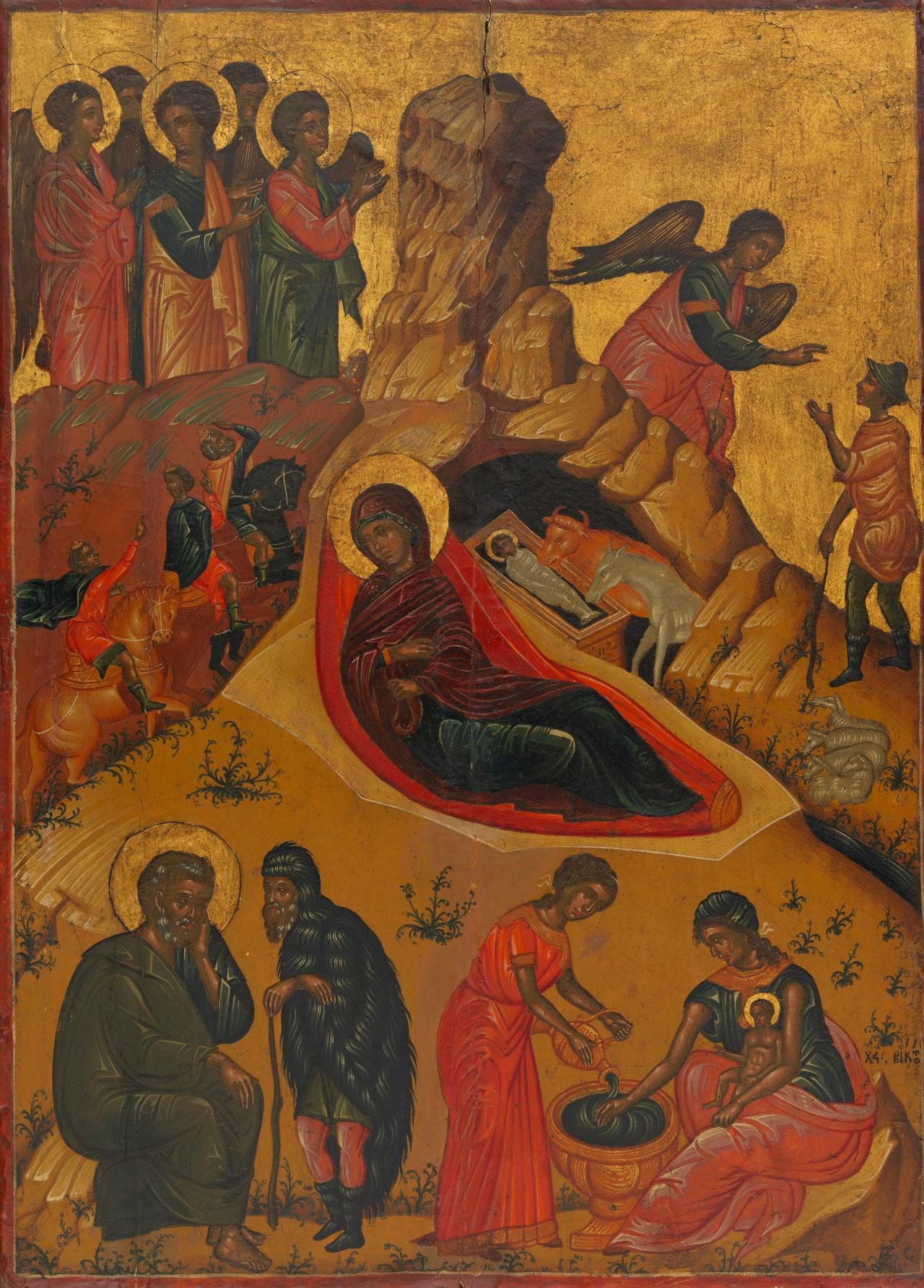
The work of art consists of tempera and gold leaf. It follows the traditional Greek Italian Byzantine manner. The height is 22.3 in (56.6 cm) and the width is 16.1 in (40.8 cm). The work was completed sometime in the late 17th century possibly on the island of Zakynthos. The work is part of the Late Cretan School. Victor followed the traditional lines frequently used by Proto-Renaissance painters. Countless patrons preferred the style. The Madonna follows the traditional Greek Byzantine style it shares similar characteristics with Duccio's masterpiece. A shepherd visits Joseph in the lower left-hand corner of the work. He is troubled because his child was born in a barn. A maiden to the right of the Joseph figure is cleaning Jesus near a bucket full of water. In the center of the work, the Virgin Mary is painted following the lines of the Greek-Italian traditional Byzantine style. The painter employs complex lines and shading to visually portray her heavenly robe. The Virgin looks away from the viewers as if she is troubled. An ox and donkey greet the Christ Child. An angel instructs one of the shepherds in the background. To our left, a cavalry of wealthy Magi are approaching to give gifts to the worried holy couple. The painter attempts to create a multidimensional landscape. The work of art is filled with animals and vegetation and a superlative mountainous environment. An unknown Cretan painter sometime in the 16th century created a similar work and added a more complex landscape but preserved the heavenly figures. Victor's work is an excellent example of traditional Greek Italian Byzantine craftsmanship mixed with Venetian painting. 1
The text above is adapted from the Wikipedia article “The Nativity (Victor)”, available under the Creative Commons Attribution-ShareAlike 4.0 licence. 1
Nativity is painting by Victor of Crete, according to the structured record cited below. This entry was generated automatically from that record and has not yet been reviewed by a person familiar with the tradition. 2
The source record links this tradition to 1 external register, which can be verified through the citation. 2