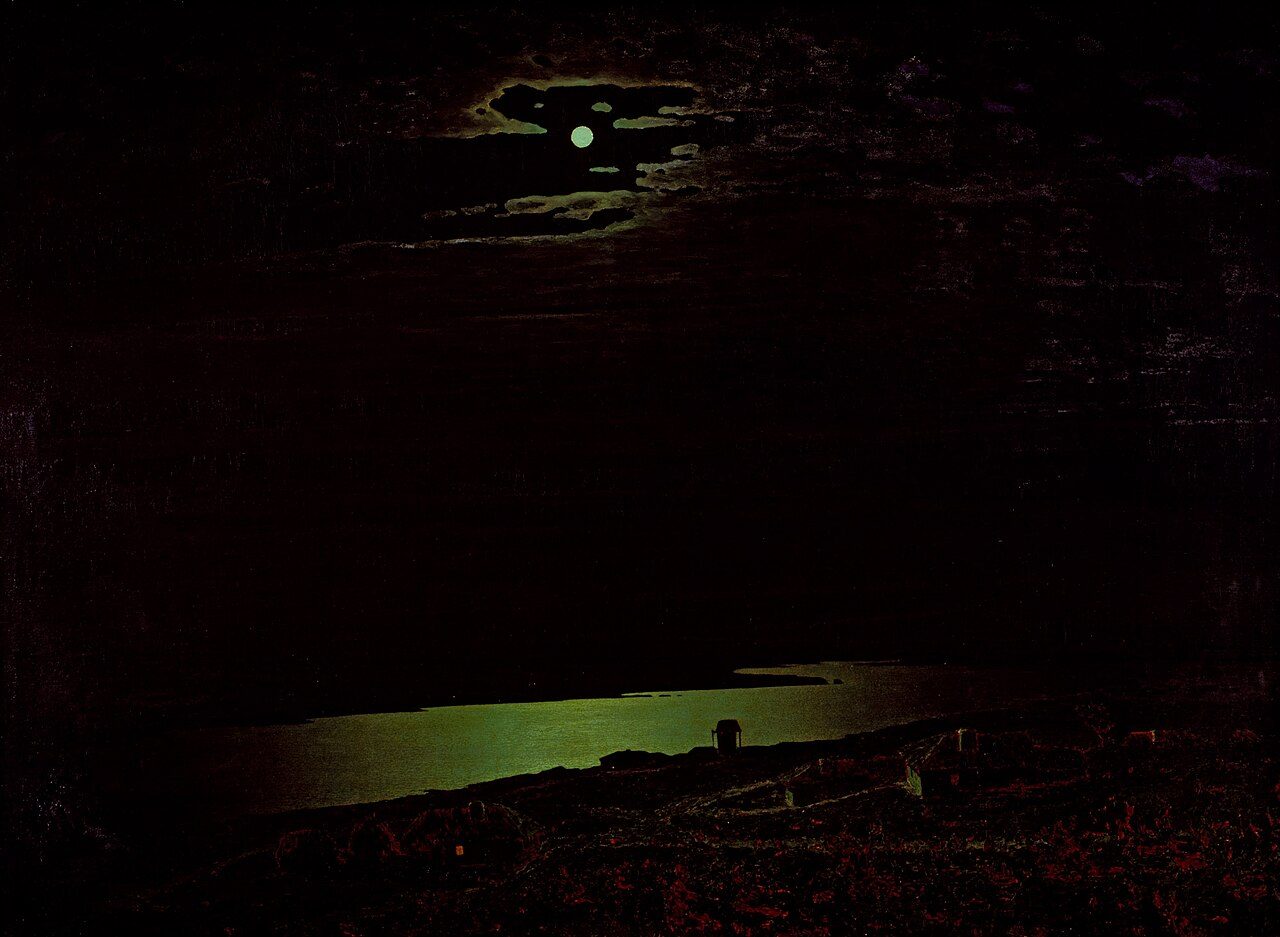
The tradition & historical record
4 min read · 2 sourcesThe depiction of night in paintings is common in Western art. Paintings that feature a night scene as the theme may be religious or history paintings, genre scenes, portraits, landscapes, or other subject types. Some artworks involve religious or fantasy topics using the quality of dim night light to create mysterious atmospheres. The source of illumination in a night scene—whether it is the moon or an artificial light source—may be depicted directly, or it may be implied by the character and coloration of the light that reflects from the subjects depicted. They are sometimes called nocturnes, or night-pieces, such as Rembrandt's The Night Watch, or the German Romantic Caspar David Friedrich's Two Men Contemplating the Moon of 1819. In America, James Abbott McNeill Whistler titled works as nocturnes to identify those paintings with a "dreamy, pensive mood" by applying the musical term, and likewise also titled (and retitled) works using other music expressions, such as a "symphony", "harmony", "study" or "arrangement", to emphasize the tonal qualities and the composition and to de-emphasize the narrative content. The use of the term "nocturne" can be associated with the Tonalist movement of the American of the late 19th century and early 20th century which is "characterized by soft, diffused light, muted tones and hazy outlined objects, all of which imbue the works with a strong sense of mood." Along with winter scenes, nocturnes were a common Tonalist theme. 1
Gaddi, The Angelic Announcement to the Shepherds
One of the first attempts in depicting night in paintings was by Taddeo Gaddi, an Italian painter and architect. Gaddi, fascinated by nocturnal lighting, depicted the effect of the light in The Angelic Announcement to the Shepherds night scene. The fresco at Basilica of Santa Croce in Florence, Italy features an incandescent angel as it hovers over a shepherd. Against the night sky the brilliance of the angel's bright glow, likely intended as "verification of the presence of God and as a metaphor for spiritual enlightenment", appears to startle the shepherd. Gaddi's use of monochromatic colors in and around the shepherd reveals how the colors are made pale due to the remarkable illumination. 1
Giotto, Crucifixion
Giotto di Bondone (1266/7–1337), Taddeo Gaddi's teacher and godfather, created the fresco of Crucifixion, one of the multiple frescoes that told the story of Christ's life, for the Arena Chapel. He depicts Christ on a cross, while the Virgin Mary is comforted by John. Kneeling at his feet is Mary Magdalene, and swirling in the sky above Jesus and the watching crowd's heads are a number of angels. Giotto depicts night and heaven through the use of a deep blue background in the fresco panel and use of stars in the otherwise blue ceiling. He was able to create depth and dimension through the use of incremental degrees of light and dark shades, the precursor to chiaroscuro. He also used light in a way to represent the divinity of people and angels from the Bible, as he did in other frescoes at Arena Chapel. 1
15th century
The Western tradition began properly in the 15th century, especially with depictions in illuminated manuscripts of the biblical night-time scenes of the Annunciation to the Shepherds in the Nativity story, and the Arrest of Christ and Agony in the Garden in the Passion of Christ. 1
Très Riches Heures, Christ in Gethsemane
In the book of miniatures, Très Riches Heures du Duc de Berry, the scene of Christ in Gethsemane is an apcolyptic one which foretells the death of Christ, through the presence of three comets in the evening sky. 1
Uccello, Niccolò Mauruzi da Tolentino at the Battle of San Romano
Niccolò Mauruzi da Tolentino at the Battle of San Romano is one of a three painting series that captures the Battle of San Romano. The passage of time, from dawn to evening, is illustrated in the three paintings with the initial use of pale, pastel shades and increasingly darker tones as the battle progresses. 1
The text above is adapted from the Wikipedia article “Night in paintings (Western art)”, available under the Creative Commons Attribution-ShareAlike 4.0 licence. 1
Night in paintings is overview of nighttime themes in European art, according to the structured record cited below. This entry was generated automatically from that record and has not yet been reviewed by a person familiar with the tradition. 2
The source record links this tradition to 1 external register, which can be verified through the citation. 2