The tradition & historical record
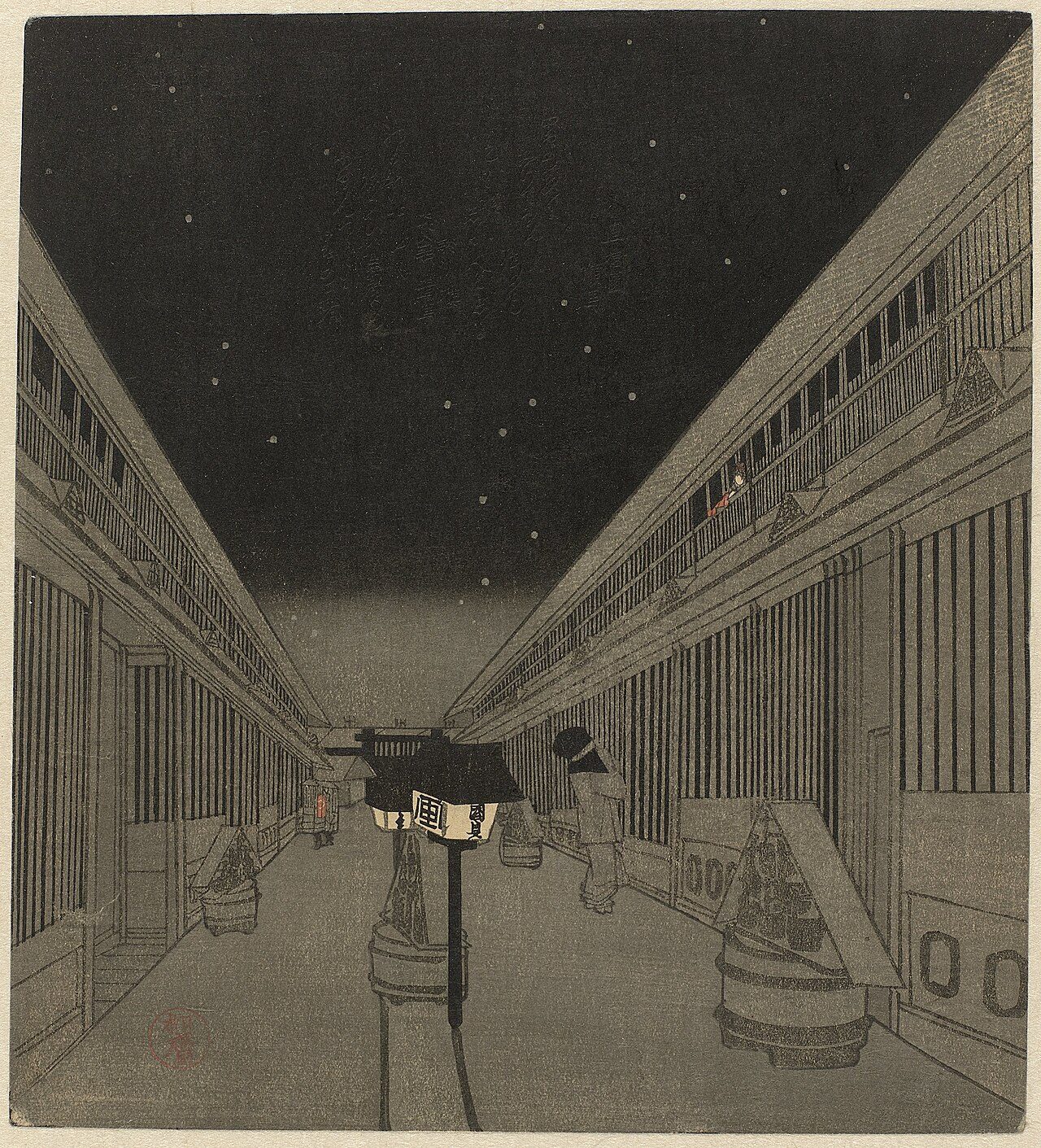
5 min read · 2 sourcesThe depiction of night in paintings is common in art in Asia. Paintings that feature the night scene as the theme are mostly portraits and landscapes. Some artworks which involve religious or fantasy topics use the quality of dim night light to create mysterious atmospheres. They tend to illustrate the illuminating effect of the light reflection on the subjects under either moonlight or artificial light sources. 1
Historical overview
Early oriental artists created works that focused on design and spiritual interpretation of their subjects rather than realistic, three-dimensional representations. For centuries, eastern night paintings were spiritually and emotionally evocative works with unshaded, two-dimensional imagery. Like the western world, the moon, candles, and stars helped set the nocturnal scene. But there were also items, such as clothing and tree leaves, that might be used in a specific way to express nighttime from an eastern perspective. The 16th-century Mughal painter Basawan was an early artist who integrated western techniques and perspective into eastern art. When trade opened up between the far east and the west art slowly changed in both sides of the world. For instance, Japanese ukiyo-e prints influenced Parisian artists. And, Jesuit priests, like Matteo Ricci, brought artwork to China that introduced western approaches for perspective and shading. These factors broadened the way in which nighttime was portrayed everywhere. 1
Symbolism
Black and grey shades often symbolize gloom, fear, mystery, superstitions, evil, death, secret, sorrow. The light source in most religious paintings symbolize hope, guidance or divinity. In fantasy paintings light could symbolize magic. 1
China
Traditional Chinese artists sought to capture the interrelated, vast and multifaceted aspects of nature here are on earth and in the heavens. From the article "The Great Art of China's 'Soundless Poems'", Heaven appears "before us only this bright shining mass; but in its immeasurable extent, the sun, the moon, stars and constellations are suspended in it, and all things are embraced under it." Night scenes, not otherwise distinguishable from daytime in Chinese art, include candles, light emanating from a building, the moon, or lake mists. Symbolism plays an enduring role in the telling of a story through painting or other Chinese art. For instance, stars and the moon are important both for religious significance and as an illustration of Chinese mythology. Symbols used in art may be grouped into four overarching categories: religious imagery, divine and mortal beings, symbols from nature and inanimate objects. Some examples of symbols include bats which means both good wishes and good luck. The moon, aside from religious and mythical connotations, can also mean a month. The particular way an image is depicted has meaning – like a round eyed-cat means it's a night scene. Artists use rice paper, silk or wood panels to paint night scenes. Silk has illuminating effect, while wood panels create a dark background. 1
Literature
Dream of the Red Chamber and Strange Stories from a Chinese Studio were inspiration for night time paintings. Almost 500 legendary tales written by Pu Songling are compiled in Strange Stories from a Chinese Studio or Liaozhai Zhiyi. The tales, inspired by oral storytelling, include strong mythical characters like ghosts, immortals, beasts and foxes. They also offer commentary about people, particularly the privileged and court officials, whose human frailties may result in unfair, unjust and other unfavorable treatment to others. He wrote with vivid imagery about the music of heaven, the inability of the light produced by a fire-fly to illuminate the demons of the night, red rings in the sky that shear the heads off of men, and the six conditions of existence: men, sinners, angels, demons, beasts and devils. Nighttime is a symbol for people's inability to understand the world around them. And the supernatural beings are meant to be a mirror to examine the nature of man. From a preface by T'ang Meng Lai to the book, Lai states that the book should prompt the readers to reflect upon the following: "We marvel at devils and foxes: we do not marvel at man. But who is it that causes a man to move and to speak?" One collection of the illustrated stories is at the National Museum of China. 1
Ghosts and hell
Many of the Chinese ghost beliefs have been accepted by neighboring cultures, notably Japan and south-east Asia. Ghost beliefs are closely associated with the traditional Chinese religion based on ancestor worship, many of which were incorporated in Taoism. Later beliefs were influenced by Buddhism, and in turn influenced and created uniquely Chinese Buddhist beliefs. Zhong Kui is a mythological figure, generally a vanquisher of ghosts and evil beings, and reputedly able to command 80,000 demons. Another mythological figure is Yan luo, the judge of Hell. 1
The text above is adapted from the Wikipedia article “Night in paintings (Eastern art)”, available under the Creative Commons Attribution-ShareAlike 4.0 licence. 1
Night in paintings is overview of nighttime themes in Asian art, according to the structured record cited below. This entry was generated automatically from that record and has not yet been reviewed by a person familiar with the tradition. 2