The tradition & historical record
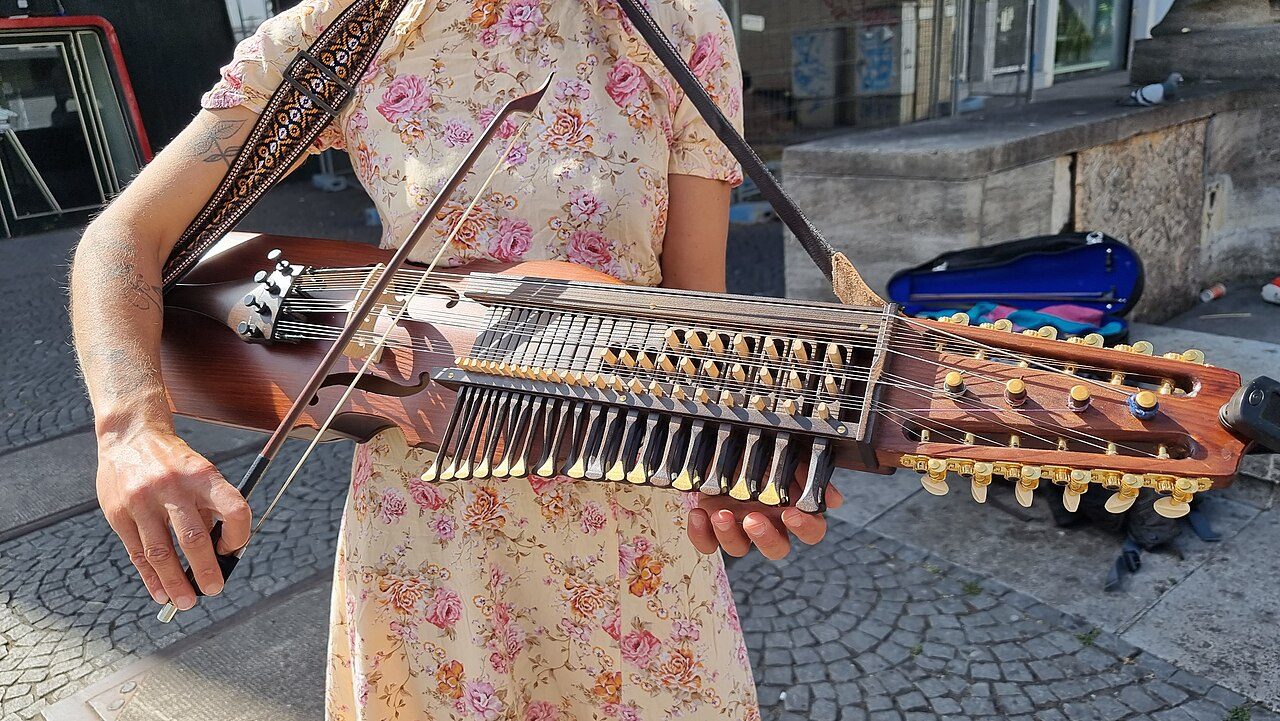
6 min read · 2 sourcesNyckelharpa (Swedish: [ˈnʏ̂kːɛlˌharːpa], roughly "keyed fiddle" in Swedish, lit. 'key-harp', plural: nyckelharpor) is a "keyed" bowed chordophone, primarily originating from Sweden in its modern form, but with its historical roots scattered across medieval Europe. It is similar in appearance to a fiddle or violin but larger (in its earlier forms essentially a modified vielle), which employs key-actuated tangents along the neck to change the pitch during play, much like a hurdy-gurdy. The keys slide under the strings, with the tangents set perpendicularly to the keys, reaching above the strings. Upon key-actuation, the tangent is pressed to meet the corresponding string, much like a fret, shortening its vibrating length to that point, changing the pitch of the string. It is primarily played underarm, suspended from the shoulder using a sling, with the bow in the overhanging arm. The origin of the instrument is unknown, but its historical foothold and modern development is much larger in Sweden than other countries, that being the only country with an unbroken usage. Many of the early historical depictions of the instrument are found in Sweden, with the earliest probable depiction being found on a relief located on a 14th century church portal. 1
Etymology
Nyckelharpa is the Swedish name for the instrument, composed of the lead nyckel ("key"), and the follower harpa ("harp"). Key is another word for tangent, while harp is an archaic word for string instrument, like a lyre; see Old Norse: harpa, Old English: hearpe, essentially "plucked string instrument". Compare tagelharpa ("horsehair-harp"), another Nordic instrument, or even jaw harp, where harp just means instrument. Synonymes include knaverharpa, the same compound, but with the lead knaver, which means tangent in this sense, and is cognate to English "knob" (compare "doorkey" in the sense of doorknob). Another form is nyckelgiga, "key-fiddle"; giga stemming from Middle Low German: gige (German: Geige), meaning fiddle. 1
1000s–1200s (first keyed instruments)
Development of keyed string instruments appears to have started during the High Middle Ages, with instruments such as the duo-played organistrum (a hurdy-gurdy), starting in the late 900s or early 1000s. Such were popular in Southwestern Europe and eventually evolved into the solo-played "symphonia"-hurdy-gurdy in France or Spain in the 1200s, featuring diatonic tangents. Somewhere along the line, it appears the keyboard of a "hurdy-gurdy" was integrated onto a bowed string instrument, producing the first keyed fiddle or proto-nyckelharpa instrument. It is unclear where the instrument first appeared, but the spread of hurdy-gurdy and bowed string instruments in Europe during the later Middle Ages makes it possible that the instrument was invented independently by several people. 1
1300s–1500s (first keyed vielles)
In the Late Middle Ages, the first depictions of nyckelharpor, or rather "keyed vielles" by appearance, appear. The earliest possible depiction known can be found in a relief on one of the portals to the Källunge Church, located on the Swedish island of Gotland. Dating from circa 1350, it depicts two musicians with bow stringed instruments suspiciously looking like nyckelharpor, appearing to have keyboxes (a cover above the strings) like a hurdy-gurdy. The relief is however eroded and damaged from time, making it hard to confirm them as nyckelharpor. 1
The earliest confirmed depiction of a nyckelharpa appears in an Italian church painting found in Siena, Italy, dating to 1408. It depicts an angel playing a vielle-looking nyckelharpa (a common nyckelharpa motif for the period), featuring five keyes and a keybox above the strings. Throughout the 15th century, more depictions of nyckelharpor start appearing in church paintings, notably in Swedish and Danish churches, such as the Emmislöv Church, which has a painting of a nyckelharpa musician dating to 1450–1475, and Lagga Church, which is dated to 1498. Others include the Tolfta Church in Sweden, which has two paintings of angels playing nyckelharpa, dating to c. 1460–1525. Interestingly, most Swedish nyckelharpa depictions on church paintings, lack keyboxes. Early Danish nyckelharpa depictions, such as the ones found in the Rynkeby Church, dated to ca. 1560, all feature keyboxes. 1
1500s–1600s (written records)
The earliest known recorded name for nyckelharpor can be found in an early German music dictionary Musica Instrumentalis Deudsch by Martin Agricola, dating to 1529. There it is called a Schlüsselfidel ("key vielle"). The corresponding image features a keybox on the instrument. The term later appears in Theatrum Instrumentorum, a famous work written in 1619 by the German organist Michael Praetorius (1571–1621). It was illustrated in 1620 and the corresponding image also feature a keybox, albeit shown in opened position flipped up to the side. It has been noted, that both authors originated from and lived their lives in a German-Polish border area, which is interesting, considering the circumstance that within this region, the local musical instrument tradition, distinctively features a number of instruments with the same special features and peculiarities as that of the later Uppland nyckelharpa. To add to this, there is a wooden nyckelharpa depiction from Hildesheim in the same general area as discussed, originally from 1529, albeit destroyed on 22 March 1945 during a bombing raid as part of WWII, later being refabricated from photographs in the 1980s. 1
Agricola and Prætorius are noted to also be the only period authors outside of Denmark and Sweden to mention the nyckelharpa, even if only briefly without elaborate information. Both authors wrote that the nyckelharpa belonged to the lowest social classes, with Prætorius even saying that their instrument should hardly be considered music and thus not worth mentioning. 1
1600s–1800s (early modern period)
At the turn of the 17th century, the nyckelharpa was not too common an instrument in Sweden, the violin outshining it in Swedish folk music; however, starting from the early 17th century, the nyckelharpa got a foothold as a popular folk instrument among spelmän (players of Swedish folk music) in the Swedish province of Uppland, which came to be the stronghold for nyckelharpa music the following centuries, including musicians like Byss-Calle (Carl Ersson Bössa, 1783–1847) from Älvkarleby. It can be found briefly in Swedish records from 1603 onwards, then primarily in court records and prose texts, however, occasional details are found in treatises from 1684, 1686, 1698, 1702 and 1717. In the oldest material, scholars used the term nyckelgiga ("key-giga", the latter also being a generic old word for instrument), eventually disappearing in favour of nyckelharpa and thereof. From Uppland, the popularisation of the instrument spread to the neighbouring provinces and eventually throughout Sweden. By the 19th century it had become a "fine" instrument which came to be played at concerts in Stockholm, and in 1899 the first detailed description of the instrument was given. 1
The text above is adapted from the Wikipedia article “Nyckelharpa”, available under the Creative Commons Attribution-ShareAlike 4.0 licence. 1
nyckelharpa is string instrument with a relatively long slender body, crafted and played in Sweden since the 17th century, according to the structured record cited below. This entry was generated automatically from that record and has not yet been reviewed by a person familiar with the tradition. 2
The source record links this tradition to 20 external registers, which can be verified through the citation. 2